
Diaper Quiz
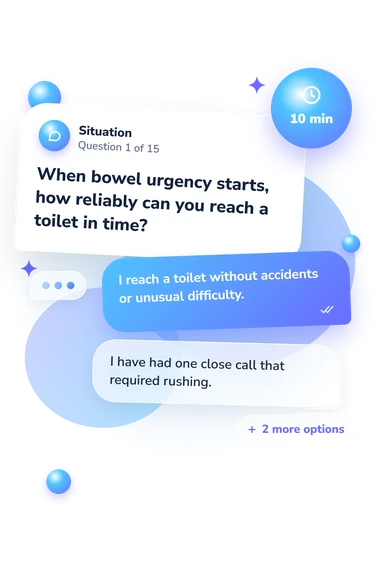
How the Scales are Structured
Who Usually Takes This Test?
See How You Compare
Below is a preview of how scores are typically distributed across each scale.
Example Questions From the Test
- I have not experienced bowel leakage while asleep.
- There has been one minor stain or isolated episode.
- Repeated episodes have required changing underwear or protection.
- Episodes regularly soil protection, clothing, or bedding.
- It has not happened.
- It happened once.
- It happened on several separate days.
- It happens most days or repeatedly in a day.
- It has not happened.
- It happened once as a small smear or stain.
- It occurred on several separate occasions.
- It occurs frequently or is difficult to contain when it happens.
Diaper Quiz - Description and methodology of the test
People who are unsure whether leakage, toilet access, or overnight accidents warrant absorbent support can use the diaper quiz to organize what is happening now. It is intended for adults reviewing their own bladder or bowel experiences, routines, and practical constraints. As a bladder and bowel protection assessment, it can turn a vague concern into a clearer profile of protection needs and situations that deserve attention.
What This Assessment Explores
The questions examine leakage and bowel control alongside urgency, sleep-related episodes, containment, toilet access, mobility, skin, laundry, and planning away from home. Rather than reducing the concern to a do i need diapers quiz, the assessment connects symptoms with practical support needs.
The result groups these themes into three reflective dimensions:
- Bladder Protection Signals (0-15) show whether bladder leakage, overnight episodes, or warning signs call for protection review.
- Bowel Protection Signals (0-15) show whether urgency, soiling, containment problems, or warning signs call for bowel-protection review.
- Daily Protection and Support Needs (0-15) show how disruption, skin problems, access barriers, or failed products affect daily support.
Each dimension is shown as No signal endorsed (0), Signal to review (1-2), or Action signal (3-15). Higher results indicate more endorsed situations, not a clinical diagnosis.
Methodology and Evidence Base
Each item offers four ordered responses, from no current problem to isolated, recurring, or disruptive experiences. Topics include urgency, overnight episodes, containment, travel, hygiene, and toilet access.
The question behind should i wear diapers quiz is handled through context rather than a single threshold. The result gives three separate totals and places them in the displayed bands, but the questionnaire does not state a per-answer weighting. Read the totals as directional summaries, not validated severity scores.
The closest conceptual anchor is ICIQ-B (Cotterill et al., 2011), which evaluates anal-incontinence symptoms and impact. Urinary content is consistent with the ICIQ (Avery et al., 2004), and PRAFAB (Hendriks et al., 2007) supplies a brief severity-oriented comparison. This questionnaire is conceptually consistent with those instruments, not an adaptation of them.
It is an online self-report measure with unvalidated reflective bands and no established clinical norms. Current context, memory, embarrassment, and self-awareness can shape responses. A red-flag answer-sudden control loss with weakness or numbness, significant bleeding, severe pain, or broken skin-should override the total and prompt timely medical attention.
- Cotterill N, Norton C, Avery KNL, Abrams P, Donovan JL. Psychometric Evaluation of a New Patient-Completed Questionnaire for Evaluating Anal Incontinence Symptoms and Impact on Quality of Life: The ICIQ-B. Diseases of the Colon & Rectum. 2011;54(10):1235-1250. 10.1097/DCR.0b013e3182272128
- Avery K, Donovan J, Peters TJ, Shaw C, Gotoh M, Abrams P. ICIQ: A Brief and Robust Measure for Evaluating the Symptoms and Impact of Urinary Incontinence. Neurourology and Urodynamics. 2004;23(4):322-330. 10.1002/nau.20041
- Hendriks EJ, Bernards ATM, Berghmans BCM, de Bie RA. The Psychometric Properties of the PRAFAB-Questionnaire: A Brief Assessment Questionnaire to Evaluate Severity of Urinary Incontinence in Women. Neurourology and Urodynamics. 2007;26(7):998-1007. 10.1002/nau.20450
Updated: