
Civil Engineering Quiz
How the Scales are Structured
Who Usually Takes This Test?
See How You Compare
Below is a preview of how scores are typically distributed across each scale.
Example Questions From the Test
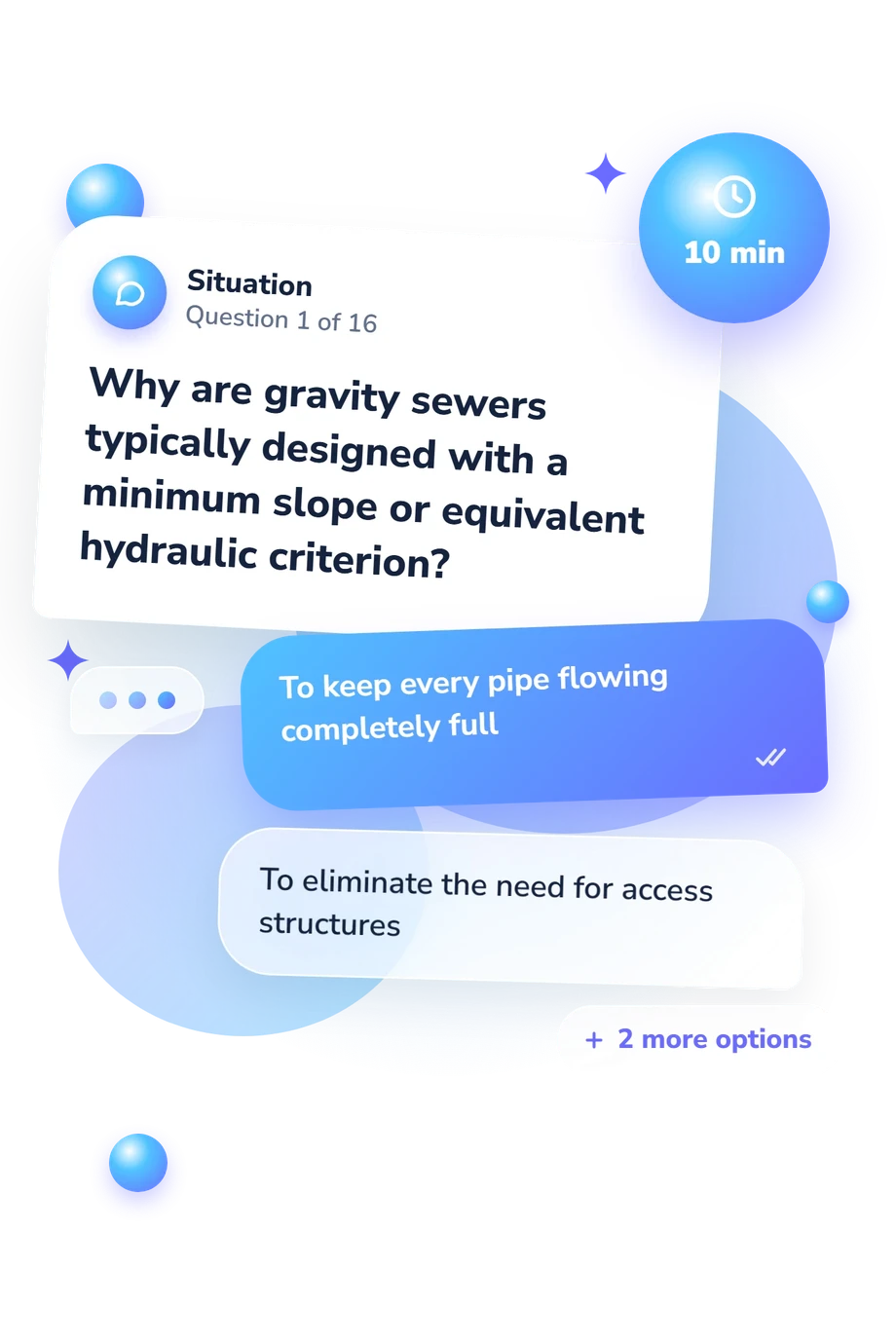
- To keep every pipe flowing completely full
- To eliminate the need for access structures
- To support flow velocities that limit solids deposition
- To prevent any air from entering the system
- Just outside either support
- At both supports
- At midspan beneath the load
- It is constant along the entire beam
- A temporary point with an assumed horizontal bearing only
- A benchmark with a known elevation
- A property corner whose elevation has not been established
- A ranging rod placed at the tallest visible point
Civil Engineering Quiz - Description and methodology of the test
Students, trainees, early-career practitioners, and curious learners can use this civil engineering quiz to check how confidently they connect principles from several branches of the field. Coursework revision is one use for this civil quiz, alongside broader study and deciding which subjects deserve more attention. The result is a focused knowledge snapshot, not a profile of one specialty.
What This Assessment Explores
This assessment checks knowledge across structures, surveying, water, soils, pavements, transportation, construction, foundations, and environmental design. Respondents recognize principles in applied situations; the displayed result reflects civil-engineering knowledge and consistent application across structures, materials, soils, water, transportation, and construction.
The questions and answers in this civil-engineering quiz cover load paths, contour interpretation, treatment, compaction, stopping sight distance, pavement distress, and wall drainage. Together, they provide broad knowledge guidance rather than topic-specific scores.
The displayed result uses one broad scale with these bands:
- Civil Engineering Knowledge (0-16) measures civil-engineering knowledge, with the strongest band indicating consistent application of major principles across structures, materials, soils, water, transportation, and construction.
- Foundations to Build (0-6) signals concepts needing core-principle and terminology review.
- Developing Engineer (7-12) indicates useful breadth with less familiar topics to strengthen.
- Strong Knowledge (13-16) indicates consistent application across the covered areas.
Methodology and Evidence Base
Each item in this civil engineering knowledge assessment presents a practical scenario with several answer choices. The respondent selects the alternative that best fits the stated principle. The item mix samples structures, surveying, hydraulics, water treatment, soils, pavements, transportation, construction, foundations, and environmental considerations; it does not test extended calculations, design drawings, laboratory procedures, or field execution. The questionnaire reports one displayed result rather than separate discipline subscores.
NCEES FE Civil specifications provide the closest organizing reference for the topic breadth, while CEBOK3 describes wider capabilities expected in civil-engineering education. Hains and colleagues document how that body of knowledge developed across editions. The questionnaire is conceptually consistent with these sources, but the cited FE and CEBOK materials provide contextual coverage, not norms, validation, or standardization for this questionnaire.
Results can help prioritize revision after a first pass through the items. Terminology familiarity, recent study, guessing, and the context of answering can influence performance. The bands are study guidance, not evidence of complete professional competence.
- National Council of Examiners for Engineering and Surveying. Fundamentals of Engineering (FE) CIVIL CBT Exam Specifications, effective beginning with the July 2020 examinations. NCEES, 2020.
- Civil Engineering Body of Knowledge 3 Task Committee. Civil Engineering Body of Knowledge: Preparing the Future Civil Engineer. 3rd ed. Reston, VA: American Society of Civil Engineers, 2019. 10.1061/9780784415221.
- Decker B. Hains, Kenneth J. Fridley, Thomas A. Lenox, Leslie Nolen, and James J. O'Brien Jr. The Evolution of the Civil Engineering Body of Knowledge: From the First Edition to the Third Edition. 2019 ASEE Annual Conference & Exposition. 2019. 10.18260/1-2--33391.
Updated: