
Chocolate and Sweets Quiz
How the Scales are Structured
Who Usually Takes This Test?
See How You Compare
Below is a preview of how scores are typically distributed across each scale.
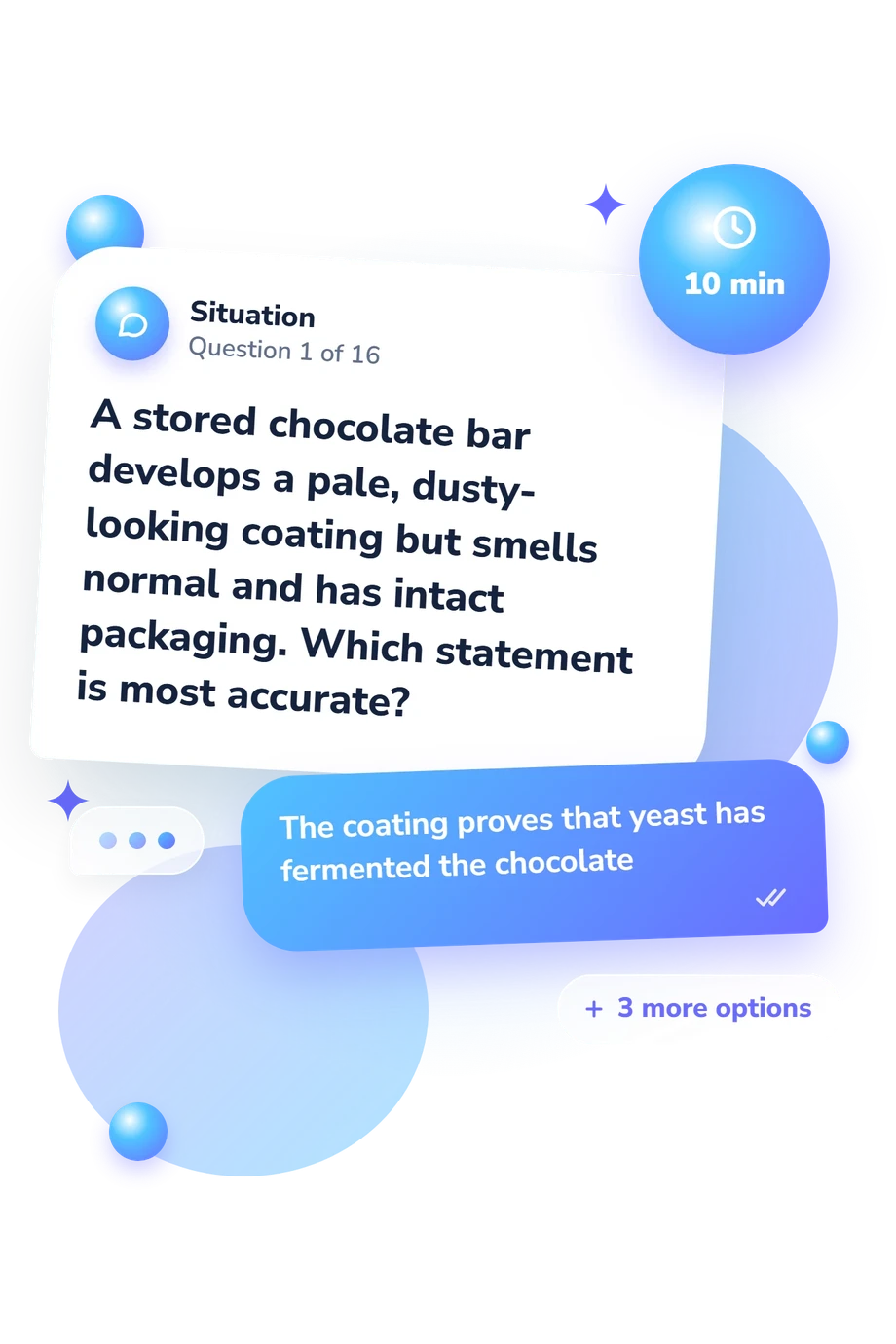
Example Questions From the Test
- Large caramel crystals
- Tempered cocoa butter
- Bicarbonate of soda alone
- Gelatin
- Carob powder
- Ground cocoa nibs
- Cane molasses
- Skimmed milk powder
- A nickname for the road beside the original factory
- A phrase printed on Victorian cocoa sacks
- The title of a play by J. M. Barrie
- The surname of the confectioner who developed the assortment
Chocolate and Sweets Quiz - Description and methodology of the test
Designed for curious readers who want to connect everyday treats with food science, the Chocolate and Sweets Quiz uses chocolate and sweets quiz questions and answers to check practical knowledge rather than personal preference. It suits home cooks, confectionery fans, and learners who want a broad indication of overall knowledge. The sweet quiz questions and answers give a combined result across the quiz, not separate feedback on each subject area.
What This Assessment Explores
Questions link confectionery with food science, covering cocoa composition, chocolate types, gelling agents, caramelization, ganache, tempering, bloom, seizure, storage, and Quality Street history. The focus is practical recognition of ingredients, processes, and product behavior.
Key areas are:
- Ingredients and composition show whether you distinguish cocoa solids, cocoa butter, sugars, gels, and fillings.
- Techniques link heating, cooling, whipping, and moisture control to the finished sweet.
- Storage explains how temperature, humidity, light, and odours affect confectionery.
- Product history tests familiarity with Quality Street names, formats, origins, and pieces.
For curious learners, home cooks, and confectionery fans, the result offers one broad indication of knowledge from this sweet and chocolate quiz. Results use Chocolate and Sweets Knowledge (0-16): Foundations (0-6), Developing (7-12), or Strong (13-16).
Methodology and Evidence Base
Each item presents a confectionery scenario or factual question with four answer choices. Selecting the most accurate option tests recognition and applied understanding rather than preferences or habits. Four answer choices give the quiz on sweets and chocolates with answers a clear recognition-based structure, linking each response to concrete areas such as ingredients, technique, history, and storage.
Schmidt et al. (2012) provides contextual support for connecting familiar food examples with STEM learning; it does not validate this questionnaire. Beckett, Fowler, and Ziegler support the technical treatment of chocolate composition, tempering, bloom, storage, and manufacture, while Nestle UK & Ireland supports the Quality Street history items.
The questionnaire displays one overall knowledge result, but it does not state how individual responses are converted into the total. Answers to its chocolate-bar questions form part of the overall performance picture rather than indicating professional culinary certification. Guessing, prior exposure, attention, and wording can influence the result.
- Schmidt, Shelly J., Dawn M. Bohn, Aaron J. Rasmussen, and Elizabeth A. Sutherland. "Using Food Science Demonstrations to Engage Students of All Ages in Science, Technology, Engineering, and Mathematics (STEM)." Journal of Food Science Education 11, no. 2 (2012): 16-22. 10.1111/j.1541-4329.2011.00138.x
- Beckett, Stephen T., Mark S. Fowler, and Gregory R. Ziegler, eds. Beckett's Industrial Chocolate Manufacture and Use. 5th ed. John Wiley & Sons, 2017. 10.1002/9781118923597
- Nestle UK & Ireland. "Happy 80th Birthday Quality Street." 2016.
Updated: