
Chinese Medicine Body Type Quiz
How the Scales are Structured
Who Usually Takes This Test?
See How You Compare
Below is a preview of how scores are typically distributed across each scale.
Example Questions From the Test
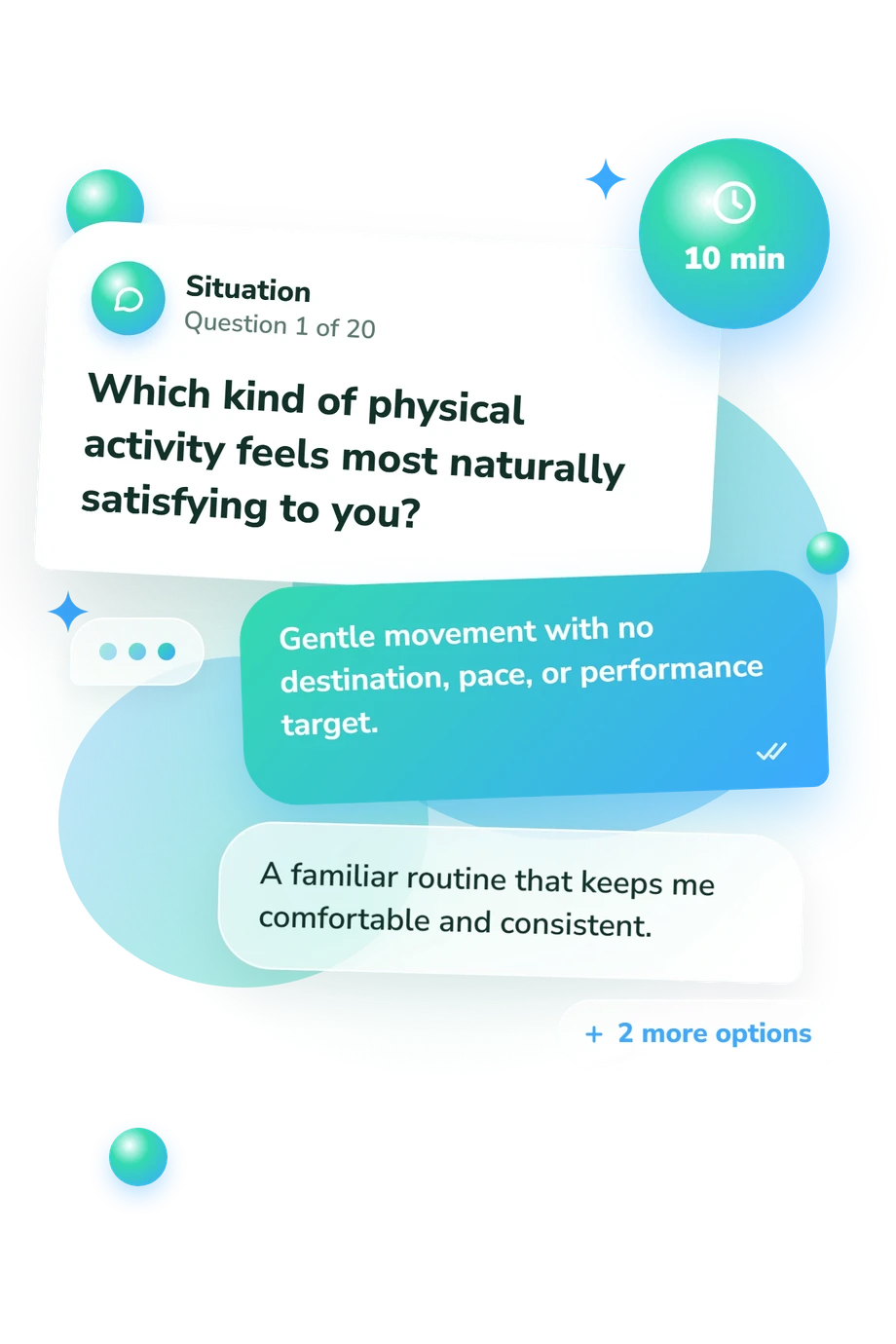
- Gentle movement with no destination, pace, or performance target.
- A familiar routine that keeps me comfortable and consistent.
- An activity where I can notice gradual progress over time.
- A vigorous challenge with a route, goal, or skill to master.
- Give them room and trust them to ask if they want something.
- Listen carefully while keeping the visit simple and unstructured.
- Offer a drink or snack and ask what kind of support would help.
- Suggest one practical way to make the next day easier.
- I find a quieter spot and enjoy observing the gathering.
- I stay near the host until a natural conversation develops.
- I introduce myself to one or two people who seem approachable.
- I start exchanging stories and soon feel energized by the room.
Chinese Medicine Body Type Quiz - Description and methodology of the test
People who want a symbolic way to reflect on how they approach energy, relationships, order, initiative, and solitude may find the Chinese Medicine Body Type Quiz a useful starting point. Rather than sorting you into a medical constitution, it organizes everyday preferences into five element affinities. As a TCM body type quiz, it is best read as a profile of recurring tendencies, not a label that fixes your identity.
What This Assessment Explores
Across the questions, familiar situations involving movement, routines, connection, completion, conflict, curiosity, and recovery reveal five symbolic dimensions. The result reflects response patterns rather than physical symptoms, framing the Chinese body type quiz as a symbolic reflection on affinities rather than a physical constitution. The scales are:
- Earth Affinity (0-12) shows how strongly steadiness, nourishment, inclusion, and practical care appear.
- Fire Affinity (0-12) shows how strongly warmth, expression, enjoyment, and social energy appear.
- Metal Affinity (0-12) shows how strongly discernment, standards, boundaries, and completion appear.
- Water Affinity (0-12) shows how strongly depth, inward attention, patience, and energy conservation appear.
- Wood Affinity (0-12) shows how strongly initiative, direction, challenge, and forward movement appear.
Each uses Light (0-4), Emerging (5-8), and Strong (9-12). The highest scale is the strongest affinity; scales within one point form a blend.
Methodology and Scientific Basis
Each item presents an everyday scenario with four responses, asking which feels most natural. Topics include activity, daily rhythm, connection, support, disagreement, organization, curiosity, decisions, release, and recovery. This self-report format captures perceived tendencies rather than observed behavior.
The questionnaire displays five affinity scores; the highest indicates the strongest affinity, and scores within one point form a blend. The TCM quiz therefore offers a symbolic profile of preferences.
Beinfield and Korngold provide the five-element framework, while Aplin-Houtz et al. (2023) report a separate published measurement study; Li et al. (2023) describe qualitative psychosomatic themes linked with TCM categories. The online questionnaire is conceptually consistent with these works, but it is not the instrument studied by Aplin-Houtz et al. or an adaptation of the framework or those studies. Neither cited study validates this online version.
Use the result to notice recurring patterns and compare close affinities. The displayed bands are reflective categories rather than clinical measures, and the result can vary with current context, self-awareness, and response style, so it is best used as educational reflection.
- Harriet Beinfield and Efrem Korngold. Between Heaven and Earth: A Guide to Chinese Medicine. Ballantine Books, 1991.
- Matthew Aplin-Houtz, Emily Lane, Sean Leahy, Sarah Willey, and April Rowsey. The Other Big Five: An Evaluation and Validation of a Measure for the Five Elements of Personality from Traditional Chinese Medicine. Proceedings of the Twelfth International Conference on Engaged Management Scholarship, 2023. 10.2139/ssrn.4322693
- Jia Jia Li, Xin Yu Yang, Hong Jun Zhang, Dong Qing Yin, Jin Tao Zhang, Jing Wen Cui, Jing Dong Han, Yan Ma, and Hong Xiao Jia. The Psychosomatic Traits of "People with the Five Elements in Traditional Chinese Medicine": A Qualitative Study. Biomedical and Environmental Sciences, 36(11), 1068-1078, 2023. 10.3967/bes2023.136
Updated: