
Cheer Quiz
How the Scales are Structured
Who Usually Takes This Test?
See How You Compare
Below is a preview of how scores are typically distributed across each scale.
Example Questions From the Test
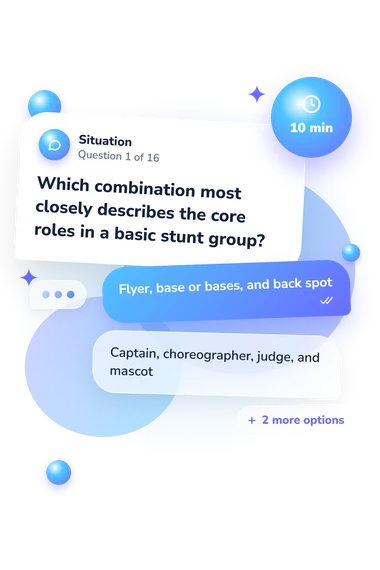
- Flyer, base or bases, and back spot
- Captain, choreographer, judge, and mascot
- Tumbler, dancer, announcer, and timekeeper
- Coach, alternate, musician, and referee
- The knees bend while the heels pull toward the seat.
- One leg stays straight while the other bends to the side.
- Both legs extend into a wide side straddle.
- Both straight legs extend together in front of the body.
- With the flyer's feet near the bases' knees
- With the flyer's feet around the bases' shoulder level
- With the flyer's feet fully extended above the bases' heads
- With the flyer seated directly on the performing surface
Cheer Quiz - Description and methodology of the test
For athletes, learners, and coaches who want to check practical cheerleading knowledge, this cheer quiz offers a focused way to review the ideas that support confident participation. It works as a cheerleading quiz for people who want to see how well they recognize fundamental roles, technique, timing, performance choices, and safety decisions. The result points to areas that may deserve further practice or study.
What This Assessment Explores
The assessment examines whether a respondent can recognize and apply foundational cheer concepts in realistic situations. Its topics include stunt-group roles, flyer and base responsibilities, body lines, jumps, arm motions, facials, chants, eight-count timing, floor awareness, tumbling progressions, spotting, and controlled responses when a stunt becomes unstable. These themes make the cheer knowledge test useful for reviewing both vocabulary and practical judgment.
The score is reported on one scale, Cheer Knowledge (0-16), which represents the number of correct answers and is shown in three bands:
- Foundations (0-6) indicates recognition of some cheer concepts, with core terms, body positions, and safety habits still needing review.
- Developing Knowledge (7-12) shows understanding of many fundamentals, while some technical distinctions may remain uncertain.
- Strong Cheer Knowledge (13-16) reflects a well-rounded command of common terminology, technique, roles, timing, and safe practice.
Methodology and Evidence Base
Each item uses a multiple-choice format with answer options built around terminology recognition or a practical scenario. A correct response adds one point, and the total score follows the catalogue's stated one-point-per-correct-answer method rather than a weighted calculation. This structure lets the respondent demonstrate factual knowledge and applied judgment in the same assessment.
The content is conceptually consistent with Complete Cheerleading, which provides a reference point for terminology, roles, jumps, motions, stunts, and performance technique. Safety decisions are framed in line with the USA Cheer safety manual, while the North Carolina competitive-cheerleading injury study offers relevant injury-incidence context from competitive cheerleading. The questionnaire is not presented as an adaptation of either source; their connection is conceptual and topical.
As a self-administered knowledge check, the cheer assessment reflects current familiarity, attention, and the ability to interpret wording under test conditions. Guessing and uneven exposure to coaching can also affect performance, so the bands are most useful as a snapshot of areas to reinforce through practice, instruction, or further reading.
- Carrier, Justin, and Donna McKay. Complete Cheerleading. Champaign, IL: Human Kinetics, 2005. ISBN 978-0-7360-5739-4.
- George, Gerald S., senior editor. USA Cheer Cheerleading Safety Manual: Risk Management for Cheerleaders, Coaches, and Administrators. 4th ed. Prosper, TX: Designs for Wellness Press, 2019. ISBN 978-1-62776-146-8.
- Schulz, Mark R., Stephen W. Marshall, Jingzhen Yang, Frederick O. Mueller, Nancy L. Weaver, and J. Michael Bowling. “A Prospective Cohort Study of Injury Incidence and Risk Factors in North Carolina High School Competitive Cheerleaders.” The American Journal of Sports Medicine 32, no. 2 (2004): 396-405. DOI 10.1177/0363546503261715.