
Cell Quiz
How the Scales are Structured
Who Usually Takes This Test?
See How You Compare
Below is a preview of how scores are typically distributed across each scale.
Example Questions From the Test
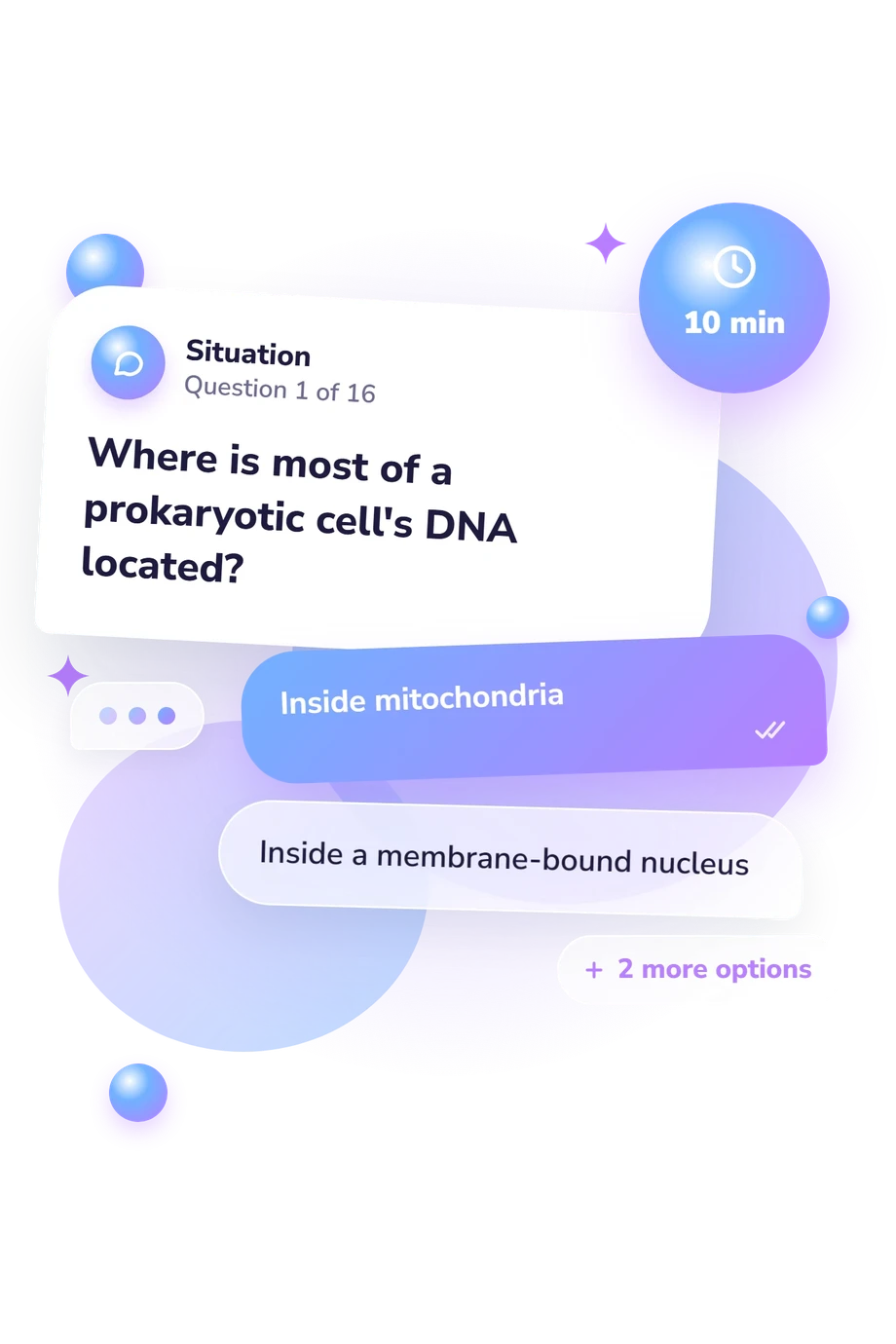
- Inside mitochondria
- Inside a membrane-bound nucleus
- Within the Golgi apparatus
- In the nucleoid region
- Smooth endoplasmic reticulum
- Central vacuoles
- Chloroplasts
- Rough endoplasmic reticulum
- A plasma membrane, cytoplasm, DNA, and ribosomes
- A nucleus, cytoplasm, DNA, and ribosomes
- A cell wall, mitochondria, DNA, and ribosomes
- Chloroplasts, cytoplasm, DNA, and a plasma membrane
Cell Quiz - Description and methodology of the test
For students, instructors, and curious learners, the cell quiz offers a focused way to check introductory cell-biology knowledge and connect core ideas about living cells. It suits anyone reviewing or consolidating the subject before further study. As a cell biology quiz, it examines understanding of structures, processes, and comparisons across common cell types.
What This Assessment Measures
The questionnaire tests whether learners connect cell structures with their functions when biological conditions change. It covers prokaryotic and eukaryotic organization, plant and animal cells, organelles, membranes, transport, secretion, energy production, photosynthesis, and division. Taken as a cell structure test, it asks respondents to identify structures and relate each one to its function in context, including distinctions between a nucleus and a nucleoid or rough and smooth endoplasmic reticulum.
The themes are:
- Cell organization shows whether you distinguish shared features from structures specific to cell types.
- Structure and function shows whether you connect organelles with protein assembly, energy, digestion, photosynthesis, and genetic organization.
- Cellular processes shows how you reason about permeability, movement, secretion, and division.
This structure-focused design supports review. Cell Knowledge runs from 0-16: Foundations to review (0-6), Developing knowledge (7-12), and Strong knowledge (13-16).
Methodology and Evidence Base
Each item presents a biology question with four alternatives and one best answer. Some test recall; others ask learners to compare cells or predict outcomes. The alternatives test application as well as recall by requiring recognition of the relevant structure or process in context.
The score is the number of correct responses, and its band follows the interval. No separate weighting, subscale calculation, or penalty is specified. Reviewing alternatives can indicate whether an error concerned a structure, its function, or the stated conditions.
Viewed as a cell biology assessment, the questionnaire is consistent with the IMCA described by Shi and colleagues (2010), but it is not presented as an adaptation of IMCA. The approach also aligns with the Biology Concept Inventory discussed by Klymkowsky and Garvin-Doxas (2008), where distractors can expose misconceptions. OpenStax is used only as a reference for underlying introductory cell-biology concepts, not as the questionnaire's framework or evidence of validity.
No norms, reliability estimate, or clinical standardization are stated. Guessing, prior coursework, language familiarity, concentration, and context can affect performance; interpret it as a study guide, not a complete measure.
- Shi, J., Wood, W. B., Martin, J. M., Guild, N. A., Vicens, Q., & Knight, J. K. (2010). A diagnostic assessment for introductory molecular and cell biology. CBE-Life Sciences Education, 9(4), 453-461. 10.1187/cbe.10-04-0055
- Klymkowsky, M. W., & Garvin-Doxas, K. (2008). Recognizing Student Misconceptions through Ed's Tools and the Biology Concept Inventory. PLOS Biology, 6(1), e3. 10.1371/journal.pbio.0060003
- Clark, M. A., Douglas, M., & Choi, J. (2018). Biology 2e. Houston, TX: OpenStax.
Updated: