
Celebrity Crush Quiz Female
How the Scales are Structured
Who Usually Takes This Test?
See How You Compare
Below is a preview of how scores are typically distributed across each scale.
Example Questions From the Test
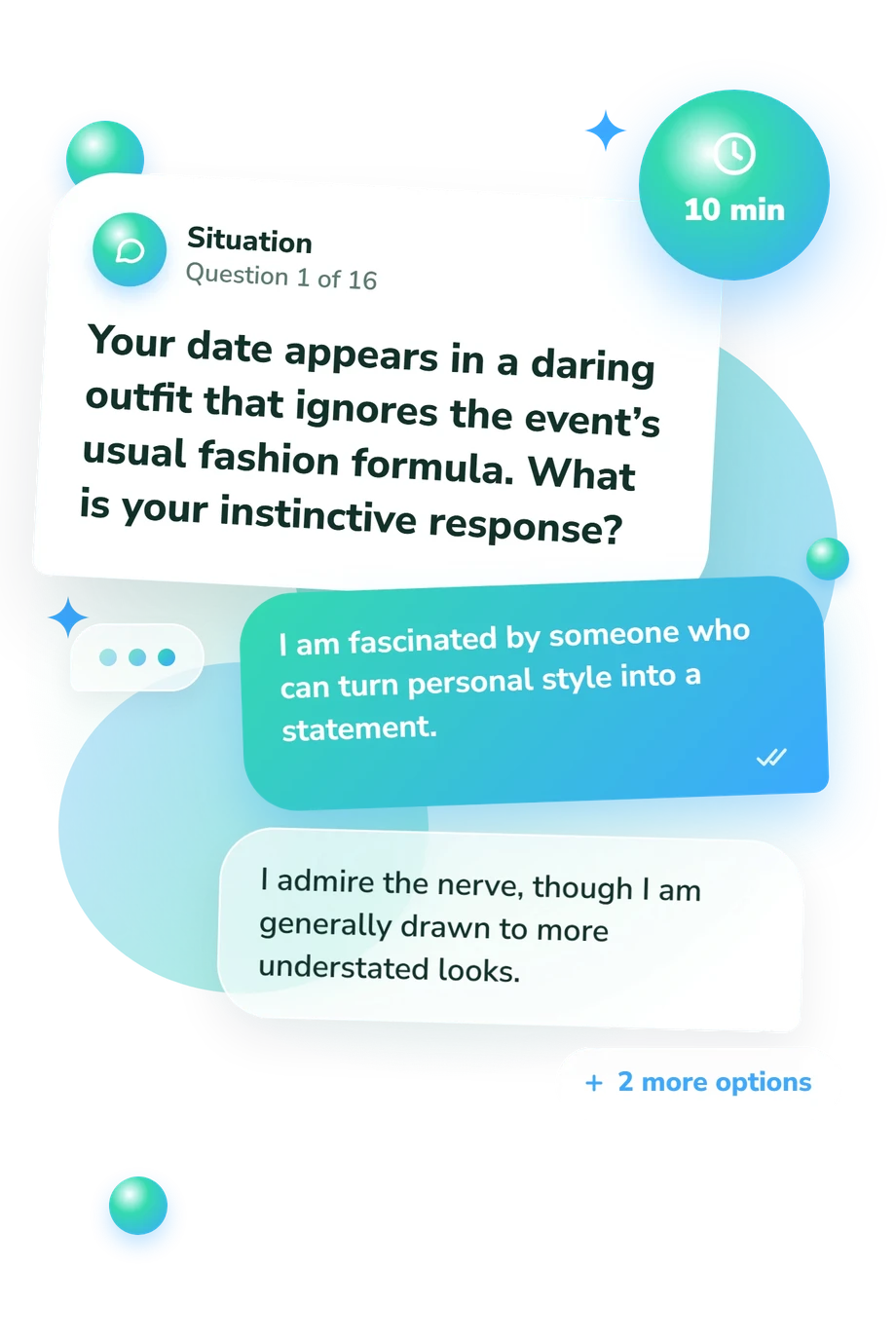
- I am fascinated by someone who can turn personal style into a statement.
- I admire the nerve, though I am generally drawn to more understated looks.
- The originality is attractive as long as the person seems comfortable in it.
- I prefer a look that works elegantly within the event’s established tone.
- I would be swept up by the shared emotion and the story behind the song.
- I would enjoy the spectacle while staying more interested in the production.
- I would connect with the moment, especially if the lyrics matched something I had felt.
- I would rather hear music that emphasizes rhythm or atmosphere over personal narrative.
- It rises sharply; self-defined confidence is one of my strongest attraction cues.
- It usually rises, although warmth and connection matter equally.
- I respect the independence more than I experience it as attraction.
- I tend to prefer a gentler, more conventional public style.
Celebrity Crush Quiz Female - Description and methodology of the test
Readers who want to understand why performers appeal in different ways can use Celebrity Crush Quiz Female as a way to compare the public qualities that draw them to different performers. Rather than reducing attraction to one ideal type, this celebrity girlfriend quiz invites you to notice whether artistry, bold independence, romantic expression, or polished versatility creates the strongest response. It suits curious readers exploring their own celebrity preferences.
What This Assessment Explores
This assessment treats attraction as a response to public persona: creativity, confidence, emotion, style, and range. It is for readers who want to understand why performers appeal in different ways. The result describes a preferred celebrity style, not a prediction about a private relationship.
The celebrity crush test groups choices about music, fashion, performance, ambition, and imagined dates into four result dimensions:
- Lupita Nyong’o - Artful Elegance (0-12) captures artistry, thoughtfulness, and elegance: Different wavelength (0-4), Genuine spark (5-8), Standout affinity (9-12).
- Rihanna - Fearless Individuality (0-12) captures bold independence and ambition: Different wavelength (0-4), Genuine spark (5-8), Standout affinity (9-12).
- Taylor Swift - Romantic Storytelling (0-12) captures emotional narrative and creative eras: Different wavelength (0-4), Genuine spark (5-8), Standout affinity (9-12).
- Zendaya - Versatile Poise (0-12) captures composure, style, and range: Different wavelength (0-4), Genuine spark (5-8), Standout affinity (9-12).
Methodology and Scientific Basis
Each item presents a social, creative, fashion, music, or date-related situation with four response options. You select the closest reaction, making it a self-report exercise in imagined preference. As a female celebrity quiz, it focuses on how women’s public images become attraction cues.
Scoring compares four displayed scores. The highest is the strongest affinity, while scores within one point form a blend. The three bands describe lower alignment, meaningful appeal, and standout preference; the questionnaire does not specify how many points each answer contributes, so no further scoring rule is inferred.
Conceptually, it is consistent with Stever’s Celebrity Appeal Questionnaire (1991) and work on celebrity attraction; Horton and Wohl (1956) provide context for mediated celebrity relationships. This online self-report is neither an adaptation nor a validated, standardized version of either source, and it does not measure parasocial intimacy.
Current interests, media exposure, familiarity, and self-awareness can influence self-report. The questionnaire has no stated normative sample or standardized validation; its displayed bands are result categories for comparing the four affinities, not clinical or population cutoffs.
- Stever, Gayle S. (1991). The Celebrity Appeal Questionnaire. Psychological Reports, 68(3), 859-866. 10.2466/pr0.1991.68.3.859
- Horton, Donald, and Richard Wohl. (1956). Mass Communication and Para-Social Interaction: Observations on Intimacy at a Distance. Psychiatry, 19(3), 215-229. 10.1080/00332747.1956.11023049
Updated: