
Carpal Bones Quiz
How the Scales are Structured
Who Usually Takes This Test?
See How You Compare
Below is a preview of how scores are typically distributed across each scale.
Example Questions From the Test
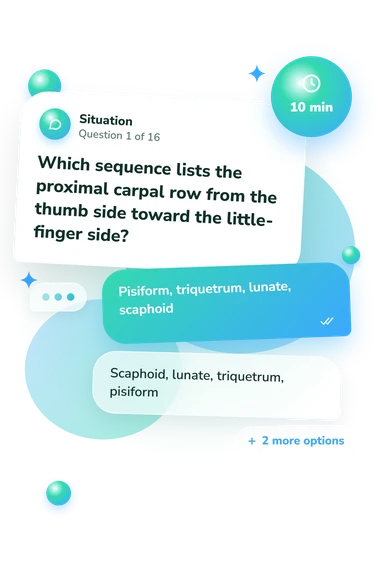
- Pisiform, triquetrum, lunate, scaphoid
- Scaphoid, lunate, triquetrum, pisiform
- Trapezium, trapezoid, capitate, hamate
- Scaphoid, trapezium, lunate, triquetrum
- Eight
- Seven
- Nine
- Ten
- Lunate and triquetrum
- Scaphoid and trapezium
- Scaphoid and lunate
- Lunate and capitate
Carpal Bones Quiz - Description and methodology of the test
Students and trainees can use this assessment to connect bone names with spatial relationships and clinical clues. The carpal bones quiz turns those links into a focused self-check rather than a passive list of terms. As a carpal anatomy quiz, it shows which topics deserve review, while the result summarizes your grasp of the subject.
What This Assessment Measures
Questions examine the eight carpal bones as a connected arrangement rather than isolated names. They cover proximal and distal rows, thumb-to-little-finger orientation, metacarpal and radial relationships, palpable landmarks, and clinically relevant structures such as the carpal tunnel and Guyon’s canal. Other items address scaphoid blood supply, snuffbox tenderness, dislocation patterns, and common fracture locations. In this carpals quiz, the result reflects how reliably you can identify anatomy and apply it to short clinical or imaging scenarios.
Carpal Bones Knowledge (0-16) is an educational scale with result bands that describe demonstrated knowledge:
- Foundation (0-6) indicates recognition of some wrist-anatomy concepts while showing a need to review names, rows, and positions.
- Developing (7-12) indicates useful working knowledge that can be strengthened through spatial relationships and clinical applications.
- Strong (13-16) indicates a well-developed grasp of carpal anatomy and common applied associations.
Methodology and Evidence Base
Each item offers one anatomy question with four answer choices. The set combines direct recall with spatial identification, palpation landmarks, joint relationships, and short clinical vignettes, testing both naming and application. Missed answers may reflect forgotten terminology or difficulty connecting a structure with its context.
Responses are combined into the educational score, but no separate weighting, wrong-answer penalty, or norm-referenced percentile is stated. Read the band as a study signal rather than a measure of overall medical competence. Its carpals labeling quiz format helps when orientation, rows, or landmarks are the main source of error.
Spielmann and Oliver (2005) provide the closest conceptual reference for basic carpal-bone knowledge. This questionnaire is conceptually consistent with that work, not presented as a reproduction of its instrument. Roche and colleagues (2011) support physical and radiographic identification, while Kaewlai and colleagues (2008) support attention to carpal anatomy, injuries, and fracture-dislocations. These sources do not establish published reliability, validity, or norms for this online version.
Memory and current study context can affect performance, so use the result to target review; it is an educational self-check, not a clinical assessment.
- Spielmann PM, Oliver CW. The carpal bones: a basic test of medical students' and junior doctors' knowledge of anatomy. The Surgeon. 2005;3(4):257-259. 10.1016/S1479-666X(05)80087-3
- Roche AJ, Williams GW, Wharton D, Brown DJ. Physical and radiographic identification of the bones of the wrist by junior doctors. Journal of Hand Surgery (European Volume). 2011;36(2):107-110. 10.1177/1753193410380823
- Kaewlai R, Avery LL, Asrani AV, Abujudeh HH, Sacknoff R, Novelline RA. Multidetector CT of Carpal Injuries: Anatomy, Fractures, and Fracture-Dislocations. RadioGraphics. 2008;28(6):1771-1784. 10.1148/rg.286085511
Updated: