
Byzantine Empire Quiz
How the Scales are Structured
Who Usually Takes This Test?
See How You Compare
Below is a preview of how scores are typically distributed across each scale.
Example Questions From the Test
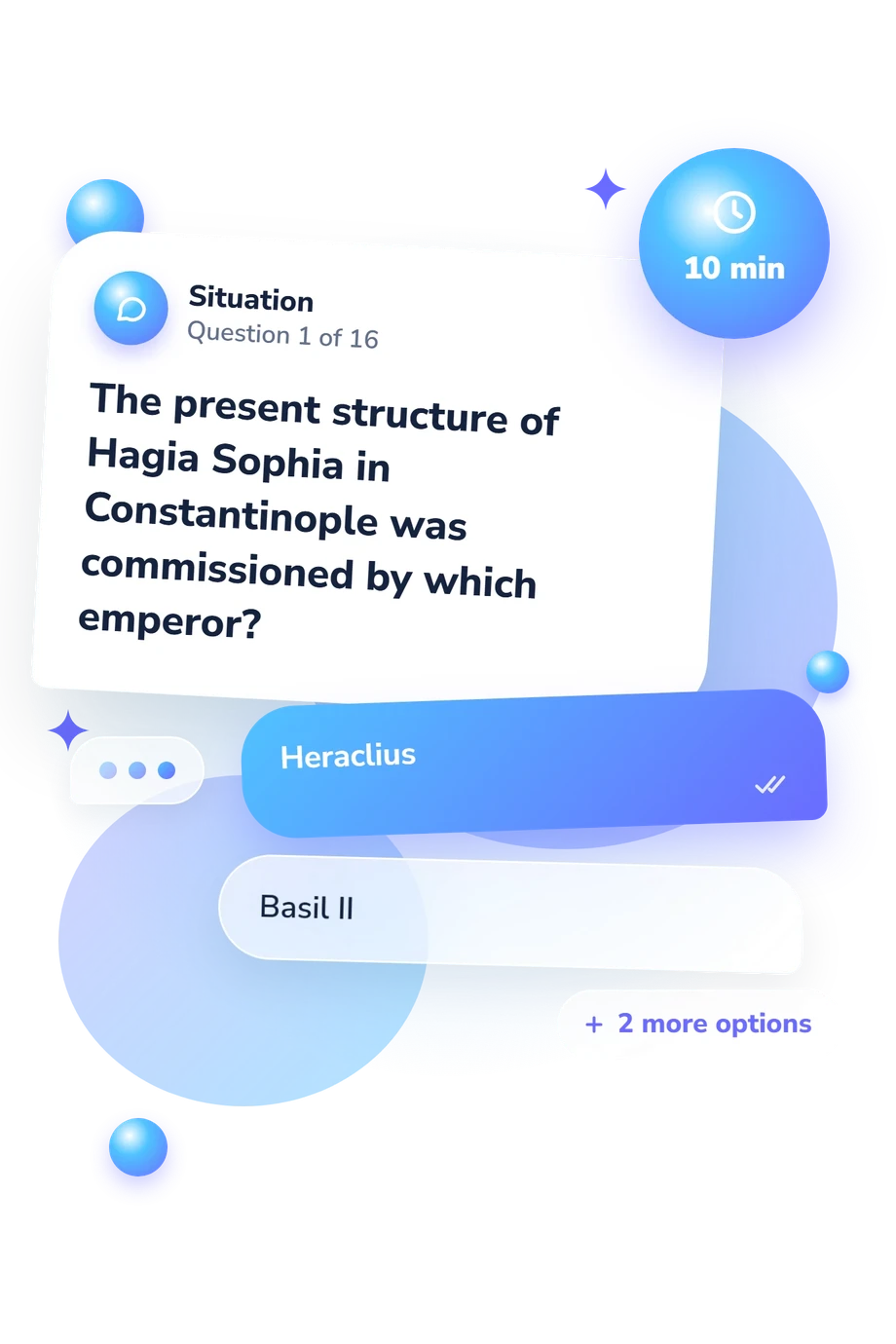
- Heraclius
- Basil II
- Alexios I Komnenos
- Justinian I
- Justinian I
- Diocletian
- Theodosius I
- Constantine I
- Whether sacred images should be venerated or removed
- Whether clergy could translate scripture into Greek
- Whether Constantinople should recognize Islam
- Whether monasteries should follow the Latin liturgy
Byzantine Empire Quiz - Description and methodology of the test
For readers seeking connections among names, institutions, and turning points, this byzantine empire quiz checks historical understanding through factual recall and contextual questions. Students, lifelong learners, and curious readers can use this Byzantine history quiz to examine political, religious, military, and cultural developments. It suits anyone wanting a concise way to see how those elements fit together across Byzantine history.
What This Assessment Measures
The questions cover the eastern Roman Empire from Constantine’s foundation of Constantinople to the Ottoman conquest in 1453. They test recognition of rulers, institutions, conflicts, religion, language, law, diplomacy, and cultural change.
The single Byzantine Empire Knowledge scale summarizes performance across the quiz. It runs from 0-16 and places results in Foundations to Build (0-6), Developing Knowledge (7-12), or Strong Knowledge (13-16). This Byzantine quiz answers questions about chronology, terminology, and relationships, so readers can choose related topics to review without implying separate error diagnoses.
These themes appear in the questions; the displayed result combines them rather than reporting separate domain scores:
- Political leadership and institutions connect emperors with administration.
- War and strategy cover conflicts, weapons, and military systems.
- Religion and culture include iconoclasm, church division, language, and learning.
- Diplomacy, law, and legacy address influence beyond the battlefield.
Methodology and Evidence Base
Each item presents a historical question or short scenario with four answer choices. The format combines factual recall with contextual recognition: respondents identify an emperor, institution, conflict, doctrine, or policy and distinguish it from plausible alternatives. The scoring produces one total knowledge result from the selected responses; further scoring details are not specified.
This Byzantine Empire test is an online educational questionnaire rather than a published standardized instrument. Historical works such as the 2008 volume edited by Jonathan Shepard, John Haldon’s historical synthesis, and scholarship on Byzantine diplomacy edited by Shepard and Franklin provide context for the events and institutions represented here; they do not establish this quiz’s authorship, standardization, or validity.
These result labels are descriptive learning markers, not population norms. Scores may reflect prior study, language familiarity, guessing, or concentration, and the total cannot capture the full depth of historical reasoning. Use the overall result band to guide further reading on chronology, institutions, and evidence.
- Jonathan Shepard, ed. The Cambridge History of the Byzantine Empire c. 500-1492. Cambridge: Cambridge University Press, 2008. 10.1017/9781139055994
- John F. Haldon. Byzantium: A History. Stroud: Tempus, 2005.
- Jonathan Shepard and Simon Franklin, eds. Byzantine Diplomacy: Papers from the Twenty-Fourth Spring Symposium of Byzantine Studies, Cambridge, March 1990. Includes Alexander Kazhdan, “The Notion of Byzantine Diplomacy,” pp. 3-24. Aldershot: Variorum, 1992.
Updated: