
Budget Quiz
How the Scales are Structured
Who Usually Takes This Test?
See How You Compare
Below is a preview of how scores are typically distributed across each scale.
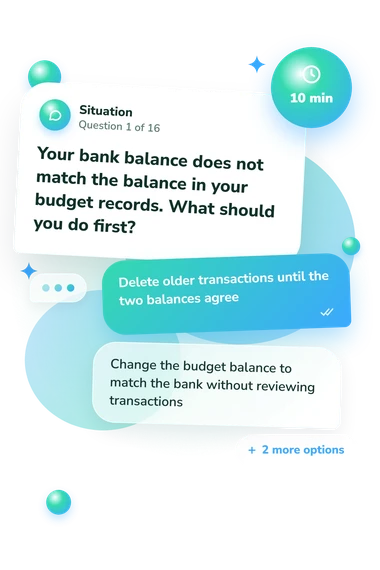
Example Questions From the Test
- $144
- $120
- $156
- $1,200
- Groceries, whose total changes with purchases
- An annual renter’s insurance premium
- Monthly apartment rent under a current lease
- A fixed-rate car payment
- Pay extra toward the debt with the smallest balance
- Pay extra toward the debt with the largest minimum payment
- Divide the extra amount equally among all debts
- Pay extra toward the debt with the highest interest rate
Budget Quiz - Description and methodology of the test
People who want a clearer picture of their everyday money-management knowledge can use this budget quiz to examine practical decisions rather than personality or financial circumstances. It is suited to anyone reviewing how they plan income, record spending, prepare for irregular costs, and balance saving with obligations. As a personal budgeting quiz, it offers an educational snapshot of current understanding, useful for choosing topics to revisit and discussing money habits more deliberately.
What This Assessment Measures
This assessment focuses on practical money-management knowledge in ordinary planning situations. It covers reconciling records, allocating income, classifying expenses, preparing for future bills, handling changing earnings, and preserving room for savings or emergencies. Questions in this budgeting quiz test sound choices and short calculations, not personal wealth or income size.
The result uses one educational scale:
- Budget Knowledge (0-16) reflects correct answers across concepts, calculations, and practical scenarios. Foundation to build (0-6) means core ideas would benefit from review; Developing knowledge (7-12) means many essentials are understood but applied details may be missed; Strong knowledge (13-16) means budgeting principles are recognized and applied accurately.
The overall educational score describes questionnaire performance; its themes may help you choose topics to review, such as cash-flow planning, debt priorities, sinking funds, or emergency preparation.
Methodology and Evidence Base
Each item presents a practical situation with four answer choices. The set covers transaction checking, category planning, sinking funds, debt repayment, credit-card recording, variable income, zero-based budgeting, and emergency reserves. Questions in this budgeting quiz test sound choices and short calculations, not personal wealth or income size.
Scoring reflects correct responses across concepts, calculations, and practical scenarios; each correct answer contributes to the total. Viewed in context, the test functions as a financial literacy quiz that samples application of knowledge to everyday decisions. Its result is a descriptive educational guide for deciding what to review.
The questionnaire is conceptually consistent with the OECD/INFE Toolkit (2022) and with measurement issues discussed by Knoll and Houts (2012) and Huston (2010), including the distinction between financial knowledge and broader financial well-being. It is not an adaptation of those instruments, and this conceptual consistency does not validate the particular questionnaire. Attention, guessing, arithmetic slips, and current circumstances can affect responses, so the score is educational and not individualized financial advice.
- OECD (2022), OECD/INFE Toolkit for Measuring Financial Literacy and Financial Inclusion 2022, OECD Publishing, Paris, DOI 10.1787/cbc4114f-en
- Knoll, Melissa A. Z., and Carrie R. Houts (2012), “The Financial Knowledge Scale: An Application of Item Response Theory to the Assessment of Financial Literacy,” Journal of Consumer Affairs, 46(3), 381-410, DOI 10.1111/j.1745-6606.2012.01241.x
- Huston, Sandra J. (2010), “Measuring Financial Literacy,” Journal of Consumer Affairs, 44(2), 296-316, DOI 10.1111/j.1745-6606.2010.01170.x
Updated: