
Brain Age Quiz
How the Scales are Structured
Who Usually Takes This Test?
See How You Compare
Below is a preview of how scores are typically distributed across each scale.
Example Questions From the Test
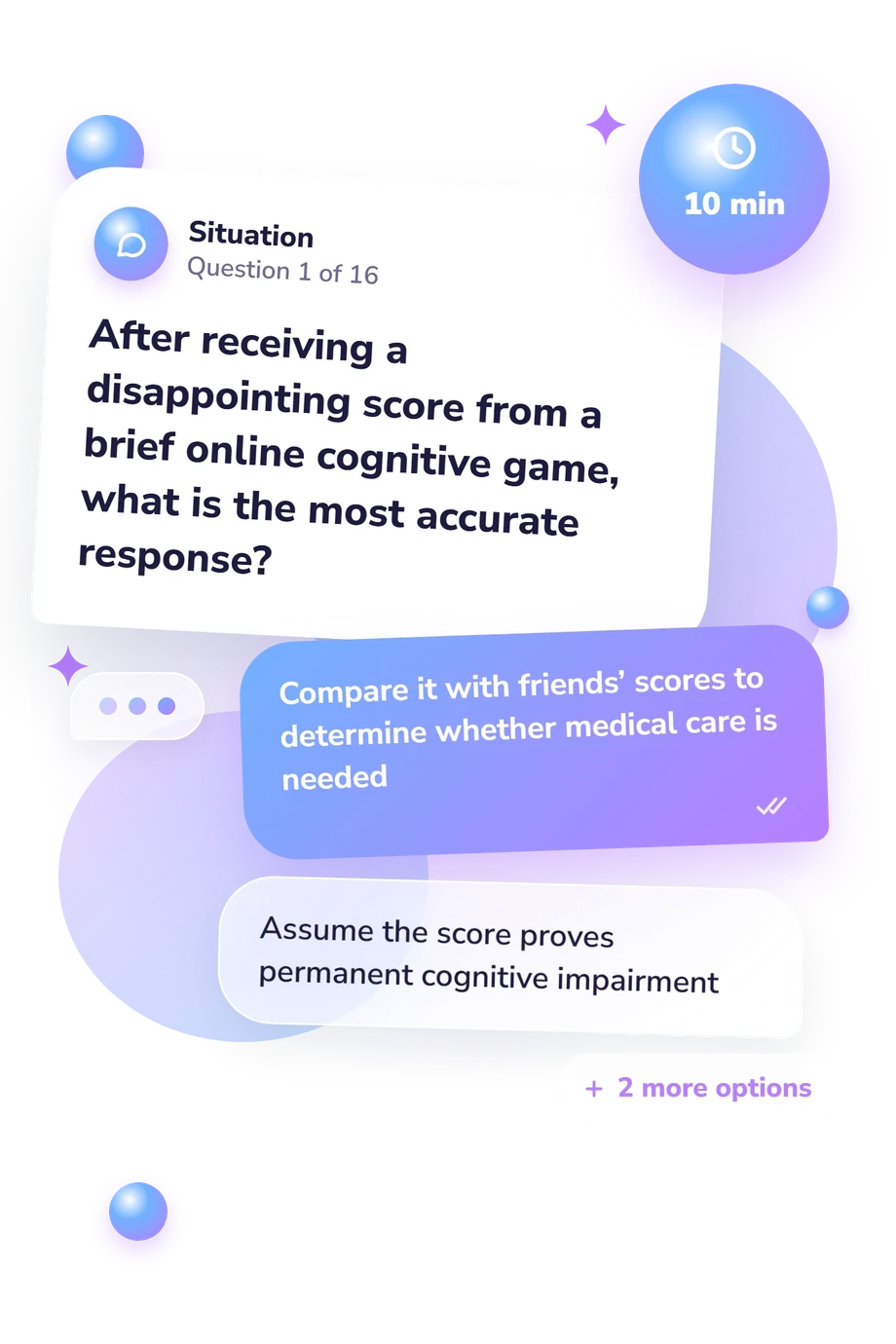
- Compare it with friends’ scores to determine whether medical care is needed
- Assume the score proves permanent cognitive impairment
- Treat it as limited performance information, not a diagnosis or literal brain age, and seek professional advice if real-world concerns persist
- Ignore persistent everyday difficulties because online tasks are never useful
- Stop every medication immediately without advice
- Discuss the timing and symptoms with a clinician or pharmacist who can review possible effects
- Assume the change is an unavoidable part of aging
- Use an online score to decide which medication caused it
- Repeating an already-mastered task at the same level indefinitely
- Learning unfamiliar music in gradually harder sections
- Choosing the most frustrating task available and refusing assistance
- Watching someone else practise without participating
Brain Age Quiz - Description and methodology of the test
For readers seeking to understand what a brief online result can and cannot mean, the brain age quiz offers educational self-reflection rather than a literal measure of biological age. It suits anyone curious about cognitive aging, everyday influences on performance, and the limits of short digital tasks. A quiz about how old your brain is can redirect curiosity toward what the task can responsibly show.
What This Assessment Explores
Understanding what your brain-age quiz is starts with its educational purpose: the questions test whether you can distinguish limited performance from broad claims about cognition. They cover neuroplasticity, memory, attention, hearing, sleep, medication, practice, lifestyle, cognitive reserve, and warning signs. The result reflects knowledge of these principles, not biological age or intelligence.
The result draws attention to four areas:
- Brain Age Knowledge runs from 0-16. Foundations to build (0-6) shows that core ideas about cognitive aging and test conditions need review; Developing knowledge (7-12) reflects understanding with some risk of overinterpreting scores; Strong knowledge (13-16) reflects a well-rounded grasp of responsible interpretation.
- Testing context matters because noise, poor sleep, hearing difficulty, medication changes, and familiarity can alter brief performance.
- Learning and cognitive reserve help explain why everyday functioning cannot be reduced to one timed task.
- Sudden confusion or rapid loss of familiar abilities calls for urgent medical assessment, not reliance on an online score.
Methodology and Evidence Base
Each item presents a brief scenario or statement with four response choices. The options test responsible interpretation: noticing context, avoiding overclaiming, and identifying sensible next steps. Selected responses are converted into the displayed educational score.
The approach is conceptually consistent with Tetereva and Pat (2024), whose findings caution against treating age-estimation scores as complete measures of fluid cognition. Turrini et al. (2023) support a multifactorial view of healthy brain ageing, while Song, Stern, and Gu (2022) review how lifestyle and cognitive reserve interact. These studies provide an evidence framework for the topics, not validation of this questionnaire, which functions as an online educational self-reflection tool rather than a published clinical instrument.
After completion, your brain-age quiz result is best read as a snapshot of knowledge and judgment at the time of answering. Stress, fatigue, health, hearing, self-awareness, and familiarity with test formats can influence responses. Because the questionnaire is educational and has no validated clinical cutoffs, the result should guide reflection and follow-up questions rather than serve alone as evidence of cognitive change.
- Tetereva A, Pat N. Brain age has limited utility as a biomarker for capturing fluid cognition in older individuals. eLife. 2024;12:RP87297. 10.7554/eLife.87297.4
- Turrini S, Wong B, Eldaief M, Press DZ, Sinclair DA, Koch G, Avenanti A, Santarnecchi E. The multifactorial nature of healthy brain ageing: Brain changes, functional decline and protective factors. Ageing Research Reviews. 2023;88:101939. 10.1016/j.arr.2023.101939
- Song S, Stern Y, Gu Y. Modifiable lifestyle factors and cognitive reserve: A systematic review of current evidence. Ageing Research Reviews. 2022;74:101551. 10.1016/j.arr.2021.101551
Updated: