
Bored Quiz
How the Scales are Structured
Who Usually Takes This Test?
See How You Compare
Below is a preview of how scores are typically distributed across each scale.
Example Questions From the Test
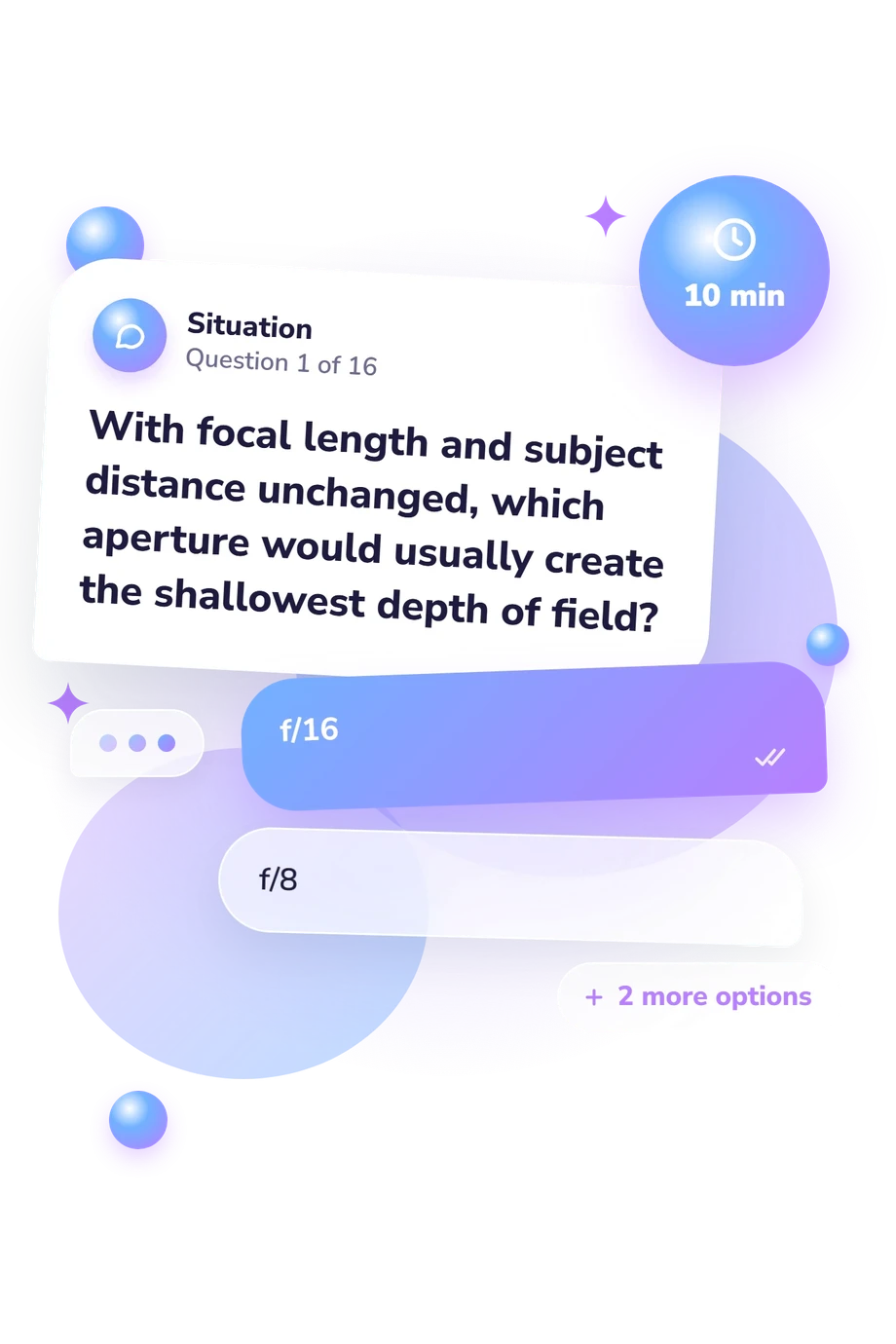
- f/16
- f/8
- f/2
- f/11
- Insufficient luminance contrast
- Inconsistent image resolution
- Excessive color saturation
- Overly tight image cropping
- It automatically selects the correct brand colors
- It gives every printed image a photographic texture
- It always creates a smaller file than any raster format
- It can be scaled without becoming pixelated
Bored Quiz - Description and methodology of the test
People who want a quick check of practical visual literacy can use the Bored Quiz to see how well they recognize and apply core photography and design principles in practical situations. It suits learners, hobbyist photographers, students, and design-curious readers who want a clear starting point for study rather than a judgment of creative talent. As a photography knowledge test, it turns familiar scenarios into focused review.
What This Assessment Explores
These questions measure applied understanding of photography and visual design, not artistic taste. They use practical situations to test whether you can connect a technical choice with its likely visual effect.
The topics include aperture and depth of field, focal length and perspective, shutter speed, exposure, RAW files, noise, white balance, composition, contrast, aspect ratio, alignment, negative space, vector graphics, typography, and CMYK color. As a visual design assessment, it is useful for beginners, hobbyist photographers, students, and readers refreshing core terminology.
The result is reported on one scale, Design & Photography Knowledge (0-16), using these reader-facing bands:
- Starting Point (0-6) indicates familiarity with some fundamentals while leaving room to review core principles.
- Developing Eye (7-12) shows that many key ideas can be applied, with some gaps remaining.
- Strong Foundation (13-16) reflects consistent command of essential photography and design principles.
Methodology and Evidence Base
Items mix short practical scenarios and direct concept questions, each with four answer choices; the respondent selects the principle or action that best answers it. The result is presented within the displayed scale, but the questionnaire does not specify how individual answers contribute to it.
The content is conceptually consistent with the SHARC framework (Huber, 2020), especially its emphasis on space, hierarchy, alignment, repetition, and color in visual communication. Huber and Ravi (2021) provide a related instructional assessment perspective. Photography technique is supported by Langford, Fox, and Sawdon Smith (2010), while the VLAT (Lee, Kim, and Kwon, 2017) offers a published example of structured multiple-choice assessment for visual literacy. This questionnaire is not presented as an adaptation of those instruments.
As a photography fundamentals quiz with a design component, it can show which concepts deserve review, but its result should be read as performance on these items rather than a population norm. No population norms, reliability estimates, or independent validation are attached to this online version, and scores may reflect prior instruction, terminology familiarity, or guessing.
- Huber, Sarah. (2020). SHARC: A Visual Design Framework. Libraries Faculty and Staff Creative Materials, Paper 32. Purdue University Libraries and School of Information Studies.
- Huber, Sarah, and Sivanand Puliyadi Ravi. (2021). A Visual Design Framework and Assessment to Inform Instruction. In J. Lee, S. M. Christensen, S. Beene, X. Chen, and W. Huang (Eds.), Visual Literacy in the Virtual Realm: The Book of Selected Readings 2021 (pp. 39-52). International Visual Literacy Association. 10.52917/ivlatbsr.2021.015
- Langford, Michael, Anna Fox, and Richard Sawdon Smith. (2010). Langford's Basic Photography: The Guide for Serious Photographers (9th ed.). Focal Press.
- Lee, Sukwon, Sung-Hee Kim, and Bum Chul Kwon. (2017). VLAT: Development of a Visualization Literacy Assessment Test. IEEE Transactions on Visualization and Computer Graphics, 23(1), 551-560. 10.1109/TVCG.2016.2598920
Updated: