
Book Character Quiz
How the Scales are Structured
Who Usually Takes This Test?
See How You Compare
Below is a preview of how scores are typically distributed across each scale.
Example Questions From the Test
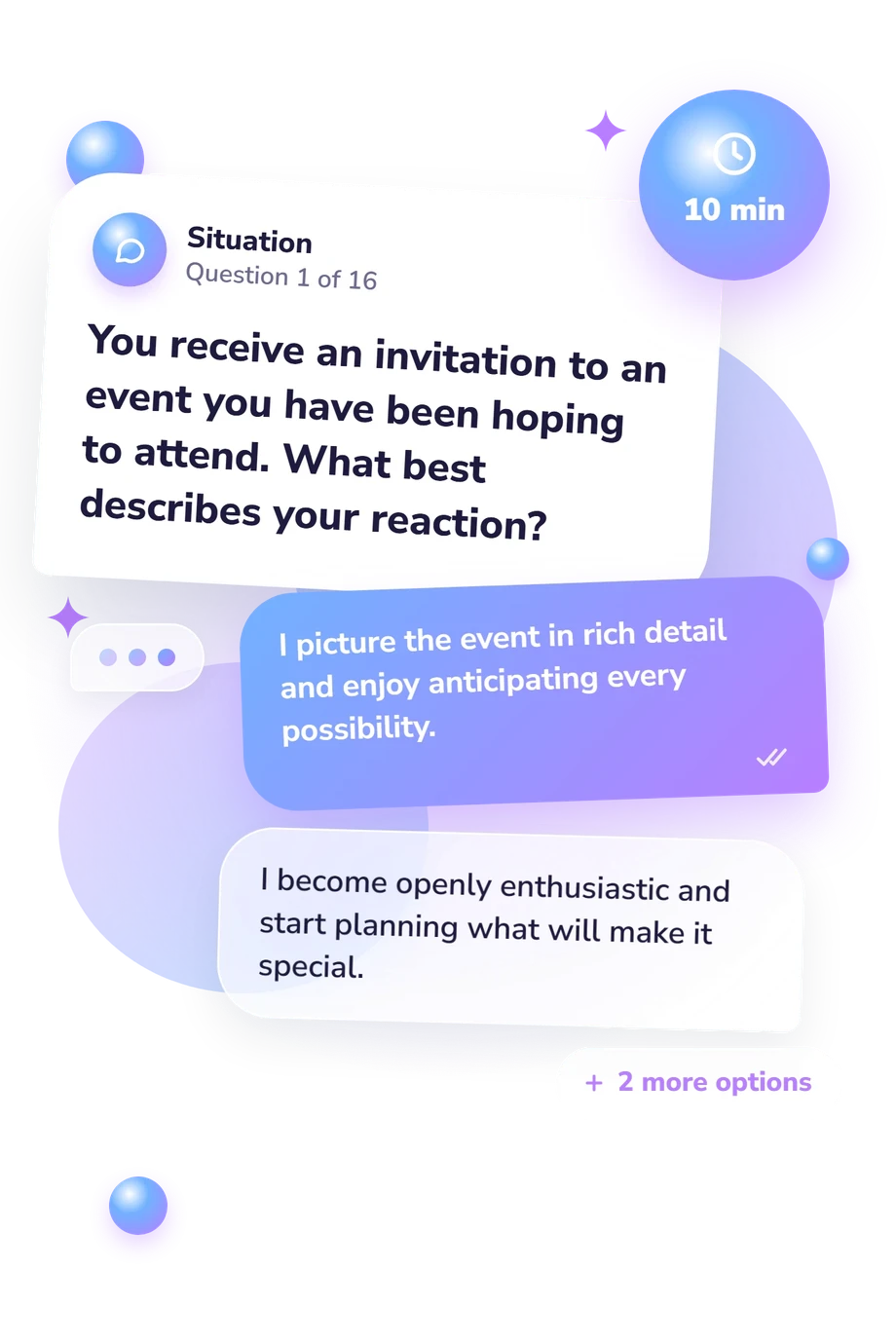
- I picture the event in rich detail and enjoy anticipating every possibility.
- I become openly enthusiastic and start planning what will make it special.
- I feel pleased but wait for the actual event before getting carried away.
- I confirm the logistics and return my attention to the present.
- Reconstruct the timeline and test each claim against observable details.
- Identify the likeliest pattern, then check the evidence that could disprove it.
- Follow my instinct about what probably happened.
- Accept the explanation that seems most reasonable to the group.
- Focus on completing the move; the discrepancy is probably irrelevant.
- Keep it in mind and see whether later context explains it.
- Ask the friend a direct question about the object.
- Examine the surrounding details before forming a precise question.
Book Character Quiz - Description and methodology of the test
Readers who know or recognize Anne Shirley, Elizabeth Bennet, Jo March, and Sherlock Holmes may use this book character quiz to compare their responses with four fictional reference points. Readers asking which book character they are can use the exercise to consider recurring preferences without reducing themselves to one character. Familiarity may influence affinities; readers seeking a what book character am I quiz can treat results as prompts for self-reflection.
What This Assessment Explores
Four affinities are compared rather than one identity. Situations involving emotion, social judgment, ambition, evidence, routine, and place reveal recurring preferences. The questionnaire functions as a character affinity test, describing how your responses resemble qualities represented by four fictional characters.
The result dimensions are:
- Anne Shirley Affinity (0-12) measures imagination, emotional expression, hopeful enthusiasm, and attachment to meaningful places: Grounded Outlook (0-4), Imaginative Spark (5-8), or Strong Affinity (9-12).
- Elizabeth Bennet Affinity (0-12) measures wit, independent judgment, and alertness to social character: Different Disposition (0-4), Kindred Streak (5-8), or Strong Affinity (9-12).
- Jo March Affinity (0-12) measures creative ambition, direct spirit, and determination to shape an unconventional life: Different Path (0-4), Independent Creator (5-8), or Strong Affinity (9-12).
- Sherlock Holmes Affinity (0-12) measures close observation, puzzle-seeking curiosity, and preference for evidence over assumption: Broad-Strokes Thinker (0-4), Curious Investigator (5-8), or Strong Affinity (9-12).
Methodology and Scientific Basis
Each item describes an everyday situation with four response options. The alternatives contrast emotional expression, imagination, social interpretation, creative drive, practical focus, and attention to evidence. This format invites comparison across situations without treating one choice as a complete portrait.
The online questionnaire presents four affinity profiles as a self-report book character assessment. Its option-to-score mapping and standardization status are not documented for this version; the displayed bands therefore describe ranges within the test, not population norms. It is a self-report assessment rather than a standardized diagnostic measure.
The Character Recognizability Scale is the closest comparison because it addresses perceived similarity in personality, attitudes, and experiences. This questionnaire is not an adaptation of that scale; it uses its own situations and dimensions. Yu and colleagues’ work on fictional personalities helps explain the role of context, while Cohen’s identification framework distinguishes affinity with selected qualities from full character identification. Mood, self-awareness, familiarity, and the imagined situation may shift responses.
- Żerebecki, Bartosz G., Suzanna J. Opree, Joep Hofhuis, and Susanne Janssen. 2024. “Beyond Perceived Similarity: Development and Validation of the Character Recognizability Scale (CRS).” Mass Communication and Society 27(5): 1220-1251. 10.1080/15205436.2024.2366224
- Yu, Mo, Jiangnan Li, Shunyu Yao, Wenjie Pang, Xiaochen Zhou, Zhou Xiao, Fandong Meng, and Jie Zhou. 2023. “Personality Understanding of Fictional Characters during Book Reading.” Proceedings of the 61st Annual Meeting of the Association for Computational Linguistics (Volume 1: Long Papers): 14784-14802. Association for Computational Linguistics. 10.18653/v1/2023.acl-long.826
- Cohen, Jonathan. 2001. “Defining Identification: A Theoretical Look at the Identification of Audiences With Media Characters.” Mass Communication and Society 4(3): 245-264. 10.1207/S15327825MCS0403_01
Updated: