
Black Cat or Golden Retriever Quiz
How the Scales are Structured
Who Usually Takes This Test?
See How You Compare
Below is a preview of how scores are typically distributed across each scale.
Example Questions From the Test
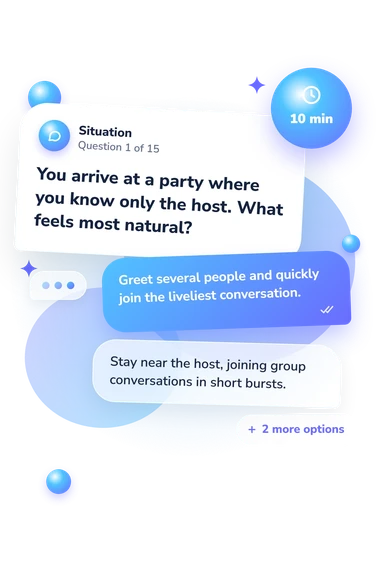
- Greet several people and quickly join the liveliest conversation.
- Stay near the host, joining group conversations in short bursts.
- Find one approachable person and settle into a quieter conversation.
- Observe for a while, then connect selectively with someone interesting.
- I give people room and trust that closeness does not need constant display.
- I offer quiet company and show warmth in subtle ways.
- I demonstrate care through dependable actions and attentive check-ins.
- I express warmth frequently through words, excitement, and welcome contact.
- Observe the dynamics and let other people initiate contact.
- Focus on the activity and respond pleasantly when approached.
- Introduce myself to people individually as opportunities arise.
- Start conversations readily and help create an upbeat atmosphere.
Black Cat or Golden Retriever Quiz - Description and methodology of the test
For readers who want a simple way to reflect on social energy and closeness, the Black Cat or Golden Retriever Quiz offers a descriptive profile of how they may enter groups, show affection, and balance connection with privacy. This black cat and golden retriever quiz gives people language for recurring interpersonal preferences without treating a style as a fixed identity. The result is comparative rather than pass-or-fail judgment.
What This Assessment Explores
Items examine entry into social settings, everyday affection, friendship roles, group participation, emotionally charged disagreements, support, changing plans, and the balance between social contact and private recovery. The black cat quiz is therefore about patterns of interpersonal style, not a simple synonym for introversion or extroversion.
The three displayed scales describe the result in these terms:
- Black Cat (0-15) shows how strongly independence, observation, understated affection, and a carefully chosen inner circle characterize your style; Faint affinity 0-5, Mixed affinity 6-10, Strong affinity 11-15.
- Black Cat-Golden Retriever Blend (0-15) shows a tendency to alternate among outgoing warmth, privacy, and independent recharging depending on mood or company; Faint blend 0-5, Mixed blend 6-10, Strong blend 11-15.
- Golden Retriever (0-15) shows how strongly visible warmth, shared excitement, active encouragement, and group connection characterize your style; Faint affinity 0-5, Mixed affinity 6-10, Strong affinity 11-15.
Methodology and Scientific Basis
Each item presents four response descriptions; choose the option matching your usual reaction. Situations cover introductions, affection, friendship roles, group chats, disagreements, support, changing plans, and time alone. This samples behavior across contexts rather than treating one answer as a complete personality label.
Within this black cat golden retriever quiz, answers yield three style scores. The highest identifies the strongest affinity; a score within one point should be read as part of a blended profile. This preserves a leading pattern while allowing overlap.
Conceptually, the questionnaire is consistent with Big Five Inventory-2 (Soto & John, 2017), which organizes broad traits through narrower facets. It also fits Fleeson’s (2001) view of personality as distributions of states and Goldberg’s (1992) lexical approach to recurring descriptors. The questionnaire is conceptually consistent with these works, not an adaptation of their published instruments.
The format addresses the question posed by this are-you-a-black-cat-or-golden-retriever quiz: which style fits best. Self-report scores can reflect mood, context, self-presentation, and self-awareness; your result is a snapshot of relational style, not a complete personality assessment.
- Soto, C. J., & John, O. P. (2017). The next Big Five Inventory (BFI-2): Developing and assessing a hierarchical model with 15 facets to enhance bandwidth, fidelity, and predictive power. Journal of Personality and Social Psychology, 113(1), 117-143. 10.1037/pspp0000096
- Fleeson, W. (2001). Toward a structure- and process-integrated view of personality: Traits as density distributions of states. Journal of Personality and Social Psychology, 80(6), 1011-1027. 10.1037/0022-3514.80.6.1011
- Goldberg, L. R. (1992). The development of markers for the Big-Five factor structure. Psychological Assessment, 4(1), 26-42. 10.1037/1040-3590.4.1.26