
Axial Skeleton Quiz
How the Scales are Structured
Who Usually Takes This Test?
See How You Compare
Below is a preview of how scores are typically distributed across each scale.
Example Questions From the Test
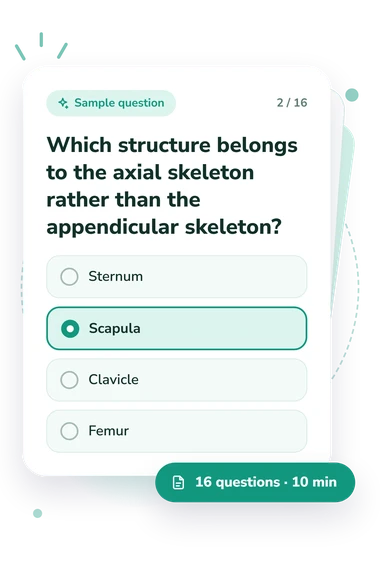
- Sternum
- Scapula
- Clavicle
- Femur
- Maxilla
- Zygomatic bone
- Mandible
- Vomer
- Cervical region
- Lumbar region
- Sacral region
- Thoracic region
Axial Skeleton Quiz - Description and methodology of the test
Students and anatomy learners can use this axial skeleton quiz to check their performance on a focused set of foundational questions. In this anatomy quiz on the axial skeleton, the intended reader is anyone reviewing foundational anatomy who wants a focused check rather than a broad survey. The result places overall performance in a knowledge band for this question set.
What This Assessment Explores
Questions connect bones with regions, landmarks, articulations, and protection. They cover skull bones, mandible, hyoid, auditory ossicles, vertebrae, ribs, sternum, thoracic cage, sacrum, coccyx, and intervertebral discs. A labeling quiz for the axial skeleton asks learners to translate a marked feature into an anatomical name.
The questions form these thematic groups; all contribute to one overall knowledge score, not separate reported scales:
- Skull questions ask you to identify cranial, facial, jaw, hyoid, and ear bones from landmarks.
- Vertebral questions require you to distinguish regions, special processes, fused elements, and discs.
- Thoracic questions ask you to classify ribs and link the cage with organ protection.
The Axial Skeleton Knowledge scale runs from 0-16. Emerging foundation (0-6) reflects partial recognition; Developing knowledge (7-12) indicates distinctions needing refinement; Strong command (13-16) indicates accurate identification of tested structures.
Methodology and Evidence Base
Each item presents four choices and asks for one response. Prompts identify landmarks, articulations, regions, and protective roles, so recognition matters more than essay recall.
Some labelled prompts add visual demand tied to a quiz with pictures of the axial skeleton; text-based items require inference from defining features. Attention, recent study, and landmark clarity can affect performance. Questions in this axial skeleton bones quiz require connections among names, regions, landmarks, and relationships rather than isolated memorization.
Scoring is criterion-based: one point per correct answer produces a raw total. That total summarizes performance on this question set; guessing, recent study, and familiarity with the structures can affect it.
The anatomy content is conceptually consistent with Betts' Anatomy and Physiology and Drake, Vogl, and Mitchell's Gray's Anatomy for Students; this questionnaire is not an adaptation of either source. Sagoo's work contextualizes image-supported assessment, while Douglas-Morris's study addresses identification-based multiple-choice formats; neither validates this quiz.
Interpret the result as a guide to reviewing names, locations, relationships, and functions. It cannot show palpation, imaging interpretation, or full three-dimensional understanding; those abilities lie beyond these questions.
- Betts JG, Young KA, Wise JA, Johnson E, Poe B, Kruse DH, Korol O, Johnson JE, Womble M, DeSaix P. Anatomy and Physiology 2e, Chapter 7: The Axial Skeleton. Houston, TX: OpenStax; 2022.
- Drake RL, Vogl AW, Mitchell AWM. Gray's Anatomy for Students. 5th ed. Philadelphia, PA: Elsevier; 2023.
- Sagoo MG, Vorstenbosch MATM, Bazira PJ, Ellis H, Kambouri M, Owen C. Online Assessment of Applied Anatomy Knowledge: The Effect of Images on Medical Students' Performance. Anatomical Sciences Education. 2021;14(3):342-351. 10.1002/ase.1965
- Douglas-Morris J, Ritchie H, Willis C, Reed D. Identification-Based Multiple-Choice Assessments in Anatomy can be as Reliable and Challenging as Their Free-Response Equivalents. Anatomical Sciences Education. 2021;14(3):287-295. 10.1002/ase.2068