
ASVAB Practice Quiz
How the Scales are Structured
Who Usually Takes This Test?
See How You Compare
Below is a preview of how scores are typically distributed across each scale.
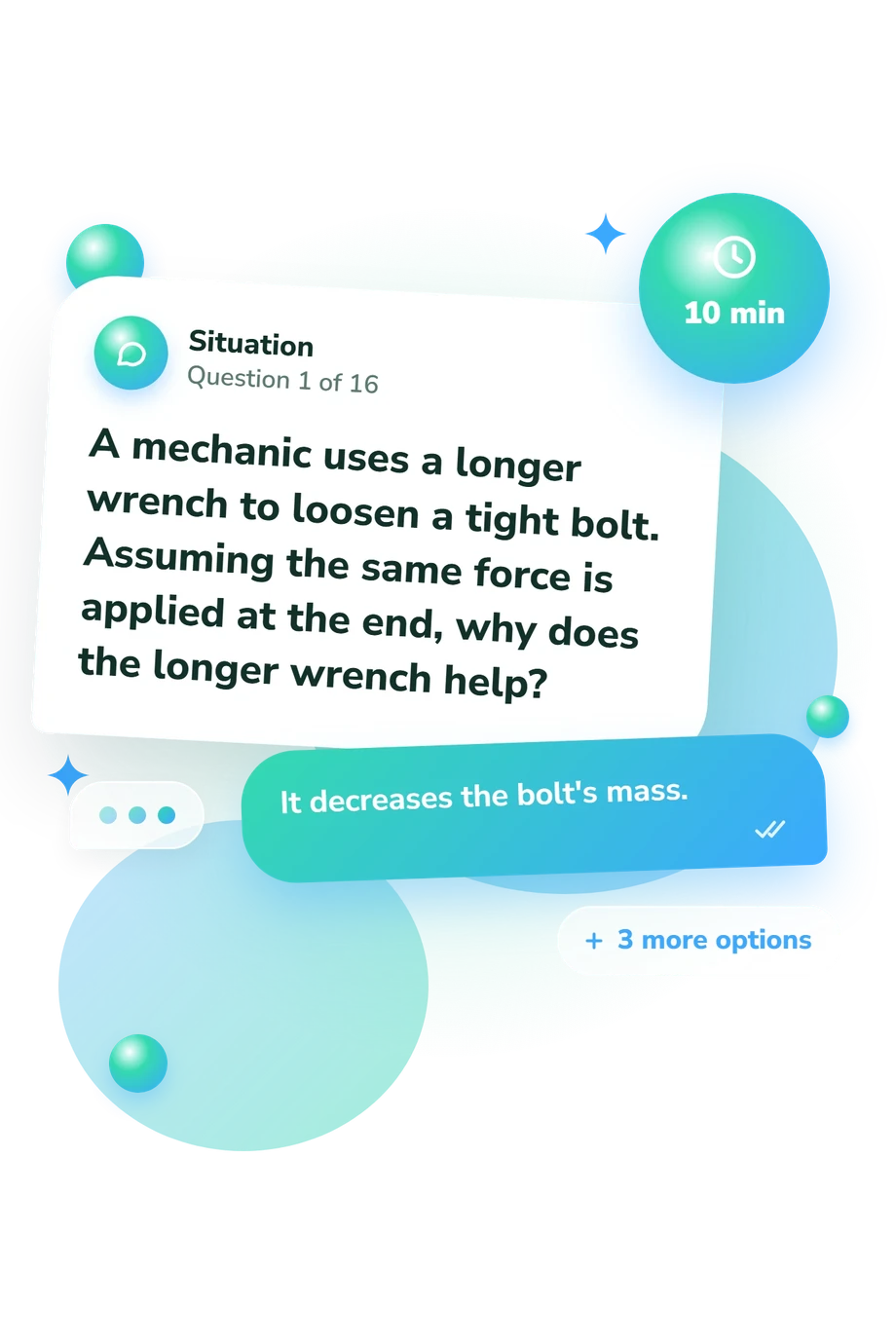
Example Questions From the Test
- Twice counterclockwise
- Once counterclockwise
- Once clockwise
- Four times clockwise
- 30 square inches
- 60 square inches
- 32 square inches
- 16 square inches
- 78
- 81
- 80
- 84
ASVAB Practice Quiz - Description and methodology of the test
People deciding how to organize their preparation can use the ASVAB Practice Quiz to see what their overall result shows across academic, scientific, and mechanical reasoning tasks before choosing specific study priorities or a review schedule. Its mixed format also makes this ASVAB quiz useful for independent review and study planning.
What This Assessment Measures
The questionnaire offers a broad educational snapshot of skills used in military aptitude preparation. It combines computation, vocabulary, science, physical principles, and short applied-reasoning problems. An ASVAB practice test in this format can help a learner decide whether errors reflect calculation, concept recall, or difficulty interpreting a situation.
The mixed set samples these areas:
- Arithmetic and algebra show how you handle means, percentages, ratios, equations, and factoring.
- Vocabulary and verbal reasoning indicate how you infer word meaning and supported conclusions.
- General science checks foundational understanding of density, organs, and scientific evidence.
- Mechanical, electrical, and practical reasoning examine torque, gears, resistance, current, and evidence-based decisions.
The catalogue reports one scale, ASVAB Practice Knowledge, from 0-16: Foundations to build (0-6), Developing knowledge (7-12), and Strong practice performance (13-16). It summarizes performance on this mixed set rather than measuring each subject separately.
Methodology and Evidence Base
Each item uses four-option multiple choice. Tasks require calculation, word definition, scientific recall, mechanical application, or selecting a conclusion from a short scenario. The format tests knowledge and rule application without producing a separate score for every skill.
The displayed result summarizes the mixed items. Its scoring logic is an unvalidated educational summary: it is not an official ASVAB score or eligibility decision. Use missed and answered tasks to choose broad review priorities, treating the total as a guide to the mixed set rather than a separate score for each subject.
DMDC (2012) documents the official ASVAB's content and technical background, while Welsh, Kucinkas, and Curran (1990) review its validity research. These sources provide context for the official assessment, but they do not validate or supply this questionnaire's online items; the questionnaire is conceptually consistent with that work, not a reproduction or adaptation of the published ASVAB.
Performance can vary with preparation, familiarity, guessing, concentration, and the testing situation. Reviewing missed items by topic can guide ASVAB preparation, while comparing later attempts can indicate practice progress across the mixed set.
- Defense Manpower Data Center, Personnel Testing Division. (2012). ASVAB Technical Bulletin No. 4: P&P-ASVAB Forms 23-27 (revised May 2012). Seaside, CA: Defense Manpower Data Center.
- Welsh, John R., Jr., Susan K. Kucinkas, and Linda T. Curran. (1990). Armed Services Vocational Aptitude Battery (ASVAB): Integrative Review of Validity Studies (AFHRL-TR-90-22, AD-A225 074). Brooks Air Force Base, TX: Manpower and Personnel Division, Air Force Human Resources Laboratory. 10.21236/ada225074
Updated: