
Am I Retarded Quiz
How the Scales are Structured
Who Usually Takes This Test?
See How You Compare
Below is a preview of how scores are typically distributed across each scale.
Example Questions From the Test
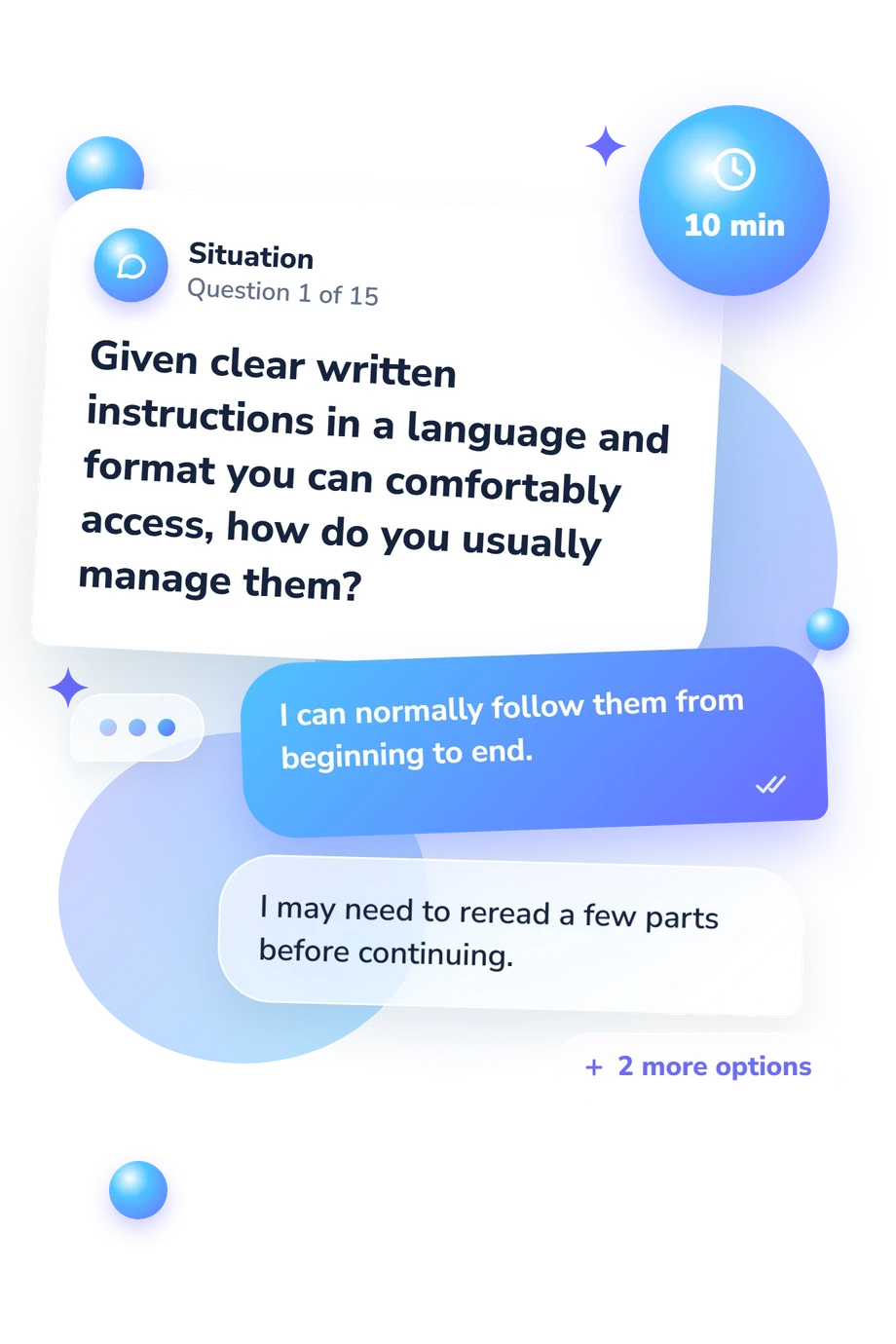
- I can normally follow them from beginning to end.
- I may need to reread a few parts before continuing.
- I often need them shortened, simplified, or shown with examples.
- I usually need another person to explain each part as I go.
- I generally keep pace with the material using the standard instruction.
- I sometimes need extra time or occasional clarification.
- I often need adapted explanations, repeated practice, or regular assistance.
- I usually need highly individualized instruction and close ongoing support.
- I can usually describe the issue and answer follow-up questions.
- I can explain it after taking time to organize my words.
- I often need a prepared note, communication aid, or prompting.
- I generally need a trusted person to explain the issue for me.
Am I Retarded Quiz - Description and methodology of the test
For anyone trying to understand how communication, learning, and daily responsibilities feel in practice, this support needs questionnaire provides structured self-reflection. The Am I Retarded Quiz is intended for self-reflection by people who want to identify situations where clearer language, extra time, reminders, adapted teaching, or another person’s help may make everyday tasks easier. Its profile emphasizes practical patterns rather than a global label.
What This Assessment Explores
Rather than assigning a broad label, the questionnaire examines communication, learning, understanding, planning, and practical action. It describes support needs in context, making an adaptive functioning questionnaire useful for noticing patterns that may deserve discussion.
Three displayed scales organize the result:
- Communication and Self-Advocacy (0-15) shows how someone understands exchanges, explains needs, and expresses choices: Lower support need (0-5), Situational support need (6-10), or Frequent support need (11-15).
- Learning and Understanding (0-15) reflects help with information, repetition, examples, and unfamiliar tasks: Lower support need (0-5), Situational support need (6-10), or Frequent support need (11-15).
- Practical Daily Functioning (0-15) describes support with planning, routines, money, travel, forms, and multistep tasks: Lower support need (0-5), Situational support need (6-10), or Frequent support need (11-15).
The profile highlights where clearer communication, preparation, tools, or trusted assistance may help.
Methodology and Scientific Basis
Each item presents a situation and four response options describing levels of ease, preparation, prompting, or direct assistance. The choices range from independent management to help, including reminders, checklists, examples, communication aids, and extra time. Responses produce domain results as support-need bands for communication, learning, and practical functioning.
The questionnaire is conceptually consistent with ADAPT (Jonker et al., 2021), a published adaptive-skills instrument, and with the adaptive-behavior and systems-of-support framework from Schalock, Luckasson, and Tassé. Its relationship to ADAPT is conceptual, not a direct adaptation or standardized administration. Jonker et al. (2023) provide factor-analytic context, but do not validate this online form.
For someone using an intellectual disability self-reflection, context matters. Self-report can be shaped by stress, anxiety, language, hearing, speech, education, culture, accessibility, instruction, and current support. This adaptive skills questionnaire is unvalidated and cannot diagnose intellectual disability, language disorders, autism, or another condition. Persistent concerns about communicating needs, understanding information, learning routines, planning tasks, or managing everyday activities may warrant qualified professional or disability-support evaluation. Sudden changes in speech, understanding, cognition, or everyday abilities require prompt medical attention.
- Jonker, F., Didden, R., Goedhard, L., Korzilius, H., & Nijman, H. (2021). The ADaptive Ability Performance Test (ADAPT): A new instrument for measuring adaptive skills in people with intellectual disabilities and borderline intellectual functioning. Journal of Applied Research in Intellectual Disabilities, 34(4), 1156-1165. 10.1111/jar.12876
- Jonker, F., de Looff, P., van Erp, S., Nijman, H., & Didden, R. (2023). The adaptive ability performance test (ADAPT): A factor analytic study in clients with intellectual disabilities. Journal of Applied Research in Intellectual Disabilities, 36(1), 3-12. 10.1111/jar.13044
- Schalock, R. L., Luckasson, R., & Tassé, M. J. (2021). Intellectual disability: Definition, diagnosis, classification, and systems of supports (12th ed.). American Association on Intellectual and Developmental Disabilities.
Updated: