
Am I Allergic to Cats Quiz
How the Scales are Structured
Who Usually Takes This Test?
See How You Compare
Below is a preview of how scores are typically distributed across each scale.
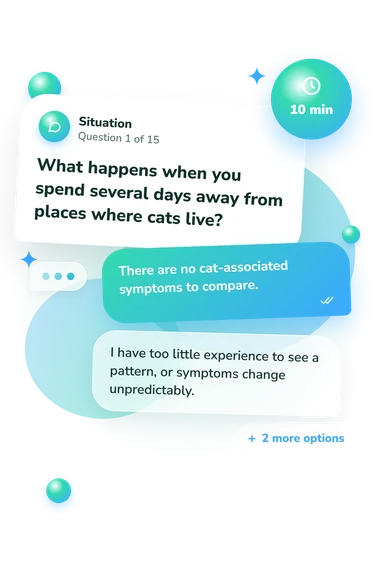
Example Questions From the Test
- There are no cat-associated symptoms to compare.
- I have too little experience to see a pattern, or symptoms change unpredictably.
- Symptoms sometimes improve away from cats but do not fully resolve.
- Symptoms repeatedly improve away from cat environments and return after renewed exposure.
- I have not noticed allergy-like symptoms in these situations.
- Symptoms occur across many settings, with no stronger connection to cats.
- Cats appear to be one of several repeatable triggers.
- Symptoms are much more consistently connected to cats than to the other situations.
- My eyes do not change, or this situation has not occurred.
- I notice brief, mild itching around an eye.
- My eyes become clearly itchy, red, or watery.
- My eyelids or the area around my eyes swell noticeably.
Am I Allergic to Cats Quiz - Description and methodology of the test
People noticing breathing, skin, nasal, or eye changes around cats may want a clearer way to organize their experience. The Am I Allergic to Cats Quiz supports self-observation, especially when symptoms seem linked to a home, visit, or contact. It can show which patterns deserve tracking and make a clinical discussion more focused. This cat allergy test organizes self-reported timing, setting, and trigger comparisons without deciding what caused the symptoms.
What This Assessment Explores
The questions ask whether symptoms follow direct contact, indirect exposure, or time in cat environments, and whether they improve away from them. They also separate cat-linked patterns from pollen, dust, smoke, colds, and other possible triggers. This suits someone noticing cat allergy symptoms but unsure whether the pattern is consistent.
The displayed groups are:
- Breathing and Skin Responses (0-15) shows breathing or skin signals; bands: No indicator endorsed (0-0), Some signal (1-2), Action warranted (3-15).
- Cat-Exposure Pattern (0-15) shows recurrence after cat contact; bands: No indicator (0-0), Some signal (1-2), Action warranted (3-15).
- Nose and Eye Responses (0-15) shows nasal or eye signals; bands: No indicator (0), Some signal (1-2), Action warranted (3-15).
Together, the groups describe endorsed patterns, not a confirmed cause; a zero may reflect limited exposure, while other triggers can resemble allergy.
Methodology and Scientific Basis
Each item offers four choices, from no change or uncertainty to mild, repeated, pronounced, or urgent reactions. Questions cover timing, direct or indirect exposure, comparison settings, and leaving because of symptoms.
For someone wondering whether they are allergic to their cat, this questionnaire organizes timing and competing triggers rather than assigning a cause.
The result presents separate scores for the three groups. The displayed bands are unvalidated reflective summaries, not diagnostic or severity cutoffs, and the questionnaire does not state a point-weighting or normative interpretation. Concerning experiences matter even when totals are low.
Its themes align conceptually with Noertjojo et al. (1999) on cat-dander exposure, sensitization, asthma, and asthma-like symptoms, but this questionnaire is not an adaptation. Dávila et al. (2018) addresses clinical history and allergy testing, while Sparkes (2022) reviews symptoms, causes, and exposure control. These sources support content areas, not validation of this questionnaire.
Use the result to record timing, setting, and triggers rather than testing exposure. Breathing difficulty, throat tightness, faintness, blue or gray lips, or facial, lip, or tongue swelling overrides the total and warrants urgent medical help.
- Noertjojo K, Dimich-Ward H, Obata H, Manfreda J, Chan-Yeung M. Exposure and sensitization to cat dander: asthma and asthma-like symptoms among adults. Journal of Allergy and Clinical Immunology. 1999;103(1 Pt 1):60-65. 10.1016/S0091-6749(99)70526-9
- Dávila I, Domínguez-Ortega J, Navarro-Pulido A, Alonso A, Antolín-Amérigo D, González-Mancebo E, Martín-García C, Núñez-Acevedo B, Prior N, Reche M, Rosado A, Ruiz-Hornillos J, Sánchez MC, Torrecillas M. Consensus document on dog and cat allergy. Allergy. 2018;73(6):1206-1222. 10.1111/all.13391
- Sparkes AH. Human allergy to cats: a review for veterinarians on prevalence, causes, symptoms and control. Journal of Feline Medicine and Surgery. 2022;24:31-42. 10.1177/1098612X211036793