
AI Quiz Questions
How the Scales are Structured
Who Usually Takes This Test?
See How You Compare
Below is a preview of how scores are typically distributed across each scale.
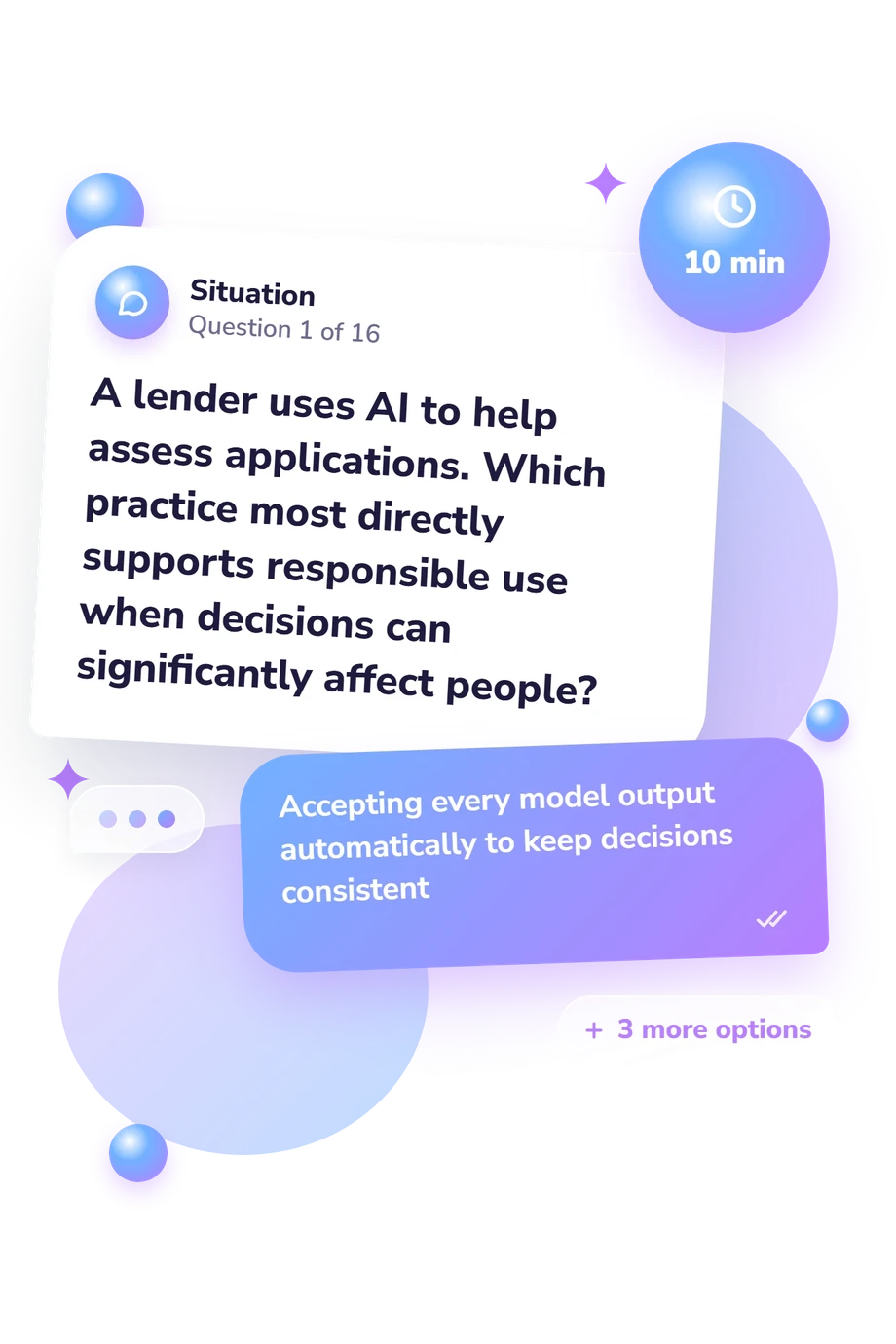
Example Questions From the Test
- A recommendation filter
- A decision tree
- A validation split
- A deepfake
- Clustering
- Classification
- Dimensionality reduction
- Sequence generation
- It always searches the live internet before responding
- It works without training data or programmed objectives
- It can produce new content based on patterns learned from data
- It guarantees that every output is original and accurate
AI Quiz Questions - Description and methodology of the test
People who want a practical check of their AI literacy can use this assessment to connect familiar terminology with decisions about models, data, and everyday tools. An artificial intelligence quiz can show which areas deserve deliberate review without turning the result into a judgment about general ability. AI quiz questions focus the exercise on knowledge that supports informed discussion and responsible use.
What This Assessment Explores
The questionnaire examines practical knowledge rather than confidence. Its artificial intelligence quiz questions use definitions and everyday scenarios to test recognition across themes, making it useful for anyone building AI literacy.
The result groups the content into three areas:
- Core concepts and learning show whether you can distinguish AI from machine learning and recognize training approaches.
- Evaluation and reliability indicate whether you can interpret recall, recognize overfitting, question unsupported outputs, and understand held-out tests.
- Responsible and secure use reflects how you understand oversight, explainability, privacy, bias, and prompt injection.
Missed distinctions are easier to revisit when the assessment acts as an AI quiz with questions and answers. These themes feed the Artificial Intelligence Knowledge scale, scored from 0-16. The displayed bands are Foundations to build (0-6), Developing knowledge (7-12), and Strong knowledge (13-16). The result describes performance on tested material, not a fixed level of intelligence.
Methodology and Scientific Basis
Each item presents a definition or practical scenario with four answer choices. The respondent selects the best response from plausible alternatives rather than rating confidence, preference, or personal experience. The scoring reports these selections on one knowledge scale and does not add a personality interpretation.
The design is conceptually consistent with the AI4Future AI literacy test (Chiu et al., 2024), the item-development work of Laupichler et al. (2023), and the competency framework of Long and Magerko (2020). These sources treat AI literacy as more than vocabulary, including capabilities, limitations, evaluation, social consequences, and appropriate use. This questionnaire is not presented as an adaptation or validation of those published instruments.
For readers comparing artificial intelligence quiz questions with answers, the result works best as a study signal: a lower band identifies foundations to strengthen, while a higher band suggests broader command of the material sampled here. Prior exposure, guessing, attention, and current context can affect performance, so the score is a snapshot rather than a complete measure of competence. The bands are descriptive categories, not population norms or clinical cutoffs.
- Chiu, Thomas K. F., Yifan Chen, King Woon Yau, Ching-sing Chai, Helen Meng, Irwin King, Savio Wong, and Yeung Yam. (2024). Developing and validating measures for AI literacy tests: From self-reported to objective measures. Computers and Education: Artificial Intelligence, 7, 100282. 10.1016/j.caeai.2024.100282
- Laupichler, Matthias Carl, Alexandra Aster, and Tobias Raupach. (2023). Delphi study for the development and preliminary validation of an item set for the assessment of non-experts’ AI literacy. Computers and Education: Artificial Intelligence, 4, 100126. 10.1016/j.caeai.2023.100126
- Long, Duri, and Brian Magerko. (2020). What is AI Literacy? Competencies and Design Considerations. Proceedings of the 2020 CHI Conference on Human Factors in Computing Systems, 1-16. 10.1145/3313831.3376727
Updated: