
Adolescent Time Attitude Scale (ATAS) Test
How the Scales are Structured
Who Usually Takes This Test?
See How You Compare
Below is a preview of how scores are typically distributed across each scale.
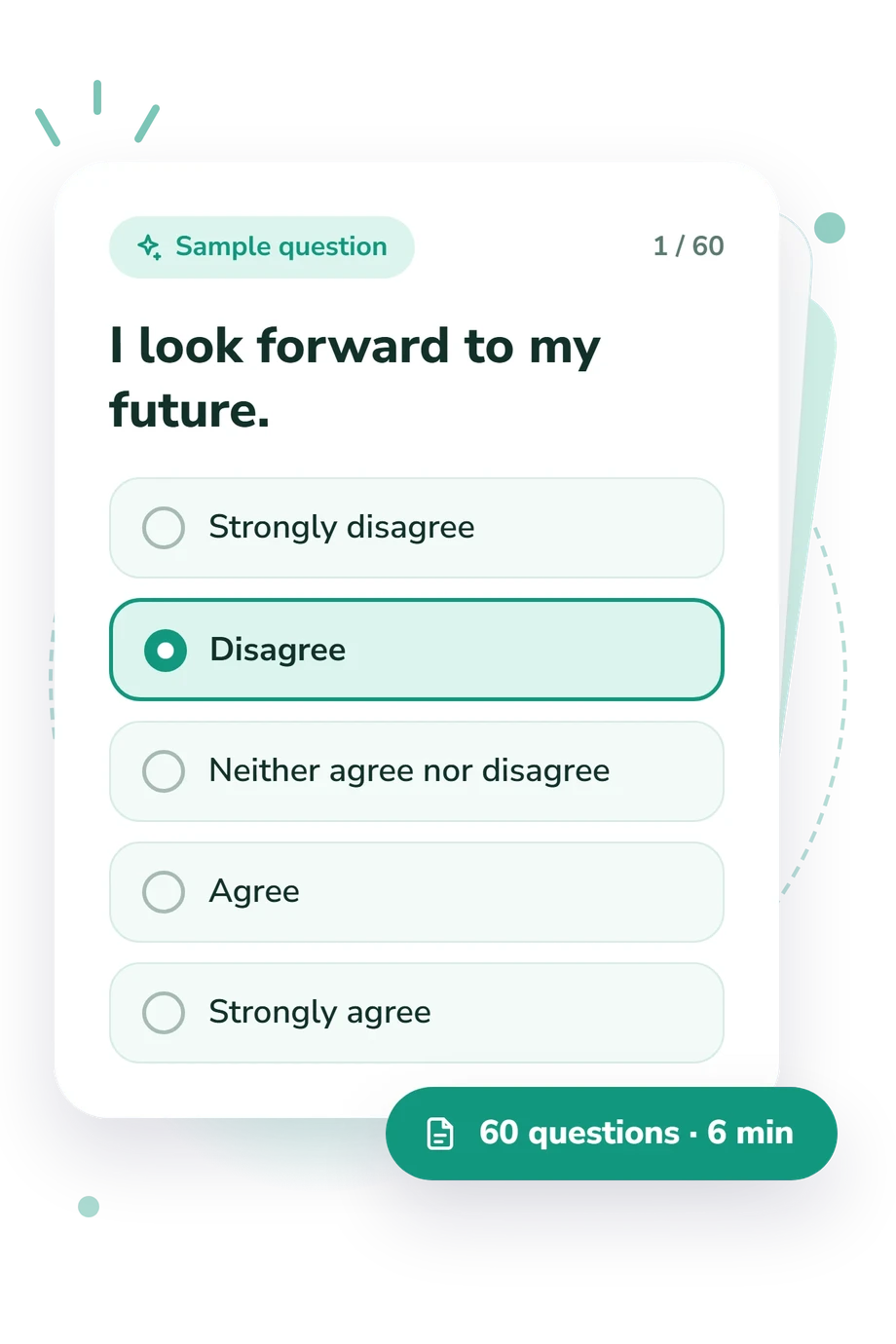
Example Questions From the Test
- Strongly disagree
- Disagree
- Neither agree nor disagree
- Agree
- Strongly agree
- Strongly disagree
- Disagree
- Neither agree nor disagree
- Agree
- Strongly agree
- Strongly disagree
- Disagree
- Neither agree nor disagree
- Agree
- Strongly agree
Adolescent Time Attitude Scale (ATAS) Test - Description and methodology of the test
Readers who want to examine how they relate to earlier experiences, current life, and what lies ahead may find the Adolescent Time Attitude Scale (ATAS) Test useful. As a time attitude questionnaire, it offers a differentiated self-report profile rather than a single overall mood label. The result can help people identify hopeful, dissatisfied, worried, or positive patterns across time.
What This Assessment Explores
Past, present, and future attitudes are compared. Readers can reflect on memories, satisfaction, and expectations. Positive and negative evaluations can coexist, making this time perspective test useful. Scales:
- Negative Future (5-25) measures negative expectations: Low negativity 5-11; Moderate negativity 12-18; High negativity 19-25.
- Positive Future (5-25) measures optimism: Low positivity 5-12; Moderate positivity 13-19; High positivity 20-25.
- Negative Present (5-25) measures dissatisfaction: Low negativity 5-11; Moderate negativity 12-18; High negativity 19-25.
- Positive Present (5-25) measures current satisfaction: Low positivity 5-11; Moderate positivity 12-18; High positivity 19-25.
- Past Negative (5-25) measures negative memories: Low negativity 5-11; Moderate negativity 12-18; High negativity 19-25.
- Past Positive (5-25) measures positive memories: Less positive 5-12; Moderately positive 13-19; Highly positive 20-25.
Methodology and Scientific Basis
Each statement asks for agreement on five response choices, from Strongly disagree to Strongly agree. Items address memories, satisfaction or worry in current life, and confidence or doubt about what lies ahead. Responses form six domain scores, allowing positive and negative attitudes toward each period to be considered separately.
The published Adolescent Time Attitude Scale (ATAS), described by Worrell, Mello, and Buhl (2013), is the closest instrument for these dimensions. Worrell and Mello (2009) examined convergent and discriminant validity in time-attitude scores, while Zimbardo and Boyd (1999) provide the broader individual-differences framework for time perspective. This questionnaire is conceptually consistent with that work, not presented as a direct adaptation.
Interpretation is comparative, making this a useful future orientation test: hope about tomorrow may coexist with dissatisfaction today, or positive memories with unpleasant ones. As an online self-report snapshot, this version has no stated standardization; current mood, memory bias, and self-presentation can shape the profile, so it should not be assumed to carry the published studies' norms, reliability estimates, or clinical meaning.
- Worrell, F. C., Mello, Z. R., & Buhl, M. (2013). Introducing English and German Versions of the Adolescent Time Attitude Scale. Assessment, 20(4), 496-510. 10.1177/1073191110396202
- Worrell, F. C., & Mello, Z. R. (2009). Convergent and Discriminant Validity of Time Attitude Scores on the Adolescent Time Perspective Inventory. Diskurs Kindheits- und Jugendforschung, 4(2), 185-196.
- Zimbardo, P. G., & Boyd, J. N. (1999). Putting Time in Perspective: A Valid, Reliable Individual-Differences Metric. Journal of Personality and Social Psychology, 77(6), 1271-1288. 10.1037/0022-3514.77.6.1271
Updated: