
Acid Reflux or Heart Attack Quiz
How the Scales are Structured
Who Usually Takes This Test?
See How You Compare
Below is a preview of how scores are typically distributed across each scale.
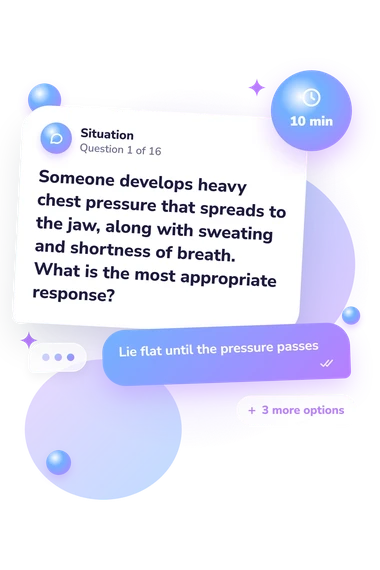
Example Questions From the Test
- Sudden weakness with severe breathlessness
- Fainting during physical exertion
- Cold sweating with heavy chest pressure
- Sour-tasting fluid or food moving back into the mouth
- An allergy skin test and a vision test
- An electrocardiogram and blood tests for cardiac troponin
- A stomach-acid test and a hearing test
- A bone-density scan and a throat culture
- A coronary artery suddenly stops carrying blood
- The heart rhythm permanently accelerates after eating
- The lung lining becomes infected
- Stomach contents move upward into the esophagus
Acid Reflux or Heart Attack Quiz - Description and methodology of the test
For readers trying to make sense of chest discomfort, this assessment organizes the overlap between reflux symptoms and possible cardiac warning signs. The Acid Reflux or Heart Attack Quiz tests practical recognition rather than identifying the cause of a current episode. For readers weighing familiar explanations, this heartburn or heart attack quiz offers a structured way to compare symptoms without relying on a familiar label.
What This Assessment Explores
Chest discomfort has multiple possible causes, so familiar heartburn does not automatically explain new, severe, persistent, or spreading symptoms. This questionnaire is for people seeking practical education about overlap, warning signs, and next steps.
The main question themes are:
- Meal-related burning and regurgitation can fit acid reflux, especially after eating or lying down.
- Pressure, spreading discomfort, sweating, breathlessness, nausea, faintness, and exertional symptoms call for urgent assessment.
- Antacid response, food timing, and chest tenderness add context, but the heartburn vs heart attack quiz practises distinguishing reflux patterns from cardiac warning signs without treating any clue as proof.
The result reflects knowledge of symptom patterns and response principles, so it highlights learning needs rather than personal symptom severity.
Methodology and Scientific Basis
Each item presents a short scenario or statement with four answer choices. The best response reflects symptom interpretation, emergency action, or appropriate evaluation; scoring places performance on one knowledge scale rather than rating personal symptom severity.
Chan et al. (2014) is especially relevant: its review found that a gastrointestinal cocktail cannot reliably distinguish reflux from myocardial ischemia or replace standard emergency assessment. Wertli et al. (2013) supports using history and clinical findings to guide evaluation while recognizing uncertainty. The 2021 AHA/ACC chest pain guideline supplies the framework for ECG, cardiac biomarkers, and risk assessment, while Katz et al. (2022) supplies reflux context. The questionnaire is conceptually consistent with these sources, not an adaptation of any one of them.
This acid reflux quiz uses Acid Reflux or Heart Attack Knowledge (0-16): Foundation to build (0-6), Developing knowledge (7-12), and Strong knowledge (13-16). These educational, unvalidated bands are not diagnostic or urgency cutoffs: the result pairs questions about acid reflux with cardiac warning signs, but cannot determine the cause of current chest symptoms, so concerning symptoms require clinical assessment regardless of the result.
- Chan S, Maurice AP, Davies SR, Walters DL. The use of gastrointestinal cocktail for differentiating gastro-oesophageal reflux disease and acute coronary syndrome in the emergency setting: a systematic review. Heart Lung Circ. 2014;23(10):913-923. 10.1016/j.hlc.2014.03.030
- Wertli MM, Ruchti KB, Steurer J, Held U. Diagnostic indicators of non-cardiovascular chest pain: a systematic review and meta-analysis. BMC Med. 2013;11:239. 10.1186/1741-7015-11-239
- Gulati M, Levy PD, Mukherjee D, et al. 2021 AHA/ACC/ASE/CHEST/SAEM/SCCT/SCMR Guideline for the Evaluation and Diagnosis of Chest Pain: A Report of the American College of Cardiology/American Heart Association Joint Committee on Clinical Practice Guidelines. Circulation. 2021;144(22):e368-e454. 10.1161/CIR.0000000000001029
- Katz PO, Dunbar KB, Schnoll-Sussman FH, Greer KB, Yadlapati R, Spechler SJ. ACG Clinical Guideline: Guidelines for the Diagnosis and Management of Gastroesophageal Reflux Disease. Am J Gastroenterol. 2022;117(1):27-56. 10.14309/ajg.0000000000001538