
ABG Quiz
How the Scales are Structured
Who Usually Takes This Test?
See How You Compare
Below is a preview of how scores are typically distributed across each scale.
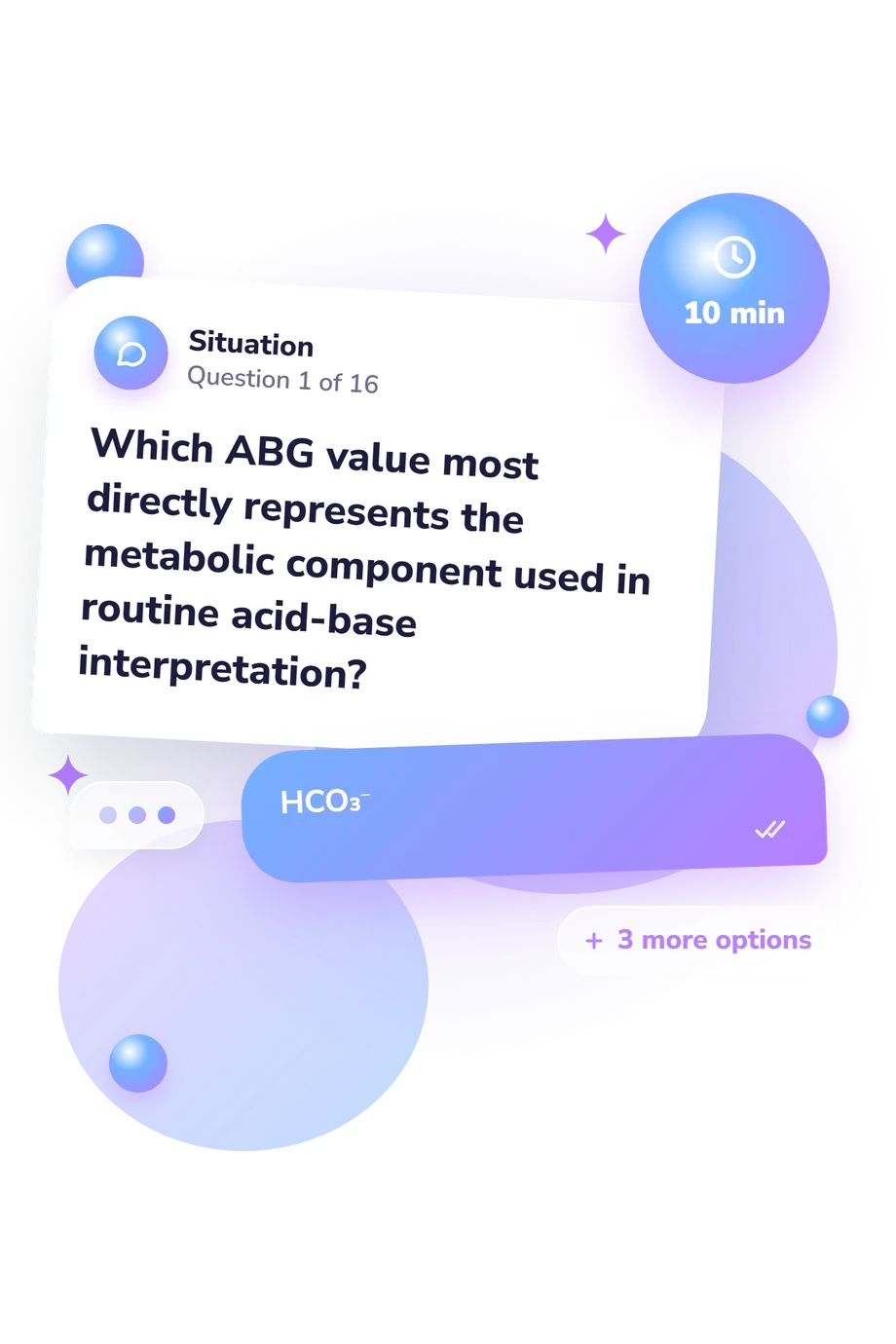
Example Questions From the Test
- HCO₃⁻
- PaCO₂
- PaO₂
- Oxygen saturation
- PaCO₂
- HCO₃⁻
- PaO₂
- Base excess
- 16 mmHg
- 40 mmHg
- 52 mmHg
- 28 mmHg
ABG Quiz - Description and methodology of the test
For students, trainees, and practitioners revisiting acid-base reasoning, the ABG Quiz offers a focused way to check readiness for further study. Because the assessment is a blood gas analysis quiz, its result can give learners a concrete starting point for planning revision and supervised practice. It can also support classroom review when a tutor discusses the reasoning behind each answer.
What This Assessment Explores
The questions test whether you can turn pH, PaCO₂, and HCO₃⁻ values into a coherent acid-base interpretation. The questionnaire functions as an ABG interpretation quiz because it asks you to make separate findings fit together, strengthening applied reasoning.
The main themes represented in the questions are:
- Component recognition shows whether you can identify how pH, PaCO₂, and HCO₃⁻ contribute.
- Primary disturbance identification shows whether the pattern is respiratory or metabolic acidosis or alkalosis.
- Compensation analysis shows whether the measured response is appropriate.
- Mixed-disorder recognition shows whether simultaneous disturbances are present.
The result is reported on one scale, ABG Interpretation Knowledge: 0-16. Foundations to build covers 0-6, Developing interpretation covers 7-12, and Strong knowledge covers 13-16. These bands show the level of educational knowledge reflected in this questionnaire.
Methodology and Scientific Basis
Each item presents a short ABG principle or value pattern with four answer choices, asking you to select the interpretation that best accounts for the data. The questions require reference-range knowledge, use of Winter’s formula, recognition of compensation, and attention to whether a normal-looking pH masks a mixed disorder. This questionnaire is an ABG practice quiz that demands active retrieval: each four-choice item asks you to connect a principle to a pattern rather than passively reading an explanation.
The item themes are conceptually consistent with acid-base reasoning described by Cowley, Owen and Bion and by Narins and Emmett; the questionnaire is not presented as an adaptation or validated version of either work.
The result is reported as a single knowledge score with the displayed descriptive bands. These bands are educational descriptors rather than standardized clinical thresholds. Because this is an unvalidated multiple-choice knowledge check, scores can vary with study exposure, test familiarity, and current context; they do not establish clinical competence or diagnose a disorder.
- Alhamad BR, Agha S. Comparing Knowledge Acquisition and Retention Between Mobile Learning and Traditional Learning in Teaching Respiratory Therapy Students: A Randomized Control Trial. Advances in Medical Education and Practice. 2023;14:333-342. 10.2147/AMEP.S390794
- Cowley NJ, Owen A, Bion JF. Interpreting arterial blood gas results. BMJ. 2013;346:f16. 10.1136/bmj.f16
- Narins RG, Emmett M. Simple and mixed acid-base disorders: A practical approach. Medicine (Baltimore). 1980;59(3):161-187. 10.1097/00005792-198005000-00001
Updated: