
ABA Quiz
How the Scales are Structured
Who Usually Takes This Test?
See How You Compare
Below is a preview of how scores are typically distributed across each scale.
Example Questions From the Test
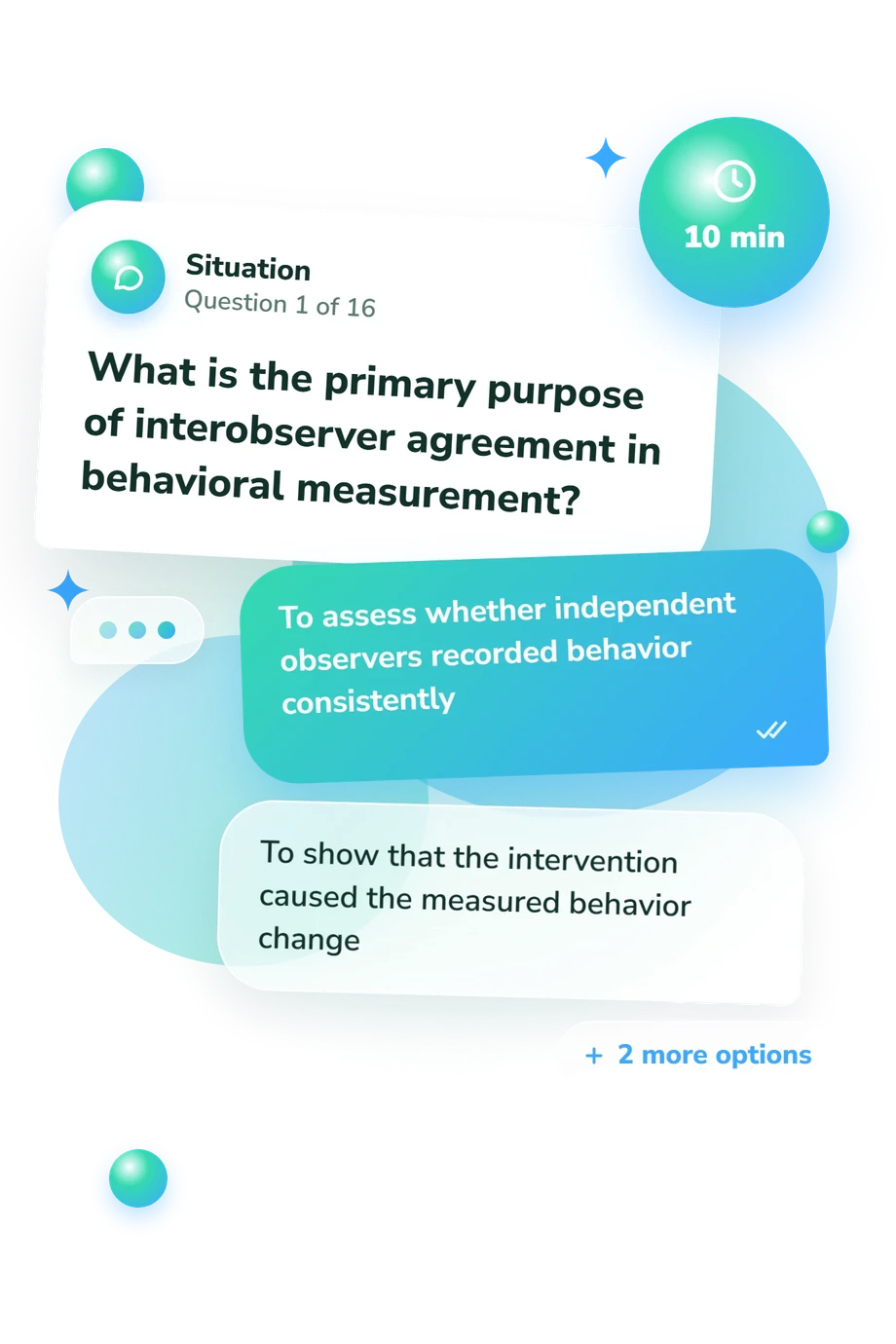
- To assess whether independent observers recorded behavior consistently
- To show that the intervention caused the measured behavior change
- To determine whether participants prefer one observer over another
- To replace operational definitions with professional judgment
- The item is automatically a reinforcer for every task and setting
- The item may function as a reinforcer, but its effect must be confirmed by whether it increases behavior
- The item should replace social reinforcement whenever possible
- The item will reduce behavior if delivered immediately afterward
- Positive punishment
- Positive reinforcement
- Negative punishment
- Negative reinforcement
ABA Quiz - Description and methodology of the test
People who want a structured introduction to behavior-analytic concepts can use the aba quiz to check how confidently they recognize measurement, learning principles, ethical responsibilities, and common intervention procedures. It suits students, caregivers, educators, and practitioners seeking a focused review before deeper study. As an applied behavior analysis quiz, it organizes revision around practical examples rather than abstract terminology. The result highlights topics worth revisiting.
What This Assessment Explores
The assessment checks whether respondents can identify core ABA concepts and apply them to brief situations. Examples address measurement, operational definitions, preference assessments, reinforcement and punishment, prompting, shaping, generalization, motivating operations, functional reasoning, and consent or assent. It suits anyone building or refreshing conceptual understanding.
The ABA questions move from terminology to judgments about consequences and interventions in context. The result offers an educational snapshot of conceptual accuracy and topics for review.
The ABA Knowledge scale runs from 0-16 and uses these bands:
- Foundational (0-6) indicates recognition of some ABA ideas while core terms and distinctions need review.
- Developing (7-12) shows understanding of many principles, with room to strengthen functional and ethical reasoning.
- Strong (13-16) reflects broad, accurate understanding of foundational concepts and applications.
Methodology and Scientific Basis
Each item presents a brief definition or applied scenario with four answer choices. Respondents select the best account of the concept, so the format tests recognition and application rather than personal behavior. The result is a keyed-answer educational summary of current mastery, not a pass/fail credential.
Content is conceptually consistent with Cooper, Heron, and Heward (2020), covering measurement, functional relations, reinforcement, punishment, prompting, shaping, generalization, and motivating operations. It also aligns with competency areas in the Behavior Analyst Certification Board’s 2022 outline. Consent, assent, humane practice, and professional responsibility correspond to the Board’s 2020 ethics code, while socially meaningful behavior reflects dimensions described by Baer, Wolf, and Risley (1968). The questionnaire is not presented as a standardized adaptation of any one source.
As an ABA knowledge test, it supports study planning and self-reflection. The score is unvalidated and has no stated norms or clinical threshold. Guessing, attention, prior coursework, and interpretations of concise wording can affect performance; the result does not establish certification, clinical competence, or diagnosis.
- Cooper, John O., Timothy E. Heron, and William L. Heward. Applied Behavior Analysis. 3rd ed. Harlow, England: Pearson, 2020.
- Behavior Analyst Certification Board. BCBA Test Content Outline. 6th ed. Littleton, CO: Behavior Analyst Certification Board, 2022.
- Behavior Analyst Certification Board. Ethics Code for Behavior Analysts. Littleton, CO: Behavior Analyst Certification Board, 2020.
- Baer, Donald M., Montrose M. Wolf, and Todd R. Risley. "Some Current Dimensions of Applied Behavior Analysis." Journal of Applied Behavior Analysis 1, no. 1 (1968): 91-97. 10.1901/jaba.1968.1-91
Updated: