
3rd Grade Quiz Questions
How the Scales are Structured
Who Usually Takes This Test?
See How You Compare
Below is a preview of how scores are typically distributed across each scale.
Example Questions From the Test
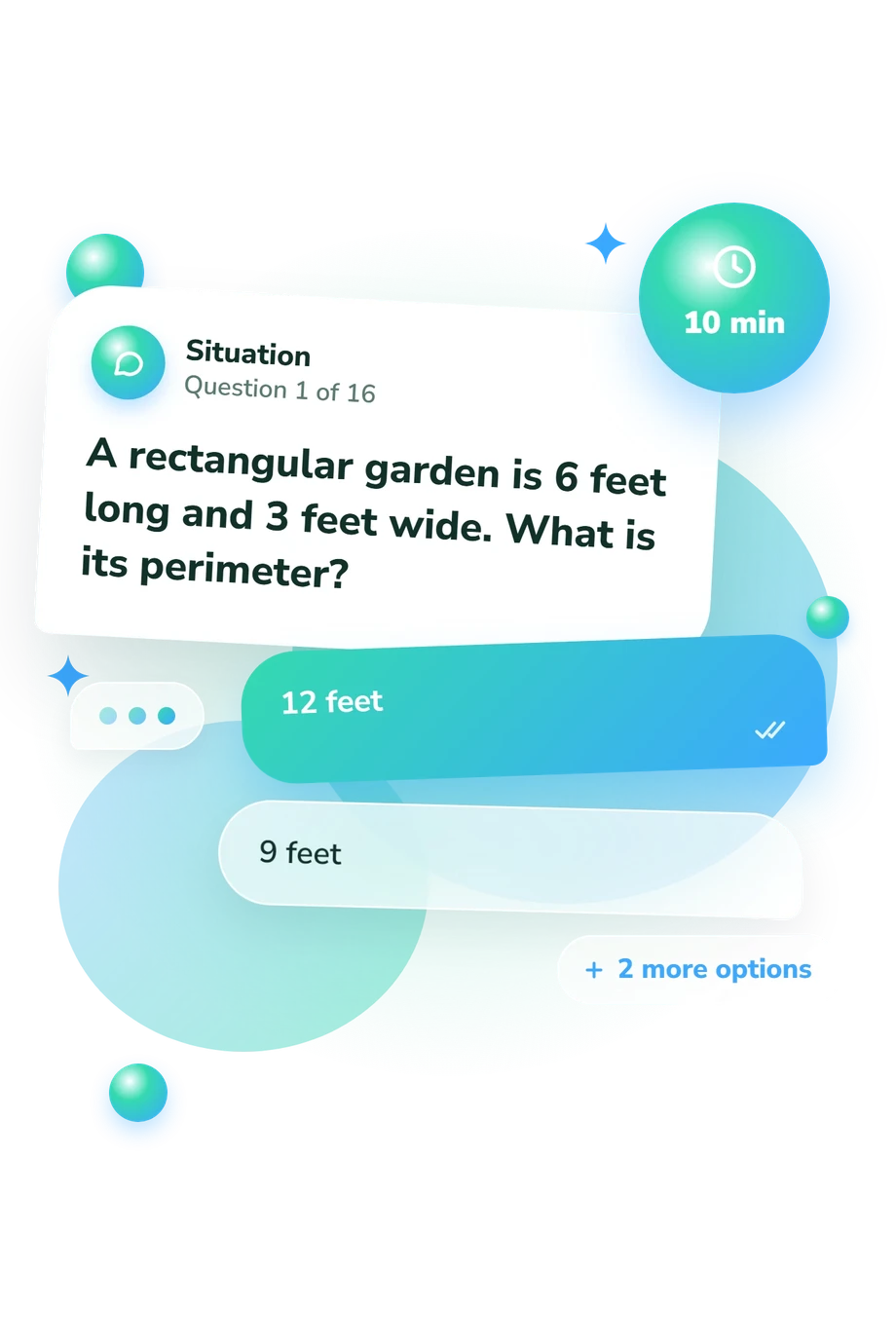
- 12 feet
- 9 feet
- 18 feet
- 24 feet
- Leaf
- Great
- Head
- Bread
- 1/2 < 1/4
- 1/3 > 2/3
- 2/6 = 3/6
- 3/4 > 2/4
3rd Grade Quiz Questions - Description and methodology of the test
For families, teachers, and learners seeking a focused check of foundational school knowledge, this assessment offers a compact look at selected classroom skills. The 3rd Grade Quiz Questions result indicates whether the sampled knowledge is emerging, developing, or strong. Four answer choices accompany each prompt, so learners encounter questions and answers in this 3rd-grade quiz in a consistent format; it suits reflection, practice planning, or a quick conversation about areas that may need review.
What This Assessment Explores
For a learner checking foundations, this third-grade knowledge test samples familiar school ideas across subjects. It suits readers who want a compact picture of strengths and areas to revisit, not a separate report for every class.
The result uses one combined scale, 3rd Grade Knowledge (0-16). Emerging Foundation covers 0-6, Developing Knowledge covers 7-12, and Strong Knowledge covers 13-16. These bands describe the sampled skills, not a school grade.
The thematic groups show what contributes to the result:
- Mathematics measures calculation, fractions, perimeter, division, and elapsed time.
- Language measures vocabulary, sound patterns, reading comprehension, grammar, and pronoun use.
- Science measures matter, forces, food chains, and Earth’s daily rotation.
- Everyday contexts bring knowledge into situations involving weather, schedules, and common materials.
- Civics measures recognition of which local authority handles a community problem.
Methodology and Evidence Base
Each item presents a prompt with four answer choices. The scoring is direct: one correct choice adds one point, and responses combine into a single total; no separate subject totals are displayed. Performance may indicate a need for further review, although the combined score does not identify a specific subject or concept. Results may also reflect guessing, reading comprehension, attention, and familiarity with the wording.
Methodologically, this third grade quiz is a mixed-skill online knowledge check rather than a standardized instrument. Its content is conceptually consistent with Common Core expectations for mathematics and language, NGSS expectations for science, and the NCSS framework for civics and social studies. The questions translate those classroom expectations into short applications involving arithmetic, language conventions, life science, physical science, Earth science, and local government.
Interpretation should remain descriptive: the combined score represents performance on these sampled items, not achievement across the full curriculum. Classroom exposure, current concentration, and honest recall can influence it, while a broader assessment would be needed to describe achievement across subjects.
- Early, Diane M., Weilin Li, Kelly L. Maxwell, and Bentley D. Ponder. “Participation in Georgia’s Pre-K as a Predictor of Third-Grade Standardized Test Scores.” AERA Open, vol. 5, no. 2, 2019. 10.1177/2332858419848687
- Common Core State Standards Initiative. Common Core State Standards for Mathematics; Common Core State Standards for English Language Arts & Literacy in History/Social Studies, Science, and Technical Subjects. National Governors Association Center for Best Practices and Council of Chief State School Officers, 2010.
- NGSS Lead States. Next Generation Science Standards: For States, By States. The National Academies Press, 2013.
- National Council for the Social Studies. National Curriculum Standards for Social Studies: A Framework for Teaching, Learning, and Assessment. NCSS Bulletin 111, 2010.
Updated: