
2000s Music Quiz
How the Scales are Structured
Who Usually Takes This Test?
See How You Compare
Below is a preview of how scores are typically distributed across each scale.
Example Questions From the Test
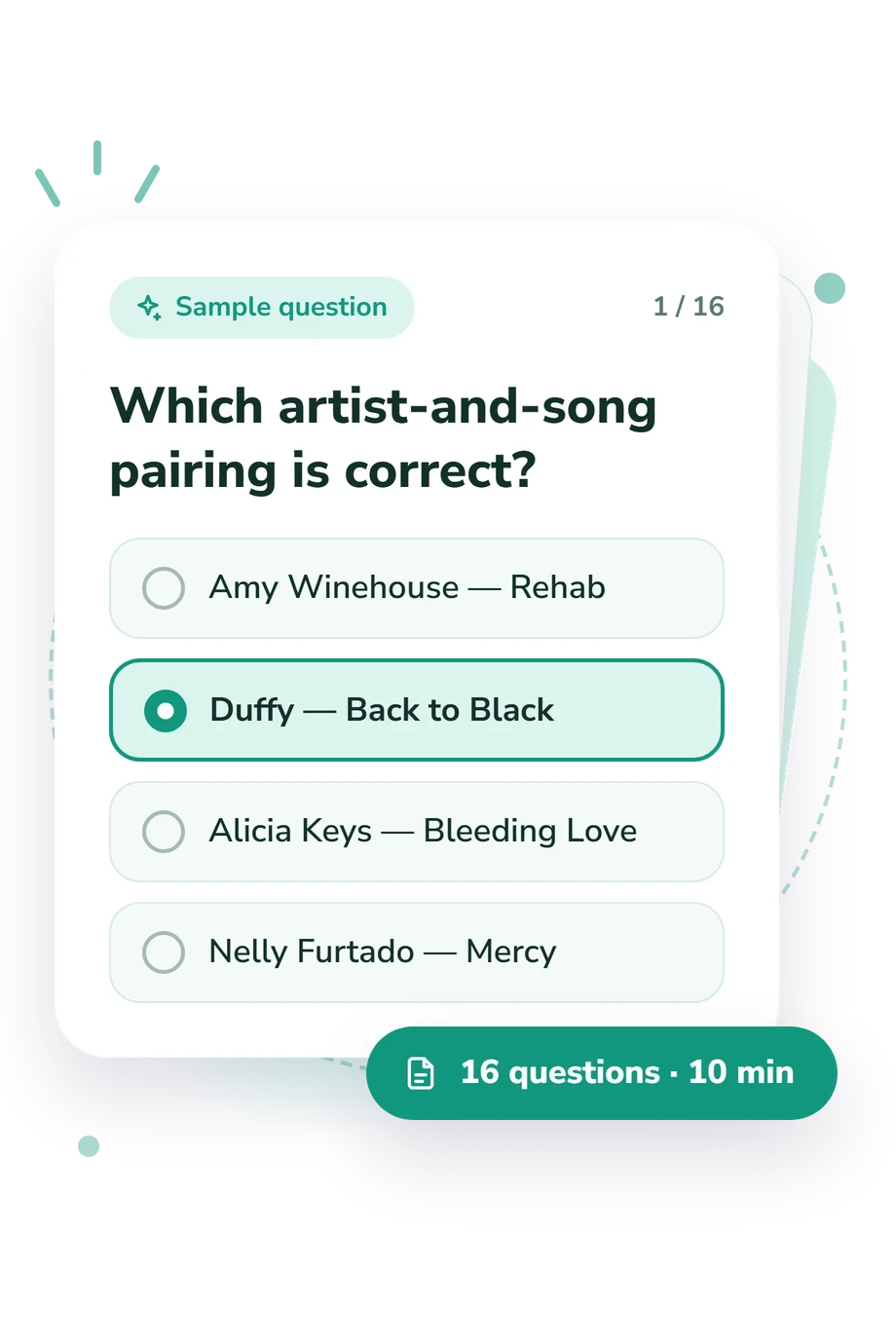
- Amy Winehouse — Rehab
- Duffy — Back to Black
- Alicia Keys — Bleeding Love
- Nelly Furtado — Mercy
- Sugar, We’re Goin Down
- I Write Sins Not Tragedies
- The Anthem
- The Middle
- Clocks
- Fix You
- The Scientist
- Viva la Vida
2000s Music Quiz - Description and methodology of the test
Listeners who want to revisit a defining pop decade can use this 2000s music quiz to map their familiarity with its musical landscape rather than rely on vague nostalgia. It suits casual fans, playlist makers, and anyone curious about which parts of the decade deserve another listen. As a 2000s music trivia quiz, it offers a focused way to plan that musical return.
What This Assessment Explores
This assessment measures recognition of 2000s music through artist-song matching, lyric identification, featured-performer knowledge, release-order judgments, and clues from memorable openings or choruses. It spans pop, rock, hip-hop, and pop-punk, so the result reflects recall rather than vocal skill, music theory, or taste.
It is a quiz covering some of the best-known 2000s songs, with enough range to check recognition across different clue types. The result is organized around one scale:
- 2000s Music Knowledge (0-16) shows how consistently you identify songs, performers, collaborations, lyrics, and decade-related clues; Foundation (0-6) indicates some recognized touchstones with substantial gaps, Developing (7-12) reflects broad but uneven knowledge, and Strong (13-16) indicates detailed, consistent recognition.
The intended audience is anyone interested in music recall. A higher band means more correct recognition within this selection, not superior taste or a complete account of what someone knows.
Methodology and Evidence Base
Each item presents one best answer from four choices. Direct identifications and short lyric, scenario, or opening clues connect a cue with a song, artist, release period, or collaborator. The format therefore functions as a 2000s song quiz built around recognition rather than musical performance.
The four-choice responses produce a result on the displayed scale. That result describes performance on these selected items rather than universal musical ability; no extra weighting, clinical threshold, or norm-referenced interpretation is stated.
The design is conceptually consistent with Peynircioğlu, Rabinovitz, and Thompson, whose findings support reciprocal retrieval among a song’s words, melody, and title. Peretz, Radeau, and Arguin likewise support treating tune and lyric recognition as related but distinguishable retrieval routes. These studies provide limited conceptual background for cue-based song recognition; this questionnaire uses written clues and four answer choices rather than melody recognition, and it does not adapt either published instrument.
Exposure, context, attention, and recall can affect performance, so the result is best read as a snapshot of recognition for this selection.
- Peynircioğlu, Z. F., Rabinovitz, B. E., & Thompson, J. L. W. (2008). Memory and metamemory for songs: The relative effectiveness of titles, lyrics, and melodies as cues for each other. Psychology of Music, 36(1), 47-61. 10.1177/0305735607079722
- Peretz, I., Radeau, M., & Arguin, M. (2004). Two-way interactions between music and language: Evidence from priming recognition of tune and lyrics in familiar songs. Memory & Cognition, 32(1), 142-152. 10.3758/BF03195827
- Müllensiefen, D., Gingras, B., Musil, J., & Stewart, L. (2014). The musicality of non-musicians: An index for assessing musical sophistication in the general population. PLOS ONE, 9(2), e89642. 10.1371/journal.pone.0089642
Updated: