
Winter Sport Quiz
How the Scales are Structured
Who Usually Takes This Test?
See How You Compare
Below is a preview of how scores are typically distributed across each scale.
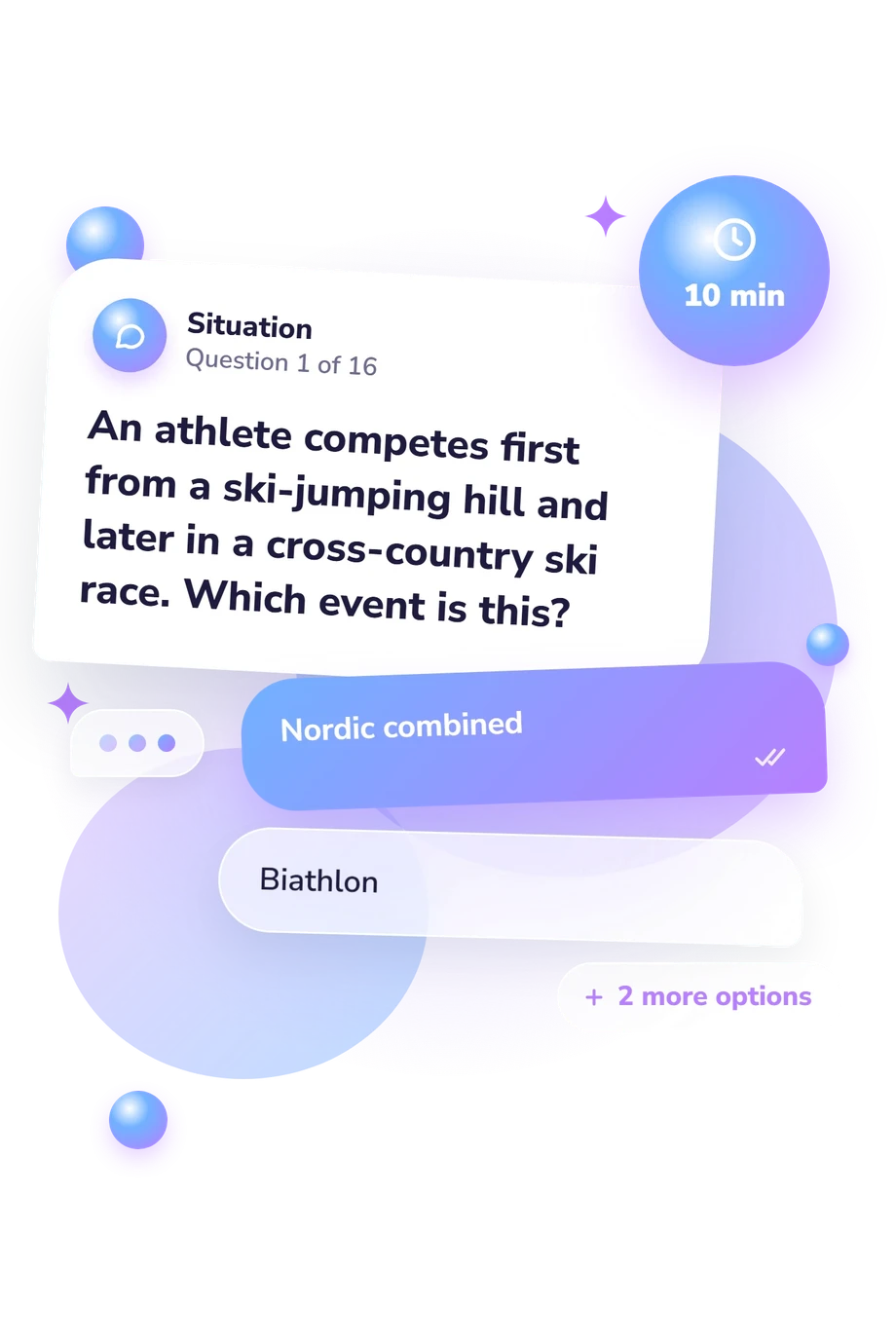
Example Questions From the Test
- Nordic combined
- Biathlon
- Skiathlon
- Alpine combined
- Running beside and pushing the sled before boarding
- Sweeping the ice in front of the runners
- Using ski poles to launch from the start
- Jumping from a takeoff ramp into the course
- Alpine skiing and archery
- Ski jumping and rifle shooting
- Cross-country skiing and speed skating
- Cross-country skiing and rifle shooting
Winter Sport Quiz - Description and methodology of the test
Readers deciding whether to test their knowledge of snow-and-ice competition can use this winter sport quiz as a focused knowledge exercise. It suits curious fans, students, and viewers who want a structured way to check what they remember before following a season more closely. Each item presents winter sports quiz questions and answers in a four-choice format, giving respondents a clear way to test what they know.
What This Assessment Explores
This questionnaire measures knowledge of winter sports rules, event identities, technical terms, equipment, and competition formats. It suits readers testing broad sports knowledge, not athletic ability. Scenarios ask the respondent to identify a discipline, connect an action with a rule, or distinguish related events such as luge and skeleton.
The questions span four thematic areas, and correct answers across them contribute to one overall knowledge score:
- Rules and officiating: this area covers recognition of offside, team-pursuit timing, and scoring factors.
- Disciplines and event identity: this area covers separating similar snow and ice sports.
- Equipment and performance features: this area covers sled positions, ski-jump landings, and course design.
- Competition formats and terminology: this area covers race structures and event names.
Winter Sports Knowledge runs from 0-16: Foundational is 0-6, Developing is 7-12, and Strong is 13-16.
Methodology and Evidence Base
Each item presents a short scenario or direct rule question with four answer choices. The respondent selects the option matching the sport, event, rule, or technical detail described. The score counts correct answers, so the method is a knowledge tally rather than a personality profile. Items cover rules, disciplines, equipment, and competition formats.
The evidence base is conceptual. Carus and Castillo (2020) examine conduct-rule knowledge among snowboarders, while Hildebrandt and colleagues (2011) relate safety perceptions to awareness of slope rules. Schrag (2018) supplies rule descriptions across sports. The questionnaire is conceptually consistent with these works, but it is not an adaptation of any one of them, and the sources do not standardize this online test.
No norm-referenced interpretation is supplied. The displayed bands describe overall winter sports knowledge through correct-answer performance, while results can shift with prior exposure, terminology familiarity, concentration, and honest recall. A score cannot show whether someone can perform a skill or apply every rule during live competition.
- Carus, Luis, and Isabel Castillo. “Snowboarders’ Knowledge of the FIS Rules for Conduct on Ski Slopes.” International Journal of Environmental Research and Public Health 17, no. 1 (2020): 316. 10.3390/ijerph17010316
- Hildebrandt, Carolin, Esmeralda Mildner, Barbara Hotter, Werner Kirschner, Chistoph Höbenreich, and Christian Raschner. “Accident Prevention on Ski Slopes-Perceptions of Safety and Knowledge of Existing Rules.” Accident Analysis & Prevention 43, no. 4 (2011): 1421-1426. 10.1016/j.aap.2011.02.018
- Schrag, Myles. The Sports Rules Book. Human Kinetics, 2018.
Updated: