
What Will My Boyfriend Look Like Quiz
How the Scales are Structured
Who Usually Takes This Test?
See How You Compare
Below is a preview of how scores are typically distributed across each scale.
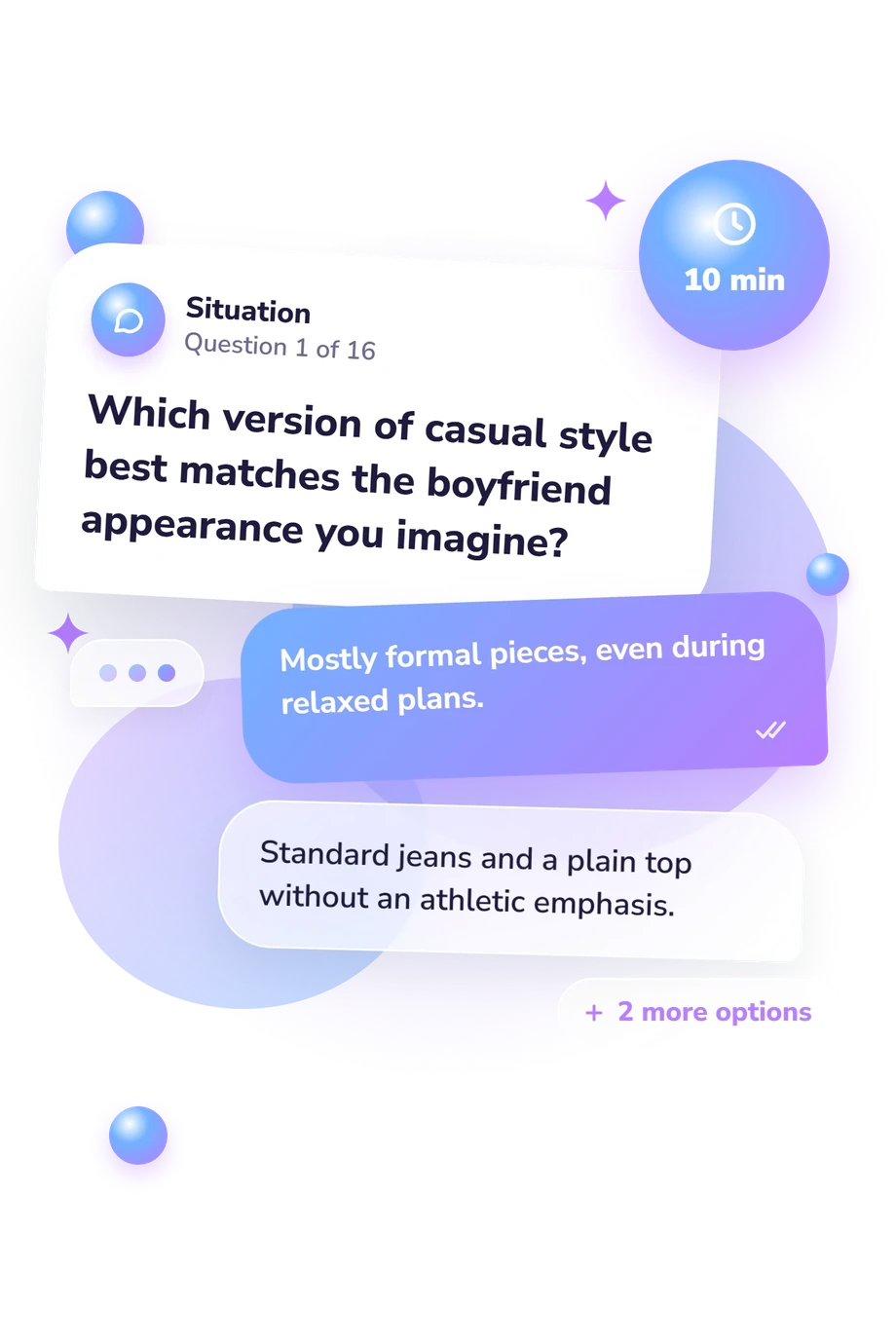
Example Questions From the Test
- A lot; those finishing touches can define the whole look.
- Quite a bit, provided they do not seem overly calculated.
- A little; one thoughtful detail is usually enough.
- Very little; I am more attracted to less coordinated styles.
- I generally prefer a completely clean-shaven look.
- Light stubble can work, but anything fuller is less appealing.
- I often like it when it is naturally shaped and maintained.
- It is one of the appearance features I find most attractive.
- Neatly shaped hair and carefully maintained facial hair.
- Mostly tidy, with a few relaxed or imperfect details.
- Simple grooming without much visible styling.
- An intentionally rough, unconventional, or highly casual finish.
What Will My Boyfriend Look Like Quiz - Description and methodology of the test
People curious about the visual qualities they imagine in a romantic partner can use the What Will My Boyfriend Look Like Quiz to turn an intuitive preference into a structured style profile. It suits readers reflecting on attraction, clothing, grooming, and overall presentation. For this what will your boyfriend look like quiz, the useful outcome is a clearer picture of the aesthetic details that catch your attention.
What This Assessment Explores
Someone using the what will my first boyfriend look like quiz framing can treat the result as a map of visual attraction. Items cover clothing, grooming, hair, facial hair, accessories, colour, physical energy, and outdoor textures.
The result has four dimensions:
- Classic & Polished Look (0-12) measures affinity for tailored details; Subtle affinity (0-4), Selective affinity (5-8), Strong affinity (9-12).
- Creative & Alternative Look (0-12) measures interest in expressive details; Subtle affinity (0-4), Selective affinity (5-8), Strong affinity (9-12).
- Relaxed & Sporty Look (0-12) measures appeal in active casual styling; Subtle affinity (0-4), Selective affinity (5-8), Strong affinity (9-12).
- Rugged & Outdoorsy Look (0-12) measures preference for sturdy, natural styling; Subtle affinity (0-4), Selective affinity (5-8), Strong affinity (9-12).
Methodology and Scientific Basis
Each item presents an appearance situation or feature with four response options, covering polished, relaxed, expressive, sporty, and rugged alternatives. Responses are assigned across the four displayed profile totals; the highest total marks the strongest affinity, while any profile within one point joins it as a blended result. This scoring logic allows the outcome to reflect a combination of styles.
When treated as a what will my next boyfriend look like quiz, the exercise is a self-report preference assessment. Its themes are conceptually consistent with Townsend and Levy (1990), who examined clothing, physical attractiveness, and partner selection. Hong and Kim (2015) offer a comparison for preferred fashion styles, and Gray et al. (2020) address facial hair as an appearance cue. These studies support the construct's relevance but do not make this questionnaire an adaptation of their instruments.
The questionnaire has no established norms, clinical cutoffs, reliability estimates, or diagnostic validation, so scores are descriptive. Mood, dating experiences, cultural context, and self-awareness may shape answers; the result captures current visual preferences rather than a literal forecast.
- Townsend, John Marshall, and Gary D. Levy. "Effects of Potential Partners' Costume and Physical Attractiveness on Sexuality and Partner Selection." The Journal of Psychology, vol. 124, no. 4, 1990, pp. 371-389. 10.1080/00223980.1990.10543232
- Hong, Yun Jung, and Young In Kim. "Preferred Fashion Style based on the Men's Self-image Including Fashion Involved Circumstances." Journal of the Korean Society of Costume, vol. 65, no. 8, 2015, pp. 1-21. 10.7233/jksc.2015.65.8.001
- Gray, Peter B., Lyndsey K. Craig, Jorge Paiz-Say, P. Lavika, Sanjitha Ajith Kumar, and Madhavi Rangaswamy. "Sexual Selection, Signaling and Facial Hair: US and India Ratings of Variable Male Facial Hair." Adaptive Human Behavior and Physiology, vol. 6, 2020, pp. 170-184. 10.1007/s40750-020-00134-4
Updated: