
What Position Are You Quiz
How the Scales are Structured
Who Usually Takes This Test?
See How You Compare
Below is a preview of how scores are typically distributed across each scale.
Example Questions From the Test
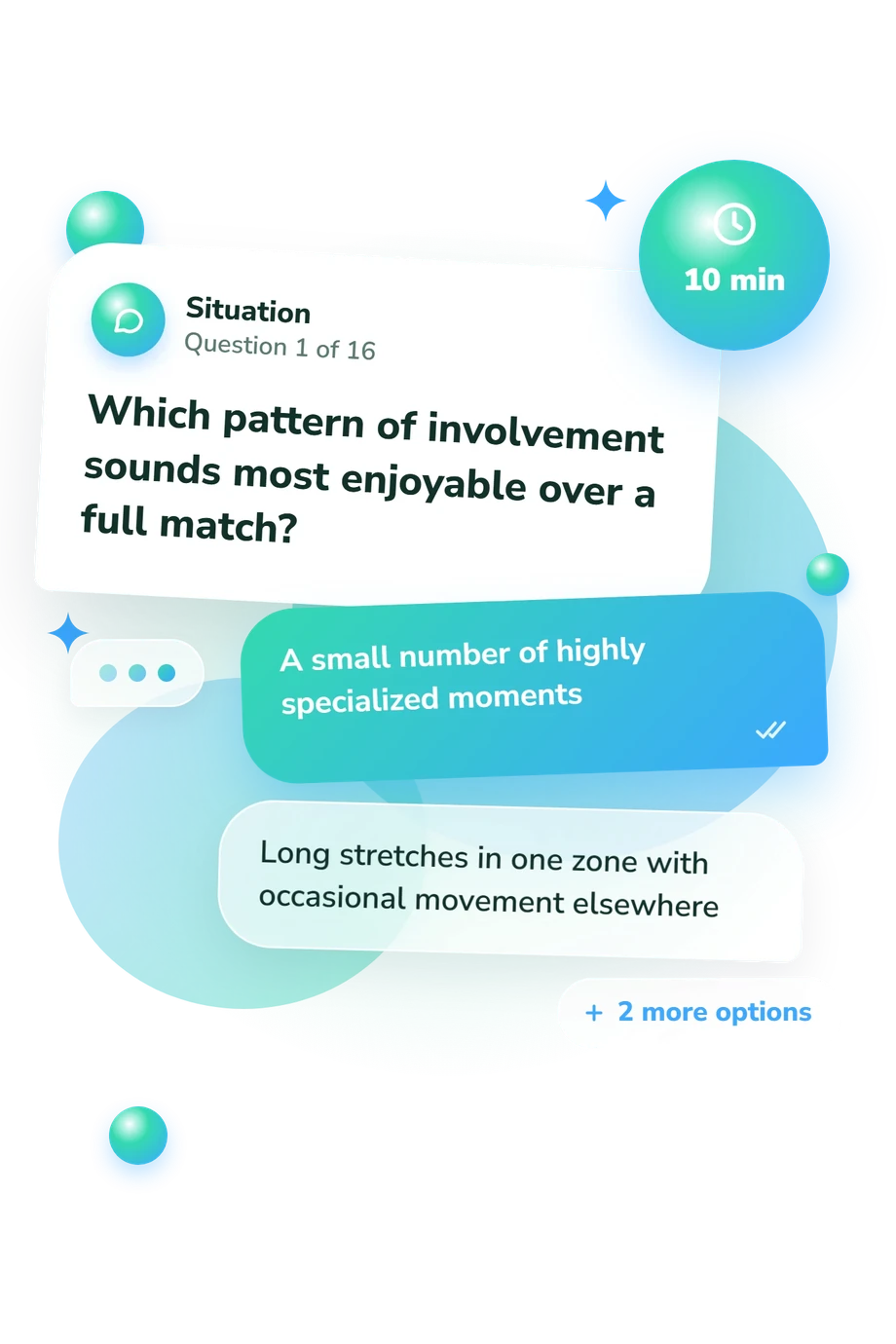
- A small number of highly specialized moments
- Long stretches in one zone with occasional movement elsewhere
- Regular touches combined with a fairly defined responsibility
- Constantly shifting to connect defense, attack, and nearby teammates
- Drop well behind the play to help secure possession
- Stay level with the ball as a safe passing option
- Move into a pocket where I can receive and combine
- Time a run behind the defense and ask for the decisive pass
- Staying farther upfield so I can help create the next attack
- Moving back to provide support around the goal area
- Reading the shooter’s body shape and narrowing the angle
- Being the final obstacle and committing fully to the save
What Position Are You Quiz - Description and methodology of the test
Readers who want to connect their playing instincts with a football role can use the What Position Are You Quiz to compare responses to pressure, space, teamwork, and decisive moments. As a soccer position quiz, this assessment explains the responsibilities behind a label rather than merely naming a preferred area of the pitch. It helps readers compare which match responsibilities they may prefer when deciding where their interests fit on the pitch.
What This Assessment Explores
These scenarios examine how you imagine contributing across a match, not your technical skill. They cover zones, pressure, runs, challenges, chances, combination play, and responsibility near goal. This football position quiz helps players and fans name natural preferences.
The displayed scales and their result bands are:
- Defender (0-12) measures stopping attacks, tracking danger, space protection, and build-up from the back: Attack-Oriented Pull (0-4), Flexible Protector (5-8), Strong Defender Affinity (9-12).
- Forward (0-12) measures attacking space, chance creation, risk-taking, and scoring responsibility: Build-Up Pull (0-4), Selective Attacker (5-8), Strong Forward Affinity (9-12).
- Goalkeeper (0-12) measures goal protection, threat judgment, isolated pressure, and starting attacks through distribution: Outfield Pull (0-4), Situational Keeper (5-8), Strong Keeper Affinity (9-12).
- Midfielder (0-12) measures connection, scanning, tempo, and involvement across phases: Specialist Pull (0-4), Supportive Connector (5-8), Strong Midfielder Affinity (9-12).
Methodology and Scientific Basis
Each scenario presents a match situation and four response options. The choices contrast specialized moments, defensive containment, connection, and direct attacking or goalkeeping responsibility, asking which role feels appealing rather than testing factual knowledge. This self-report format reflects stated preferences.
Scoring produces a separate result for each role. Compare all four: the highest indicates strongest affinity, while scores within one point form a blended result. The displayed categories are descriptive labels, not population norms.
The questionnaire is conceptually consistent with Taylor, Mellalieu, and James (2004), whose positional analysis distinguishes defensive, attacking, and linking demands. Forcher et al. (2022) support considering individual variation, while Arjol-Serrano et al. (2021) show that formation changes positional demands. The questionnaire uses a comparable positional lens, while its role-affinity scoring remains separate from those studies. This soccer position test offers role-affinity information, not a standardized ability ranking.
Because answers can shift with current experience, imagined match context, and self-awareness, treat the result as focused reflection on preferences-especially when two scores are close-rather than a fixed account of performance or a clinical judgment.
- Taylor, Joseph B., Stephen D. Mellalieu, and Nic James. “Behavioural comparisons of positional demands in professional soccer.” International Journal of Performance Analysis in Sport, 4(1), 81-97, 2004. 10.1080/24748668.2004.11868294
- Forcher, Leon, Leander Forcher, Sascha Härtel, Darko Jekauc, Hagen Wäsche, Alexander Woll, Timo Gross, and Stefan Altmann. “Does Technical Match Performance in Professional Soccer Depend on the Positional Role or the Individuality of the Player?” Frontiers in Psychology, 13, 813206, 2022. 10.3389/fpsyg.2022.813206
- Arjol-Serrano, José Luis, Miguel Lampre, Adrián Díez, Daniel Castillo, Fernando Sanz-López, and Demetrio Lozano. “The Influence of Playing Formation on Physical Demands and Technical-Tactical Actions According to Playing Positions in an Elite Soccer Team.” International Journal of Environmental Research and Public Health, 18(8), 4148, 2021. 10.3390/ijerph18084148
Updated: