
What Cat Am I Quiz
How the Scales are Structured
Who Usually Takes This Test?
See How You Compare
Below is a preview of how scores are typically distributed across each scale.
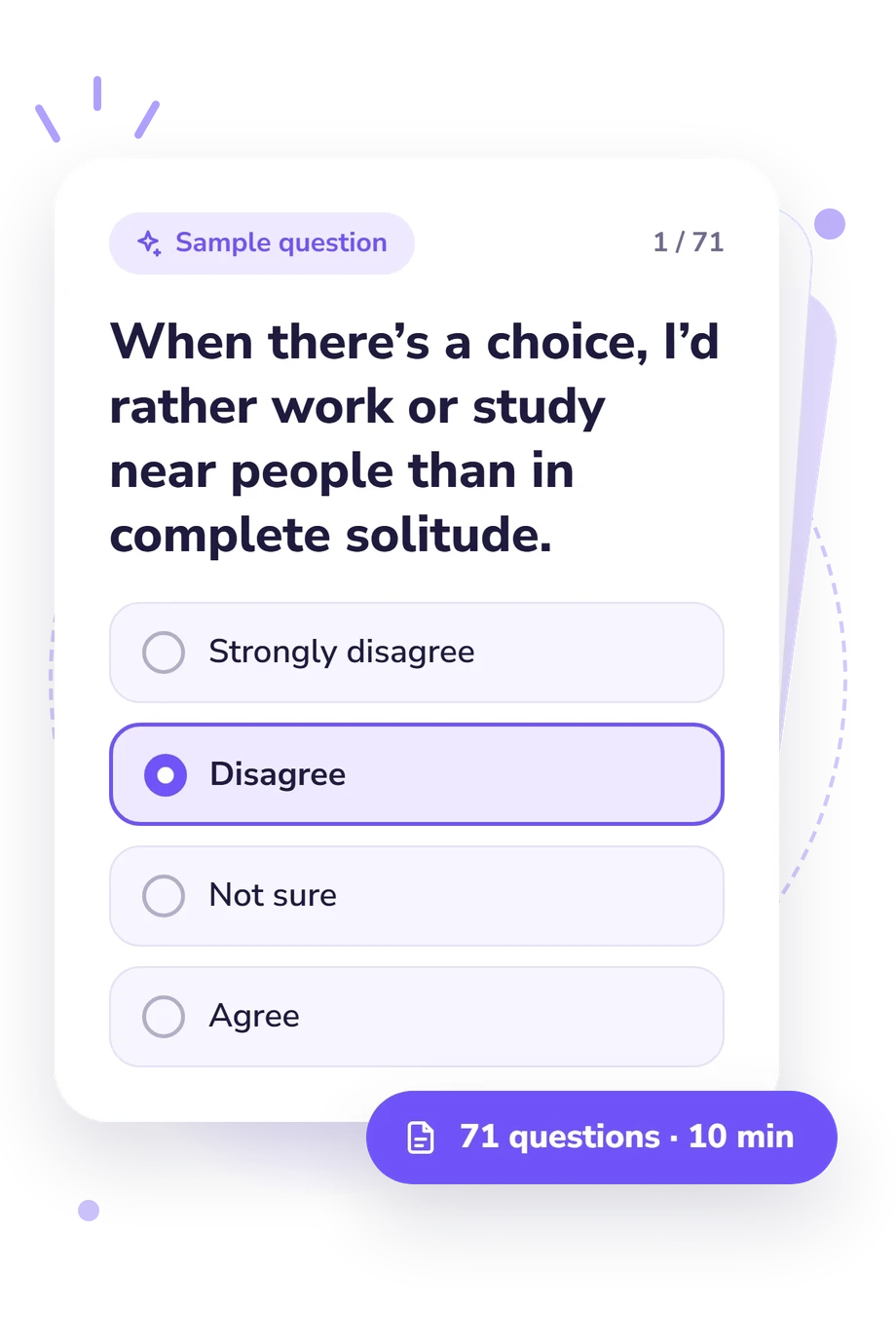
Example Questions From the Test
- Strongly disagree
- Disagree
- Not sure
- Agree
- Strongly disagree
- Disagree
- Not sure
- Agree
- Strongly disagree
- Disagree
- Not sure
- Agree
What Cat Am I Quiz - Description and methodology of the test
People who enjoy online personality tests but prefer an imaginative, low-pressure format can use this questionnaire to explore what their everyday preferences might say about them. The What Cat Am I Quiz is intended for anyone curious about the practical question of which feline qualities feel familiar in their own behavior. It offers a playful reflection on self-image rather than a fixed identity.
What This Assessment Explores
Rather than assigning a breed, this assessment organizes everyday preferences into three feline-themed tendencies. Its feline-themed format makes the result a personality profile of the respondent, examining their approach to novelty, playful unpredictability, and social contact rather than appearance or breed knowledge.
The three dimensions shown in the result are:
- Curiosity & Exploration (0-20) shows whether you are a Comfort-First Homebody (0-6), Balanced Explorer (7-13), or Curious Adventurer (14-20).
- Playful Chaos (0-20) places spontaneity between Steady & Predictable (0-6), Playfully Spontaneous (7-13), and Chaos Gremlin Energy (14-20).
- Sociability (0-20) indicates an Independent (0-7), Balanced (8-14), or Social Butterfly (15-20) pattern of seeking company and affection.
The result translates the three dimensions into a cat-themed profile of routines, energy, and connection. The bands describe tendencies, not value judgments, and mixed scores can be more informative than one high or low result.
Methodology and Evidence Base
Items use first-person statements about exploring unfamiliar options, starting spontaneous activities, approaching people, and enjoying closeness. Four agreement options run from Strongly disagree toward agreement; some include Not sure, while others distinguish Strongly agree. This trait-oriented self-report test turns everyday reactions into the displayed dimension scores.
The questionnaire reports three dimension scores and places them into the displayed bands; no item weighting or detailed scoring procedure is stated for this format. The profile, rather than any single answer, carries the interpretation.
Feline Five (Litchfield et al., 2017) offers a thematic reference for personality in pet cats. The BFI-2 (Soto and John, 2017), Curiosity and Exploration Inventory-II (Kashdan et al., 2009), and Adult Playfulness Scale (Glynn and Webster, 1992) provide conceptual parallels for sociability, exploration, and playfulness. These works are thematic references only, not validation evidence; this questionnaire was not adapted from or validated against them.
Interpretation is descriptive: displayed bands are categories for tendencies rather than cutoffs. Mood, circumstances, and self-awareness can affect self-report results, so the profile is best read as a snapshot rather than a fixed conclusion.
- Carla A. Litchfield, Gillian Quinton, Hayley Tindle, Belinda Chiera, K. Heidy Kikillus, and Philip Roetman. The ‘Feline Five’: An exploration of personality in pet cats (Felis catus). PLOS ONE, 12(8), e0183455, 2017. 10.1371/journal.pone.0183455
- Christopher J. Soto and Oliver P. John. The next Big Five Inventory (BFI-2): Developing and assessing a hierarchical model with 15 facets to enhance bandwidth, fidelity, and predictive power. Journal of Personality and Social Psychology, 113(1), 117-143, 2017. 10.1037/pspp0000096
- Todd B. Kashdan, Matthew W. Gallagher, Paul J. Silvia, Beate P. Winterstein, William E. Breen, Daniel Terhar, and Michael F. Steger. The curiosity and exploration inventory-II: Development, factor structure, and psychometrics. Journal of Research in Personality, 43(6), 987-998, 2009. 10.1016/j.jrp.2009.04.011
- Mary Ann Glynn and Jane Webster. The Adult Playfulness Scale: An Initial Assessment. Psychological Reports, 71(1), 83-103, 1992. 10.2466/pr0.1992.71.1.83
Updated: