
Useless Trivia Quiz
How the Scales are Structured
Who Usually Takes This Test?
See How You Compare
Below is a preview of how scores are typically distributed across each scale.
Example Questions From the Test
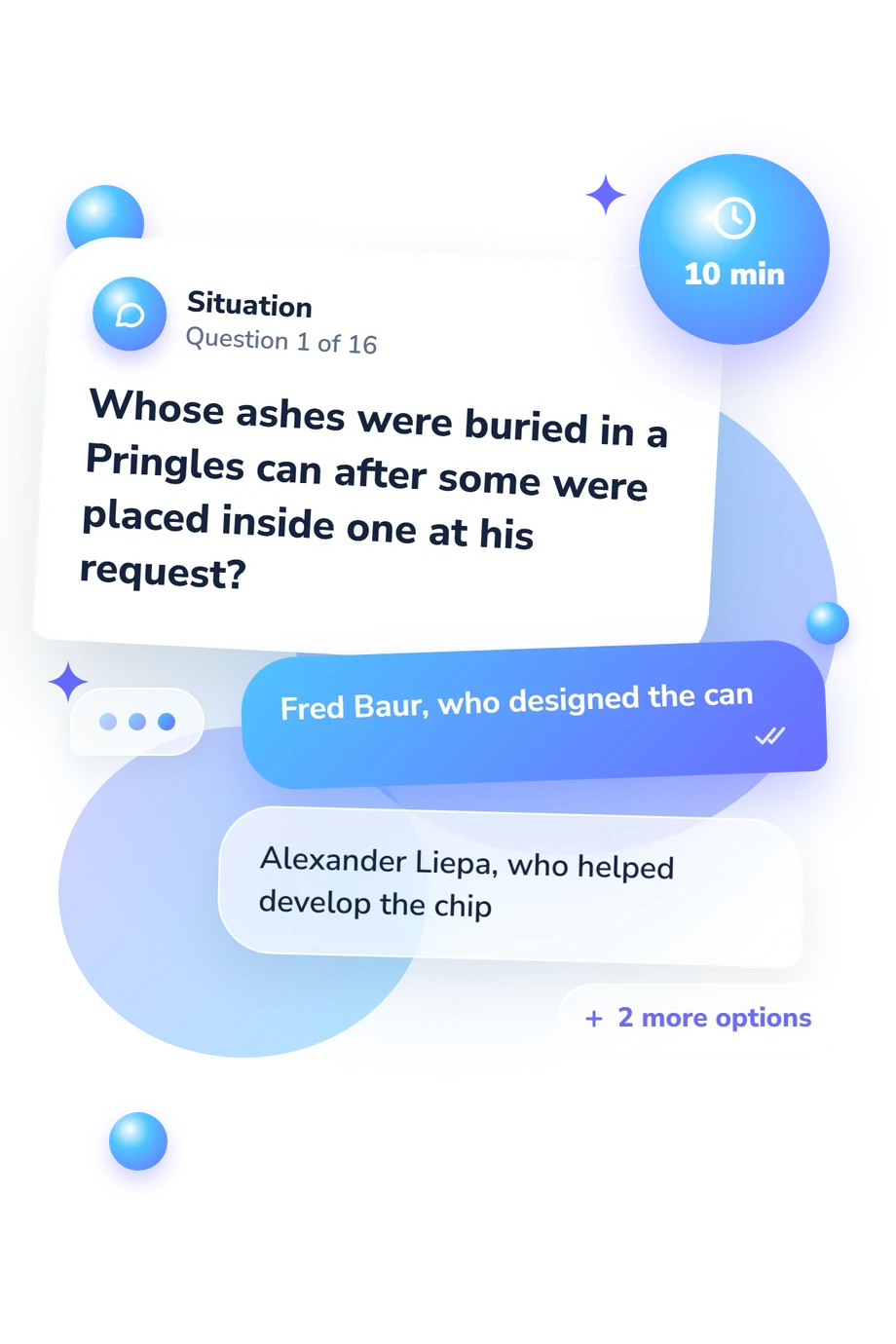
- Fred Baur, who designed the can
- Alexander Liepa, who helped develop the chip
- Julius Pringle, the brand's fictional mascot
- Gene Wolfe, who helped engineer a cooking process
- Cedilla
- Serif
- Tittle
- Tilde
- Mercury
- Venus
- Mars
- Jupiter
Useless Trivia Quiz - Description and methodology of the test
Curious readers who enjoy unusual facts can use this assessment to sample how well they retrieve specific information across subjects that rarely appear together. The useless trivia quiz suits someone seeking a playful challenge, a conversation starter, or a prompt for self-reflection. This questionnaire is a pointless knowledge quiz whose unexpected topics make the challenge entertaining, while the result remains a record of performance on selected facts rather than a broad measure of ability.
What the Test Measures
Rather than measuring personality or intelligence, the questionnaire samples precise, surprising facts that can be easy to confuse. The useless quiz suits anyone who enjoys broad factual challenges and wants to see which areas feel familiar or difficult.
The questions draw on these themes:
- Science and nature show recall of astronomy, biology, physics, and animal behavior.
- Language and terminology reveal knowledge of exact words for objects and symbols.
- Food and classification test whether familiar examples fit technical categories.
- History, brands, and culture draw on memory for origins, names, and traditions.
The Useless Trivia Knowledge scale runs from 0-16 correct answers. Curious Starter covers 0-6, Trivia Tinkerer covers 7-12, and Random-Fact Ringer covers 13-16. These labels describe this quiz only, not general intelligence.
Methodology and Evidence Base
Each item presents a short factual prompt with four answer choices, requiring the respondent to select the alternative that best matches the known fact. This trivia quiz uses a four-choice format that combines recognition with retrieval: unfamiliar wording, partial memory, or distractors can make a known fact harder to access. The score is the number of correct responses, and the bands describe performance on this quiz rather than general ability.
The instrument called General Knowledge of the World offers a relevant comparison; Mariani and colleagues reported it in 2002 as a systematic way to sample broad factual knowledge. This online questionnaire is conceptually consistent with that approach, not an adaptation of the published instrument. Little (2018) supports multiple-choice testing as a way to make difficult-to-retrieve information more accessible, while Koller, Levenson, and Glück (2017) emphasize matching item content to the construct being assessed.
Interpret the outcome as a snapshot of recall for the selected topics. Prior reading, language familiarity, attention, guessing, and current context can affect performance, so the score should not be extended to general intelligence or broader knowledge.
- Mariani, C., Sacco, L., Spinnler, H., & Venneri, A. (2002). General Knowledge of the World: a standardised assessment. Neurological Sciences, 23(4), 161-175. 10.1007/s100720200057
- Little, J. L. (2018). The role of multiple-choice tests in increasing access to difficult-to-retrieve information. Journal of Cognitive Psychology, 30(5-6), 520-531. 10.1080/20445911.2018.1492581
- Koller, I., Levenson, M. R., & Glück, J. (2017). What Do You Think You Are Measuring? A Mixed-Methods Procedure for Assessing the Content Validity of Test Items and Theory-Based Scaling. Frontiers in Psychology, 8, 126. 10.3389/fpsyg.2017.00126
Updated: