
Tagline Quiz
How the Scales are Structured
Who Usually Takes This Test?
See How You Compare
Below is a preview of how scores are typically distributed across each scale.
Example Questions From the Test
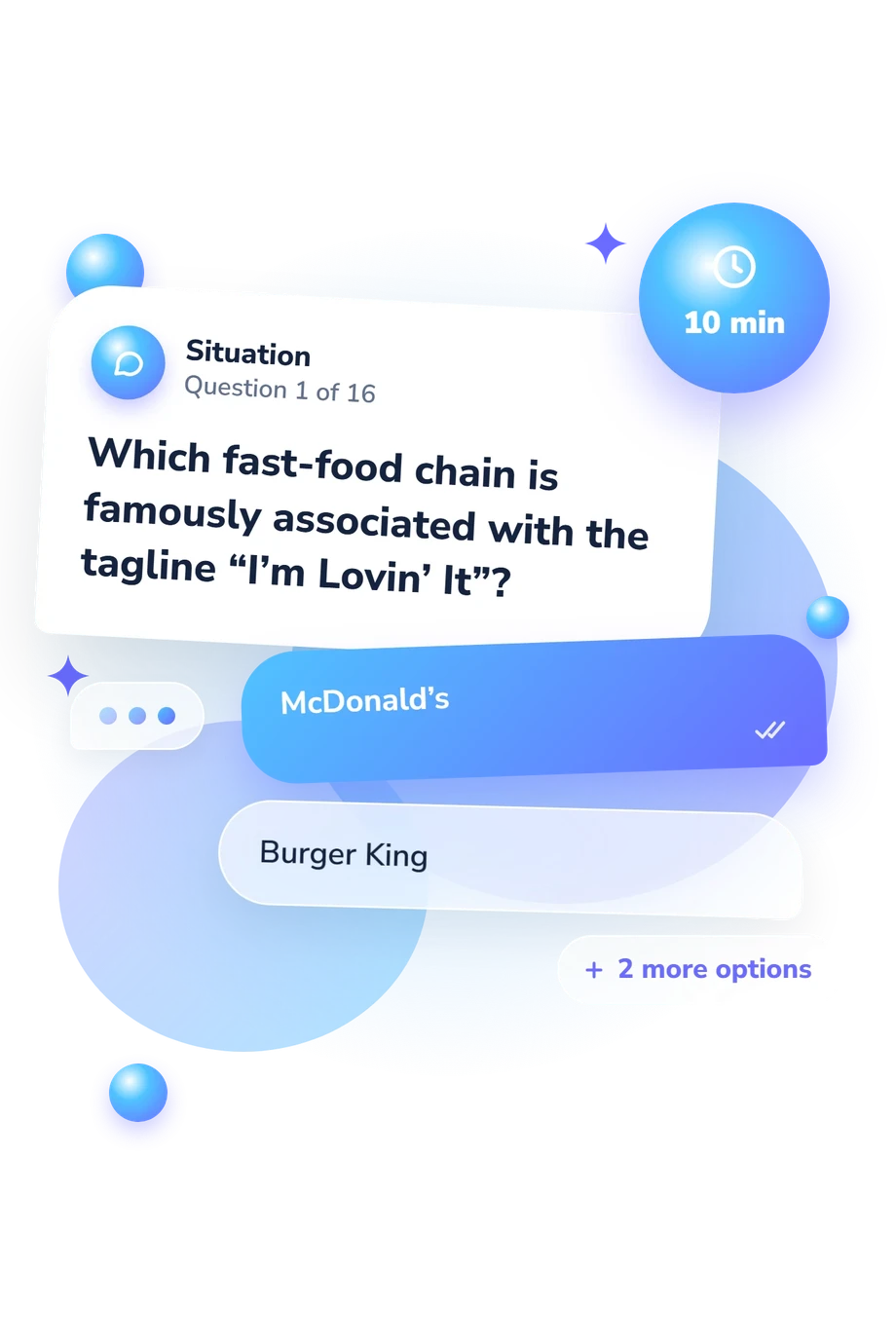
- McDonald’s
- Burger King
- Wendy’s
- Subway
- Tiffany & Co.
- Cartier
- De Beers
- Swarovski
- Popeyes
- Nando’s
- KFC
- Chick-fil-A
Tagline Quiz - Description and methodology of the test
People who enjoy advertising history, branding, or cultural trivia can use the Famous Tagline Quiz to check how readily they recognize well-known commercial slogans. This tag line quiz focuses on matching memorable wording with the company that made it famous. The result offers a focused snapshot of recognition across familiar consumer categories, useful for casual self-reflection and marketing-minded readers.
What This Quiz Measures
The items sample slogans from fast food, confectionery, technology, beauty, finance, automotive, restaurants, and other consumer brands. Some prompts quote a line and ask for its owner; others give a brand and ask which wording belongs with it. Together, these tasks assess recognition of verbal slogans and discrimination between the correct brand and plausible alternatives. This brand slogan quiz rewards linking wording to the correct brand rather than judging whether a campaign is persuasive.
The result is organized under one scale, Famous Tagline Knowledge (0-16). It describes how consistently the respondent identifies established brand-tagline pairings. The displayed bands are:
- Foundation (0-6) indicates recognition of major slogans, with possible confusion among similar categories.
- Developing (7-12) indicates familiarity with advertising classics, while exact wording or less obvious matches remain uneven.
- Strong (13-16) indicates broad, accurate recognition across industries and eras.
Methodology and Evidence Base
The format is a structured multiple-choice assessment: each item presents a slogan-related prompt and four answer choices, with the respondent selecting a brand or completion. Varied contexts do not change the recognition task. Results summarize performance on the knowledge scale; no item-weighting rule is specified, so interpretation should remain limited to the displayed 0-16 score and its supplied bands.
Research by Kohli and colleagues in 2013 examined why some slogans are easier to remember, while Kohli, Leuthesser, and Suri's 2007 work discussed slogan characteristics linked to effective brand communication. The questionnaire is conceptually consistent with this slogan-recall research, not an adaptation or reproduction of either published work. These studies clarify why familiarity, distinctiveness, wording, and brand linkage matter, but they do not establish norms for this version.
Performance on this brand tagline assessment provides a descriptive snapshot of recognized advertising associations. It can reflect exposure to particular markets, generations, languages, and media, as well as attention and guessing; it should not be treated as a standardized measure of intelligence, creativity, or marketing ability.
- Kohli, Chiranjeev, Sunil Thomas, and Rajneesh Suri. “Are You In Good Hands? Slogan Recall: What Really Matters.” Journal of Advertising Research 53, no. 1 (2013): 31-42. 10.2501/JAR-53-1-031-042
- Kohli, Chiranjeev, Lance Leuthesser, and Rajneesh Suri. “Got Slogan? Guidelines for Creating Effective Slogans.” Business Horizons 50, no. 5 (2007): 415-422. 10.1016/j.bushor.2007.05.002
Updated: