
Stock Market Quiz
How the Scales are Structured
Who Usually Takes This Test?
See How You Compare
Below is a preview of how scores are typically distributed across each scale.
Example Questions From the Test
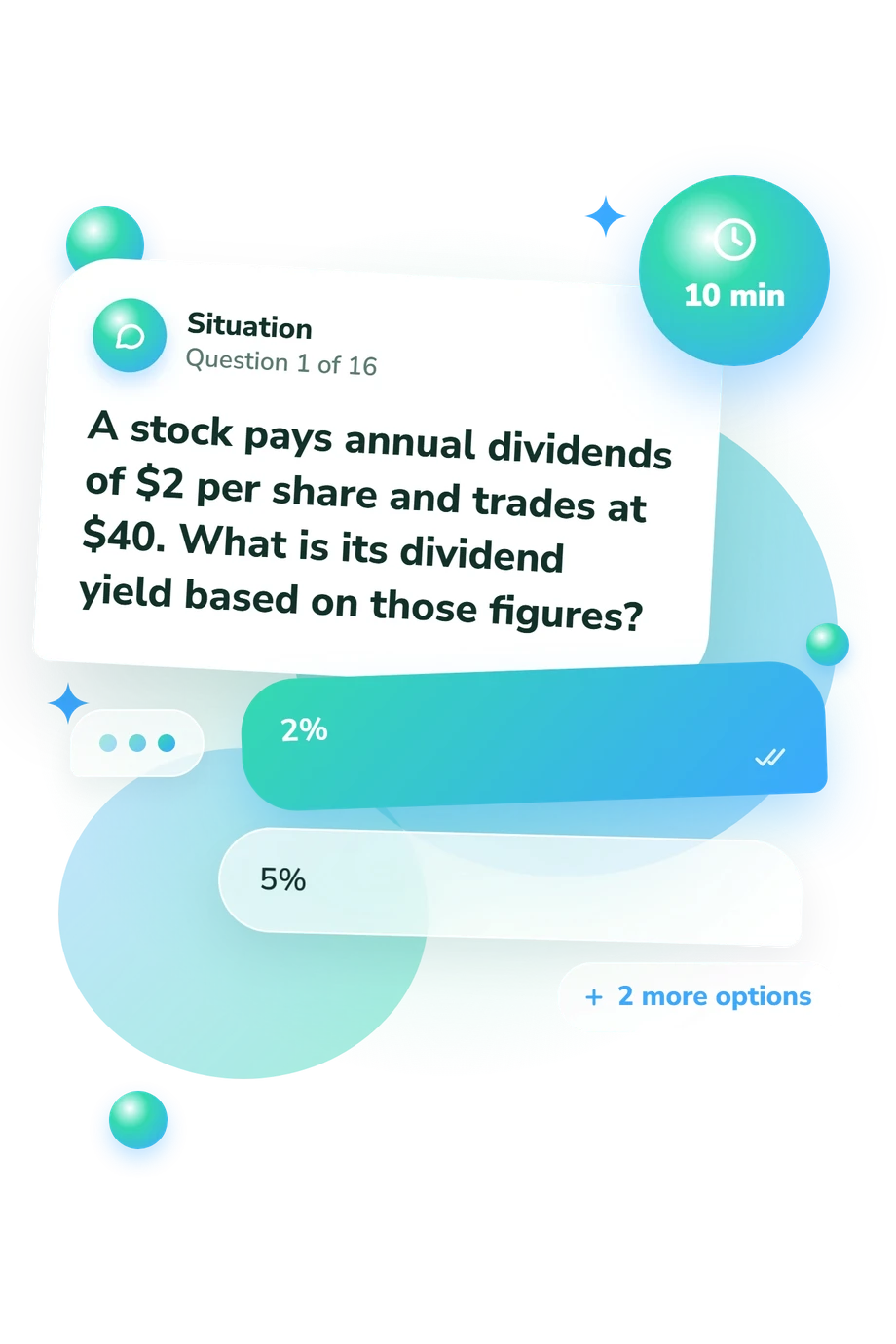
- 2%
- 5%
- 8%
- 20%
- Secured creditors
- Unsecured bondholders
- Preferred shareholders
- Common shareholders
- A fractional ownership interest in a company
- A loan to the company with guaranteed repayment
- A contract guaranteeing a fixed annual dividend
- A deposit insured against market losses
Stock Market Quiz - Description and methodology of the test
People who want to judge how confidently they can apply everyday investing concepts may use this stock market quiz before choosing what to study next. This stock market knowledge quiz can help learners and prospective investors decide which areas deserve closer review. The result places current understanding on a three-band scale and points toward practical topics for further study.
What This Assessment Explores
These items assess practical understanding of shares, companies, and markets for readers learning investing vocabulary or reviewing stock-market concepts. As a stock market knowledge test, it asks whether common principles can be recognized and applied in short numerical and situational examples.
Questions cover ownership, dividends, returns, valuation, diversification, orders, funds, bonds, and compounding, while also touching on short selling, stock splits, and bankruptcy claims. The result shows how well core concepts are handled; it is not financial advice or a prediction of investing success.
The result is presented on Stock Market Knowledge (0-16), with three bands:
- Foundations to build (0-6) indicates that market ideas are partly familiar but several essentials need review.
- Developing knowledge (7-12) shows that many essentials are understood, with some gaps in application or calculation.
- Strong knowledge (13-16) reflects accurate application of core concepts across common scenarios.
Methodology and Evidence Base
Each of the 16 items presents a short investing scenario with four answer choices. The respondent selects the best-fitting option, and the pattern of answers is converted into the displayed educational result. Individual point weights are not defined, so no more detailed scoring rule should be inferred from the range alone.
Ford et al. (2007) studied financial-market knowledge across concepts relevant to this questionnaire. The questionnaire is conceptually consistent with that work, but is not presented as a reproduction or validated adaptation of it. Van Rooij, Lusardi, and Alessie (2011) offer contextual evidence linking financial literacy with stock-market participation; that association does not validate this questionnaire, its items, or its result bands.
The online form has no reported standardization or population norms, and its bands are educational descriptions rather than validated predictive cutoffs. Performance can vary with guessing, attention, prior exposure, and current learning. As a stock market basics quiz, it can help identify topics worth revisiting, especially when a result reveals uncertainty about calculations or order mechanics.
- Matthew W. Ford, Todd Harrison, Steve Devoto, and Daniel W. Kent (2007). Threat, Intimidation, and Student Financial Market Knowledge: An Empirical Study. Journal of Education for Business, 82(3), 131-139. 10.3200/JOEB.82.3.131-139
- Maarten van Rooij, Annamaria Lusardi, and Rob Alessie (2011). Financial literacy and stock market participation. Journal of Financial Economics, 101(2), 449-472. 10.1016/j.jfineco.2011.03.006
Updated: