
State-Trait Anxiety Inventory (STAI) Test
How the Scales are Structured
Who Usually Takes This Test?
See How You Compare
Below is a preview of how scores are typically distributed across each scale.
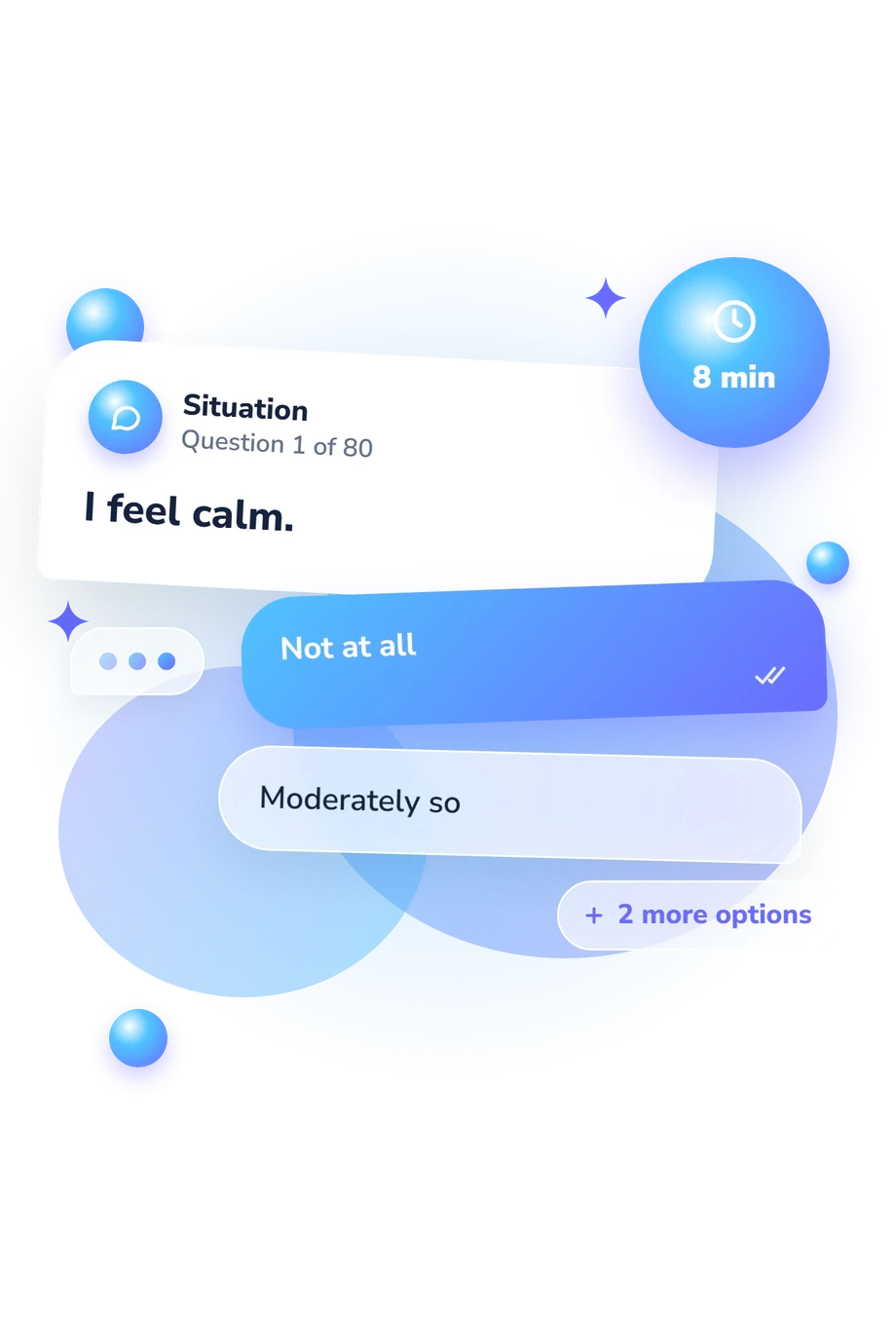
Example Questions From the Test
- Not at all
- Somewhat
- True
- Very much so
- Not at all
- Moderately so
- Somewhat
- Very much so
- Moderately so
- Somewhat
- Not at all
- Very much so
State-Trait Anxiety Inventory (STAI) Test - Description and methodology of the test
People who want to distinguish a passing surge of tension from a more enduring tendency toward anxious reactions may find this assessment useful. The State-Trait Anxiety Inventory (STAI) Test separates anxiety linked to the present situation from a general disposition to perceive situations as threatening. Together, the state and trait dimensions of this anxiety assessment offer a structured starting point for self-reflection about stress, worry, and emotional steadiness.
What This Assessment Explores
The questionnaire separates two related dimensions. State anxiety reflects tension, worry, nervousness, and uneasiness linked to circumstances, while trait anxiety reflects a steadier tendency to view situations as threatening. The wording touches calmness, security, satisfaction, restlessness, self-confidence, and everyday worry. The trait dimension helps show whether the anxiety profile is mainly situational or more recurring.
The result presents four related views:
- Trait Anxiety (Sten), 0-10, compares trait anxiety with normative groups: Low 0-3, Average 4-6, High 7-10.
- State Anxiety (STEN), 0-10, compares current anxiety with normative data: Low 0-3, Moderate 4-6, High 7-10.
- Trait Anxiety, 20-80, reflects a stable anxious tendency: Low 20-30, Moderate 31-45, High 46-80.
- State Anxiety, 20-80, reflects current stress-related anxiety: Low 20-30, Moderate 31-45, High 46-80.
Methodology and Scientific Basis
The items separate feelings in the present moment from usual emotional tendencies. Present-state prompts use graded choices such as not at all to very much so, while trait prompts use frequency choices from almost never to almost always. This contrast distinguishes a temporary reaction from a broader pattern.
In this inventory, answers produce state and trait results in raw-score and STEN formats. Higher values indicate more anxiety within the relevant dimension. This anxiety questionnaire does not publish an item-by-item weighting rule, so point values should not be inferred from ranges or labels.
The source instrument is the State-Trait Anxiety Inventory (STAI; Spielberger et al., 1983), with the earlier manual by Spielberger, Gorsuch, and Lushene (1970) providing foundational guidance. Vagg, Spielberger, and O’Hearn (1980) examined its dimensional structure, supporting the distinction between state and trait anxiety. The cited manuals and study describe the published STAI and do not establish separate standardization or revalidation of this online implementation. Self-report results can shift with current stress and self-awareness, so consider them alongside personal circumstances.
- Spielberger, Charles D., Richard L. Gorsuch, Robert E. Lushene, Peter R. Vagg, and Gerard A. Jacobs. Manual for the State-Trait Anxiety Inventory (Form Y). Palo Alto, CA: Consulting Psychologists Press, 1983.
- Spielberger, Charles D., Richard L. Gorsuch, and Robert E. Lushene. STAI Manual for the State-Trait Anxiety Inventory (Self-Evaluation Questionnaire). Palo Alto, CA: Consulting Psychologists Press, 1970.
- Vagg, Peter R., Charles D. Spielberger, and Thomas P. O'Hearn Jr. Is the State-Trait Anxiety Inventory multidimensional? Personality and Individual Differences, 1(3), 207-214, 1980. 10.1016/0191-8869(80)90052-5
Updated: