
Which Pop Star Are You Quiz
How the Scales are Structured
Who Usually Takes This Test?
See How You Compare
Below is a preview of how scores are typically distributed across each scale.
Example Questions From the Test
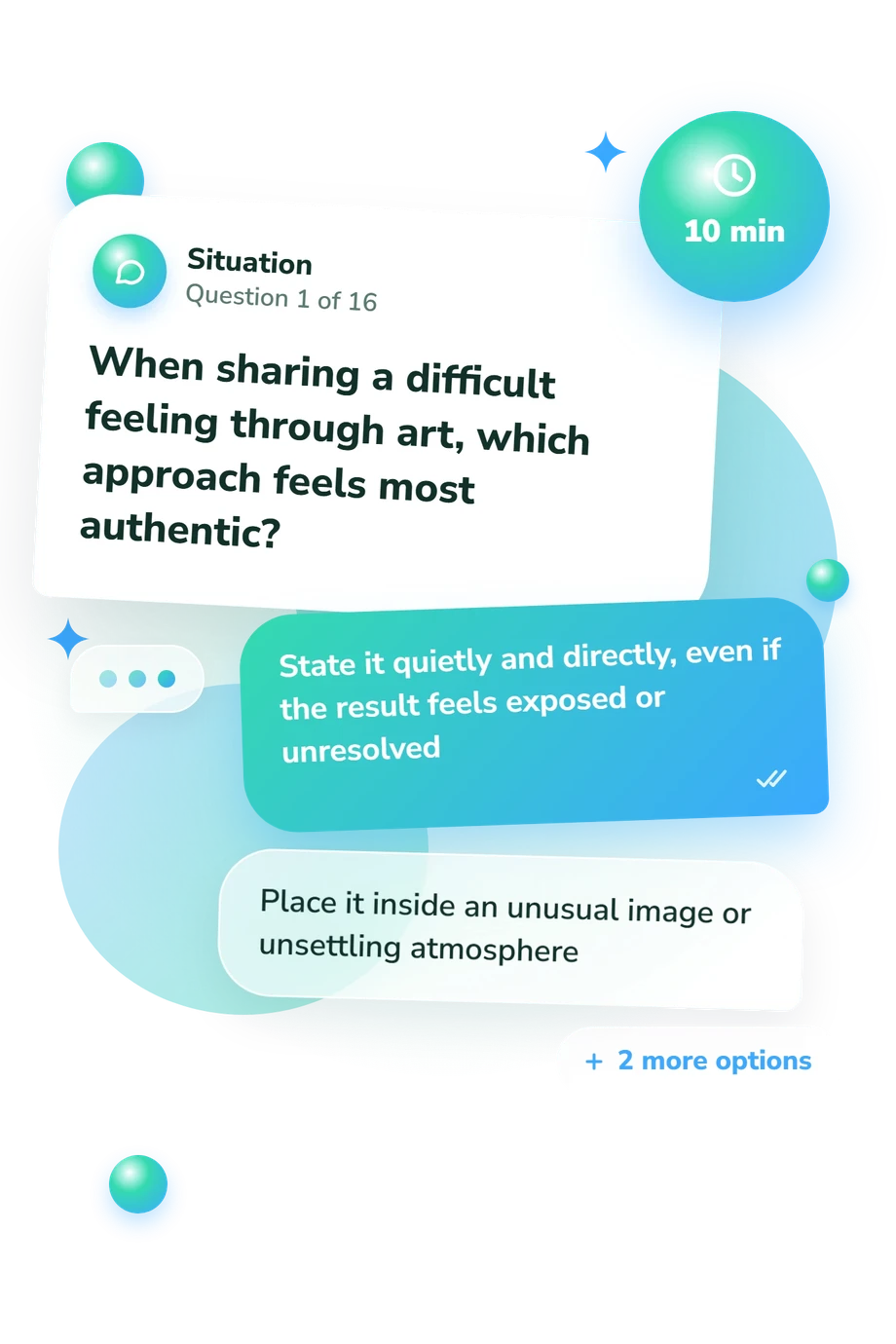
- State it quietly and directly, even if the result feels exposed or unresolved
- Place it inside an unusual image or unsettling atmosphere
- Build toward a large emotional release that makes the feeling unmistakable
- Transform it into an uplifting message that moves beyond the original mood
- Invite them into a shared activity without putting attention on their difference
- Talk one-to-one and look for an interest you already share
- Openly appreciate what makes their perspective distinctive
- Help create a space where their difference can be celebrated rather than minimized
- An unusual sonic texture that creates an immediate atmosphere
- A memorable vocal performance that carries the emotion
- A powerful hook that fits many moments and moods
- Detailed lyrics that unfold like a scene or confession
Which Pop Star Are You Quiz - Description and methodology of the test
Curious music fans can use the Which Pop Star Are You Quiz to explore how their creative preferences, social instincts, and performance choices resemble four recognizable artist personas. The question behind a what pop star am i quiz can be more useful when it opens reflection on self-expression rather than treating celebrity resemblance as a fixed identity. It offers a playful profile for reflection, conversation, and comparing different styles.
What This Assessment Explores
Items address emotional candor, inclusion, experimentation, leadership, reinvention, storytelling, preparation, atmosphere, and presentation. As a which female pop star are you quiz, it compares expressive affinities rather than fame or musical skill. The four result dimensions are:
- Beyoncé (0-12) reflects disciplined preparation, commanding presence, and purposeful leadership; Different rhythm (0-4), Shared power (5-8), and Strong affinity (9-12) indicate increasing affinity.
- Billie Eilish (0-12) reflects intimate candor, atmospheric minimalism, and resistance to convention; Different frequency (0-4), Shared atmosphere (5-8), and Strong affinity (9-12) indicate increasing affinity.
- Lady Gaga (0-12) reflects theatrical expression, bold experimentation, and community-minded individuality; Different stage (0-4), Shared sparkle (5-8), and Strong affinity (9-12) indicate increasing affinity.
- Taylor Swift (0-12) reflects narrative thinking, thoughtful detail, and intentional reinvention; Different wavelength (0-4), Shared notes (5-8), and Strong affinity (9-12) indicate increasing affinity.
Methodology and Scientific Basis
Each item presents a concrete situation with four contrasting responses. Themes include emotional communication, collaboration, risk, change, audience, preparation, and atmosphere. Presented as a what popstar are you quiz, the result compares styles rather than testing musical knowledge.
Methodologically, the structure is conceptually consistent with the Celebrity-Persona Identification Scale (Brown & Bocarnea, 2007), which frames public-figure connection as identification, not shared biography. Bui (2017) adds similarity and parasocial interaction; Greenberg et al. (2016) connect musical preferences with personality-related tendencies. This questionnaire is neither a direct administration nor an adaptation of those instruments.
Scoring compares the four totals: the highest is the strongest affinity, and totals within one point form a blended result. Exact answer weights are not stated, so choices cannot be reverse-engineered into a point rule. Presented as a which pop singer are you quiz, the result produces a comparative profile, not a categorical identity.
Because no normative sample, reliability coefficients, or clinical cutoffs are supplied, the bands support reflection rather than population-level interpretation. Results may shift with mood, context, response bias, and self-awareness; the profile is not a diagnosis.
- Brown, William J., and Mihai C. Bocarnea. (2007). Celebrity-Persona Identification Scale. In Rodney A. Reynolds, Robert Woods, and Jason D. Baker (Eds.), Handbook of Research on Electronic Surveys and Measurements (pp. 302-305). Idea Group Reference. 10.4018/978-1-59140-792-8.ch037
- Bui, Ngoc H. (2017). Exploring Similarity Characteristics, Identification, and Parasocial Interactions in Choice of Celebrities. Psychology of Popular Media Culture, 6(1), 21-31. 10.1037/ppm0000082
- Greenberg, David M., Michal Kosinski, David J. Stillwell, Brian L. Monteiro, Daniel J. Levitin, and Peter J. Rentfrow. (2016). The Song Is You: Preferences for Musical Attribute Dimensions Reflect Personality. Social Psychological and Personality Science, 7(6), 597-605. 10.1177/1948550616641473
Updated: