
Olympics Quiz
How the Scales are Structured
Who Usually Takes This Test?
See How You Compare
Below is a preview of how scores are typically distributed across each scale.
Example Questions From the Test
- Unity, Honor, Victory
- Faster, Higher, Stronger
- Courage, Effort, Excellence
- Peace, Friendship, Sport
- 50 lengths
- 15 lengths
- 30 lengths
- 60 lengths
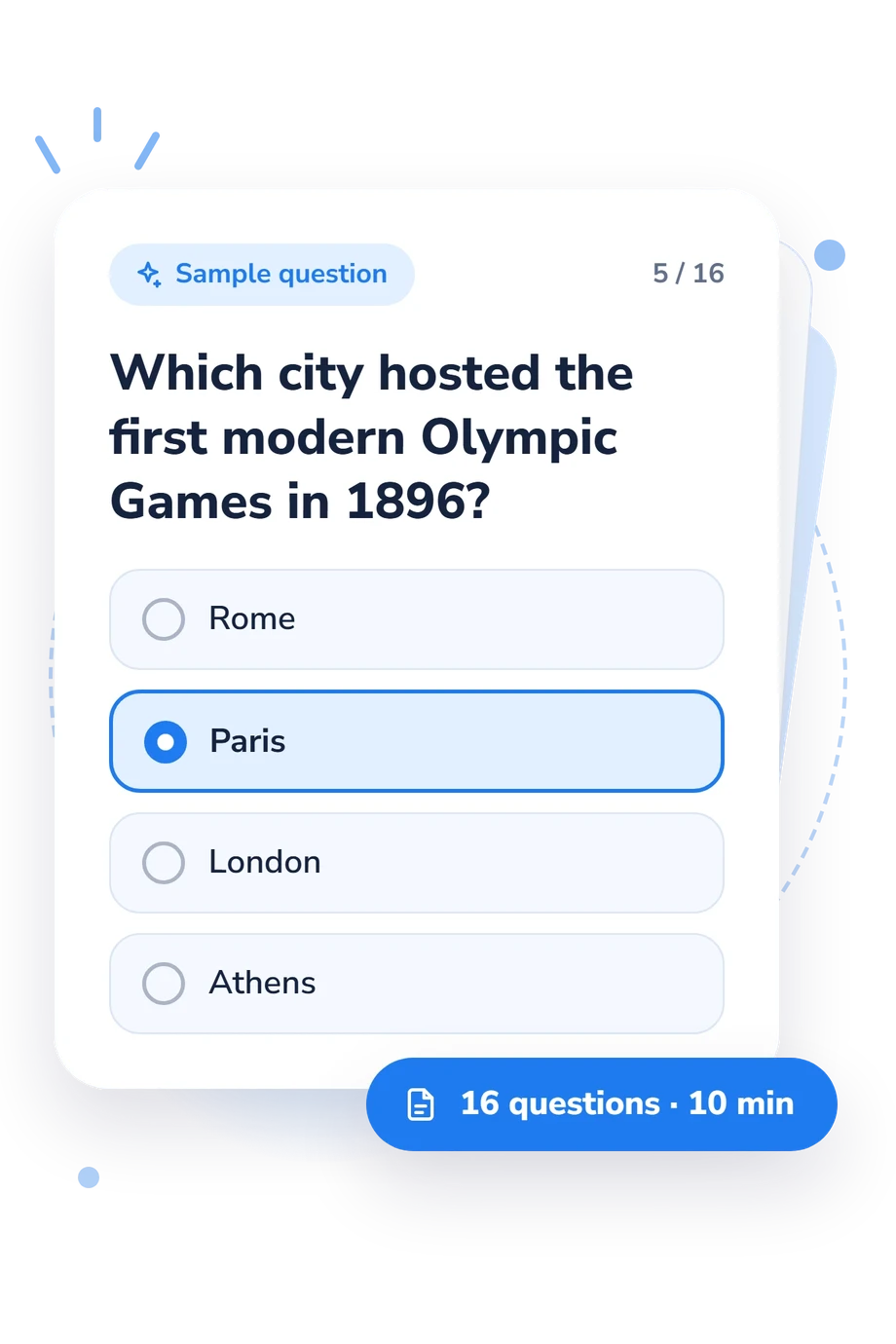
- Geneva
- Lausanne
- Athens
- Paris
Olympics Quiz - Description and methodology of the test
Readers who want a focused way to test their general knowledge can use this Olympics Quiz to answer olympics quiz questions. It suits trivia fans, learners, and families looking for Olympic trivia they can discuss together. The activity works for a quiet individual check or a shared round, while the result provides an overall performance snapshot rather than item-by-item feedback.
What This Assessment Explores
The content samples Olympic knowledge across ancient Olympia, the first modern Games, ceremonies, symbols, sports, event formats, host cities, and institutions. This Olympic knowledge test suits individual play or group trivia, while showing how the result reflects factual knowledge and simple application.
The result is Olympics Knowledge, scored from 0-16. It reflects performance on Olympic knowledge questions involving factual knowledge and simple application within Olympic history, customs, and competition. The displayed bands are:
- Starting Line, 0-6, indicates recognition of some Olympic basics alongside open areas.
- Building Momentum, 7-12, indicates a solid foundation with room to strengthen less familiar topics.
- Podium-Level Recall, 13-16, indicates broad, dependable knowledge across the Games.
These labels describe performance on this questionnaire, not general intelligence or overall Olympic expertise.
Methodology and Evidence Base
Methodologically, this is a self-administered, four-option knowledge test. Each item presents a factual prompt and four possible answers, sometimes asking for simple application, such as calculating pool lengths or identifying a sport from equipment. The stated scoring gives one point for each correct answer.
Respondents select one option rather than writing explanations, so the score captures selected-answer performance.
Across the questionnaire, the Olympic quiz score summarizes total performance. Guessing, wording, previous exposure, and current attention can all affect the total.
For factual context, the questionnaire's subject matter can be read alongside Findling and Pelle (2004); Finley and Pleket (1976) and Young (2004) provide complementary historical context. The 2025 Olympic Charter supports terminology and institutional details. Together, these references situate questions about ancient customs, modern institutions, ceremonies, sports, and competition.
Families may use the general-interest quiz together, especially as a shared trivia activity.
- Findling, John E., and Kimberly D. Pelle, eds. Encyclopedia of the Modern Olympic Movement. Westport, CT: Greenwood Press, 2004. ISBN 0-313-32278-3.
- Finley, Moses I., and Henry Willy Pleket. The Olympic Games: The First Thousand Years. New York: Viking Press, 1976. ISBN 0-670-52406-9.
- Young, David C. A Brief History of the Olympic Games. Malden, MA: Blackwell Publishing, 2004. 10.1002/9780470774823.
- International Olympic Committee. Olympic Charter: In Force as from 30 January 2025. Lausanne: International Olympic Committee, 2025.
Updated: