
Should I Get a Bunny Quiz
How the Scales are Structured
Who Usually Takes This Test?
See How You Compare
Below is a preview of how scores are typically distributed across each scale.
Example Questions From the Test
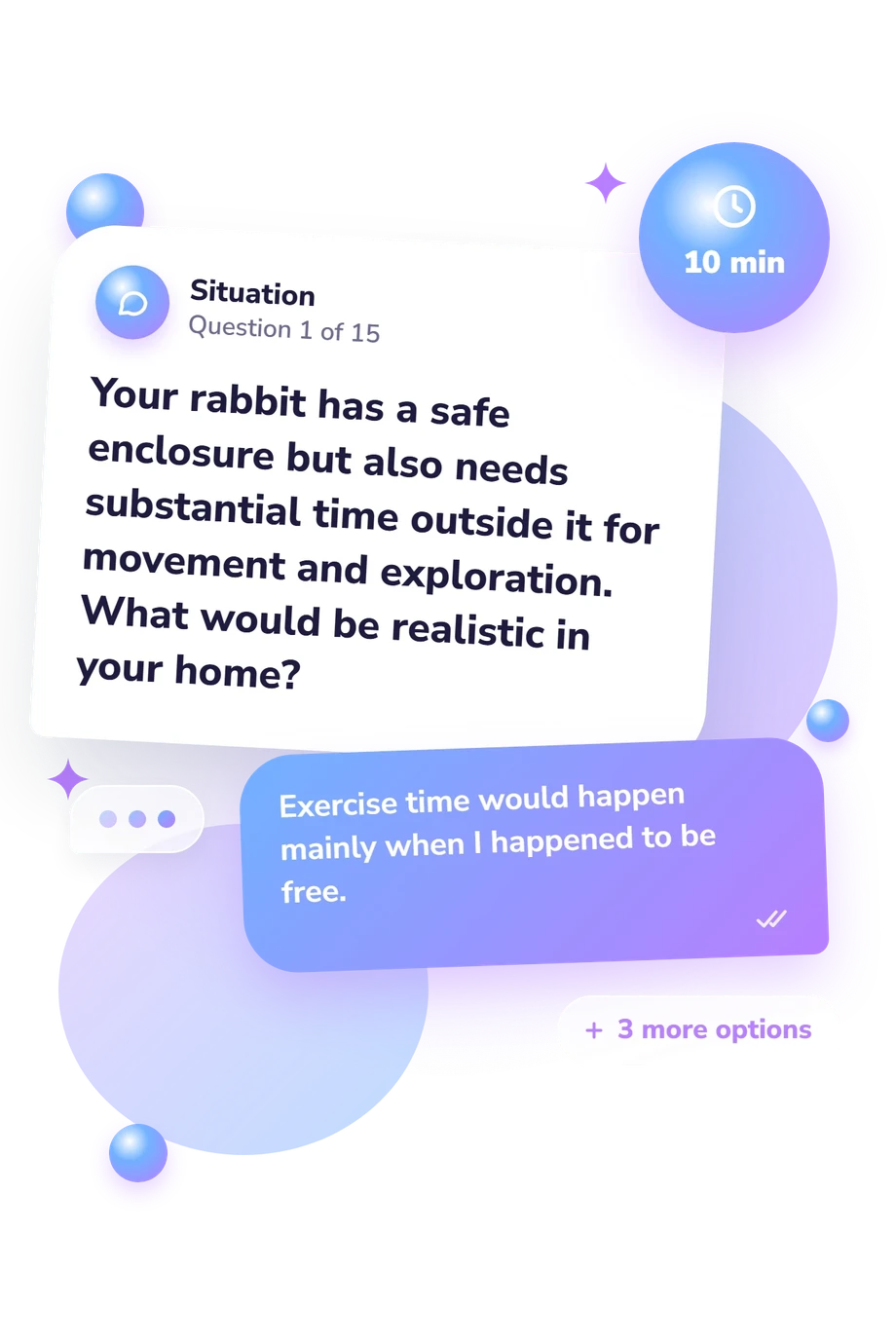
- Exercise time would happen mainly when I happened to be free.
- I could provide a roomy permanent area, but additional supervised exploration might be inconsistent.
- Space and scheduling constraints would make regular exercise difficult.
- I could provide a large home base plus several hours of safe daily exercise or free-roam access.
- I could do it at consistent times and already know where it would fit into my day.
- I could usually manage it, although some busy days would require reminders or backup help.
- My schedule changes often, so I would need to create a dependable system first.
- Regular daily care would be difficult with my current routine.
- The rabbit would need to adapt to the household’s existing activity wherever space was available.
- I could reduce some noise but could not guarantee a retreat from regular disruption.
- I could provide a quieter covered retreat, though it would still be near household activity.
- I could provide secure hiding places and a calm area where the rabbit could withdraw without being pursued or disturbed.
Should I Get a Bunny Quiz - Description and methodology of the test
People considering a rabbit can use this assessment to examine whether their routines, household, finances, and expectations support responsible guardianship. The Should I Get a Bunny Quiz turns that decision into a structured reflection rather than a yes-or-no verdict. It offers the practical perspective expected from an is a rabbit right for me quiz, showing which preparations are solid and which need attention before adoption.
What This Assessment Explores
The questions cover care routines, exercise, health checks, veterinary access, costs, housing, rabbit-proofing, handling, introductions, and future changes. They are useful for the question behind an is a rabbit the right pet for me quiz: whether daily realities match rabbit care.
Three practical dimensions organize the result:
- Daily Rabbit Care Capacity (0-15) shows sustainable daily care: Routine needs work (0-5), Foundation forming (6-10), or Strong routine fit (11-15).
- Long-Term Commitment and Support (0-15) reflects costs, veterinary access, expectations, and backup plans: Major planning gaps (0-5), Commitment developing (6-10), or Well-planned commitment (11-15).
- Rabbit-Suitable Home and Handling (0-15) reflects space, security, gentle interaction, and introductions: Home changes needed (0-5), Partly prepared (6-10), or Supportive environment (11-15).
Together, the results identify preparation priorities.
Methodology and Scientific Basis
Each item presents a household situation with four response options. This self-report format asks the respondent to choose the statement closest to current circumstances; choices represent different levels of preparation or likely behavior. Themes group into routine care, long-term planning, and home and handling conditions.
Responses are grouped within those dimensions and reported separately. Because the questionnaire does not document a per-option weighting formula or population norms, scores organize reflection on readiness rather than estimate a probability of successful ownership. Used as a rabbit readiness quiz, the results can suggest next steps such as confirming rabbit-experienced veterinary care, arranging emergency funds, or improving exercise space.
The content is conceptually consistent with Rooney et al. (2014), which describes welfare, housing, and husbandry concerns in pet rabbits. Mullan and Main (2006), Mayer et al. (2017), and Rioja-Lang et al. (2019) add evidence about owner practices, health, and priority welfare issues. This questionnaire is not presented as an adaptation or validation of those studies. Honest self-report and current circumstances affect the result, which cannot capture every future household or individual rabbit.
- Rooney NJ, Blackwell EJ, Mullan SM, Saunders R, Baker PE, Hill JM, Sealey CE, Turner MJ, Held SDE. The current state of welfare, housing and husbandry of the English pet rabbit population. BMC Research Notes. 2014;7:942. 10.1186/1756-0500-7-942
- Mullan SM, Main DCJ. Survey of the husbandry, health and welfare of 102 pet rabbits. Veterinary Record. 2006;159(4):103-109. 10.1136/vr.159.4.103
- Mayer J, Brown S, Mitchell MA. Survey to Investigate Owners' Perceptions and Experiences of Pet Rabbit Husbandry and Health. Journal of Exotic Pet Medicine. 2017;26(2):123-131. 10.1053/j.jepm.2017.01.021
- Rioja-Lang F, Bacon H, Connor M, Dwyer CM. Rabbit welfare: determining priority welfare issues for pet rabbits using a modified Delphi method. Veterinary Record Open. 2019;6(1):e000363. 10.1136/vetreco-2019-000363
Updated: