
Does My Dog Have ADHD Quiz
How the Scales are Structured
Who Usually Takes This Test?
See How You Compare
Below is a preview of how scores are typically distributed across each scale.
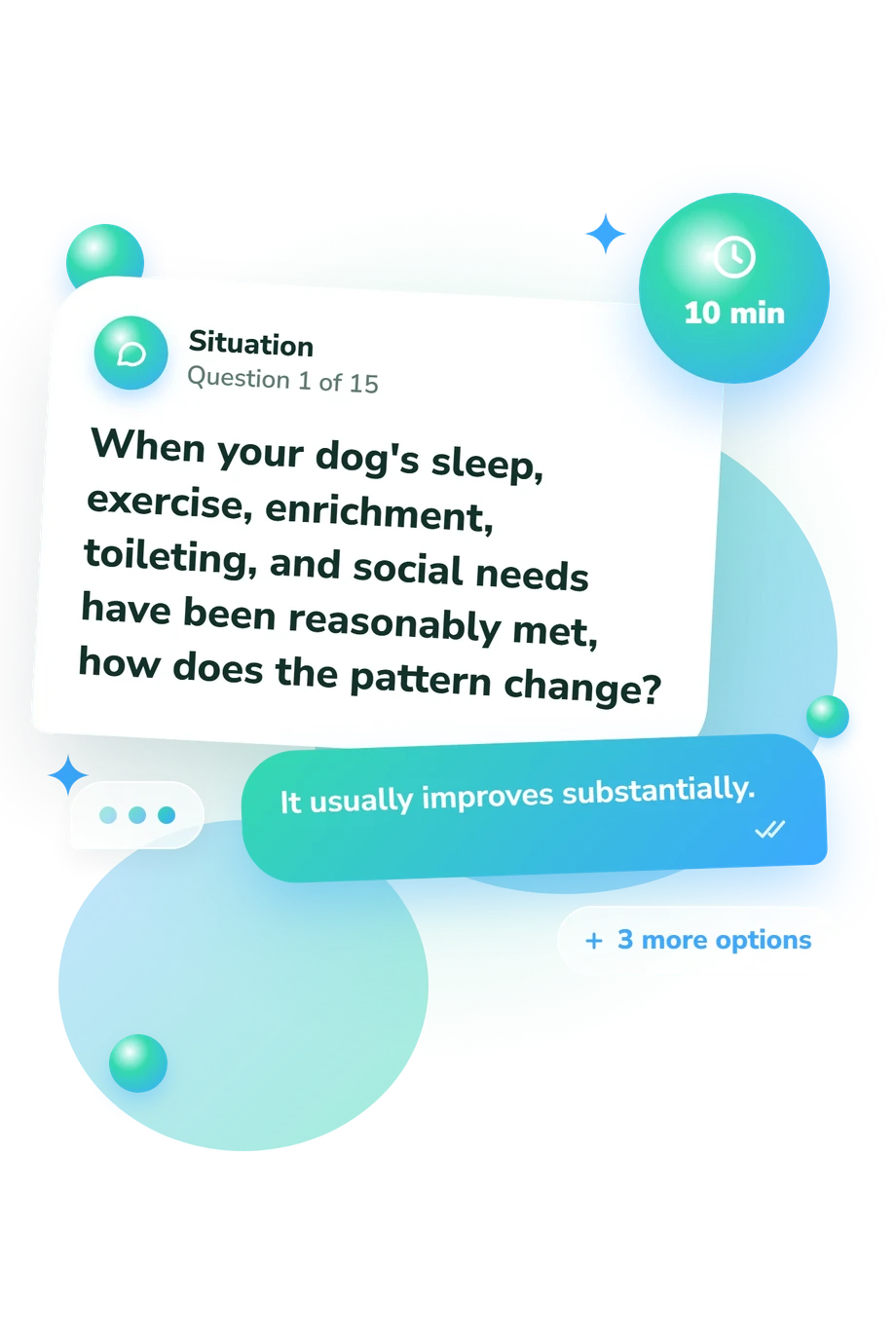
Example Questions From the Test
- It usually improves substantially.
- It remains strong and frequent despite those needs being met consistently.
- It is not generally present once normal needs are met.
- It improves somewhat but continues to affect the day.
- My dog remains intensely active for a long time and seems unable to shift into rest.
- My dog stays lively briefly, then settles with little help.
- My dog usually relaxes or sleeps when the activity ends.
- My dog often needs repeated prompts or a calming routine before settling.
- Sometimes, particularly on unusually stimulating days.
- Rarely or not at all.
- On most days, often through several attempts to settle.
- Several times a week, even when the routine is fairly normal.
Does My Dog Have ADHD Quiz - Description and methodology of the test
Dog guardians who notice persistent restlessness, distractibility, rapid reactions, or trouble calming down may use the Does My Dog Have ADHD Quiz to examine behavior across ordinary routines. Looking at sleep, exercise, training, meals, and calm time can show whether a concern follows the dog through the day or appears only under particular conditions. This dog ADHD quiz places those everyday comparisons in one structured assessment.
What This Assessment Measures
This assessment focuses on how a dog manages energy, attention, pausing, and participation rather than on one exciting episode. Items cover rest after activity, familiar cues, waiting, reorientation after distractions, persistence in enrichment, and effects on routines. This assessment is an ADHD in dogs quiz for guardians comparing calm and stimulating situations; it organizes observations without claiming to explain their cause.
The three result dimensions are:
- Activity and Settling (0-15) shows whether the dog settles after activity, with Occasional activity (0-5), Recurring restlessness (6-10), or Marked settling difficulty (11-15).
- Attention and Impulse Regulation (0-15) indicates how readily the dog sustains attention, pauses, and reorients, with Situational distraction (0-5), Recurring challenges (6-10), or Broad difficulty (11-15).
- Consistency and Daily Impact (0-15) reflects whether concerns are Limited pattern (0-5), Noticeable pattern (6-10), or Persistent impact (11-15) across time and ordinary activities.
Methodology and Evidence Base
Each item presents a situation and four response options describing levels of settling, distraction, impulse control, persistence, duration, or daily interference. The guardian selects the choice that best matches the dog’s pattern rather than an exceptional moment. Scores summarize responses into three bands; higher bands reflect more frequent or disruptive observations, while the displayed scores are unvalidated reflective summaries rather than clinical cutoffs.
The 2022 study replicated the earlier application of a human ADHD questionnaire to dogs, while the DAFRS was described later by Csibra, Bunford, and Gácsi (2024). This questionnaire is conceptually consistent with DAFRS, but it is neither a standardized administration nor a direct adaptation of that instrument or the earlier questionnaire.
This assessment, used as an ADHD test for dogs, lets a guardian record patterns for discussion. Interpretation remains sensitive to honest observation, memory, training history, age, breed, environment, fear, excitement, pain, sleep disruption, medication, and medical conditions; similar behaviors can have different causes. Persistent, sudden, severe, or unsafe changes merit veterinary review and, when appropriate, humane behavior support.
- Csibra, Barbara; Bunford, Nóra; Gácsi, Márta. Development of a human-analogue, 3-symptom domain Dog ADHD and Functionality Rating Scale (DAFRS). Scientific Reports. 2024;14:1808. 10.1038/s41598-024-51924-9
- Csibra, Barbara; Bunford, Nóra; Gácsi, Márta. Evaluating ADHD Assessment for Dogs: A Replication Study. Animals. 2022;12(7):807. 10.3390/ani12070807
- Vas, Judit; Topál, József; Péch, Éva; Miklósi, Ádám. Measuring attention deficit and activity in dogs: A new application and validation of a human ADHD questionnaire. Applied Animal Behaviour Science. 2007;103(1-2):105-117. 10.1016/j.applanim.2006.03.017
Updated: