
4th Grade Science Quiz
How the Scales are Structured
Who Usually Takes This Test?
See How You Compare
Below is a preview of how scores are typically distributed across each scale.
Example Questions From the Test
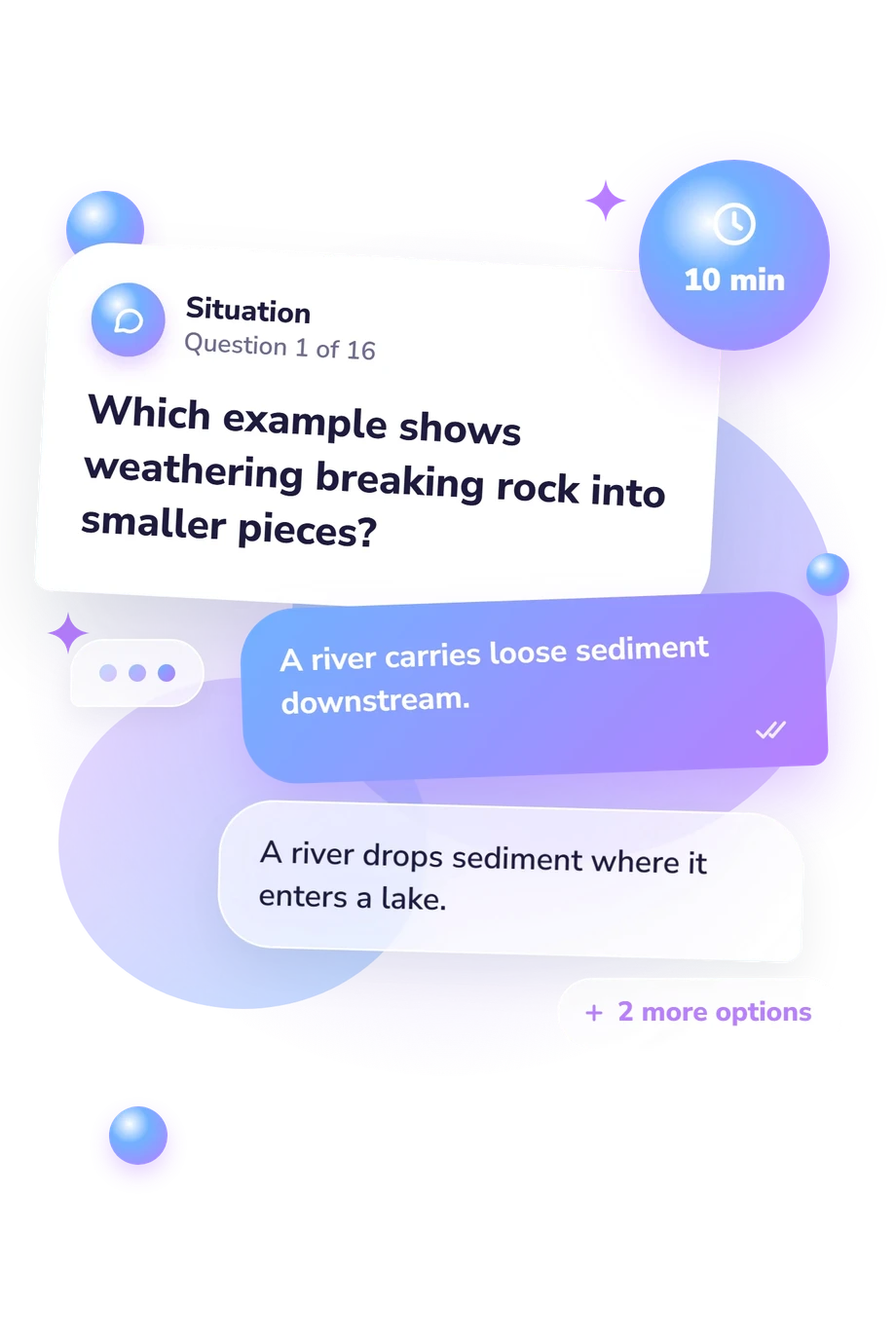
- A river carries loose sediment downstream.
- A river drops sediment where it enters a lake.
- Plant roots grow into a crack and slowly split a rock.
- Melted rock cools and becomes solid.
- Oxygen in the air froze onto the glass.
- Liquid water passed directly through the solid glass.
- The glass changed into liquid water as it cooled.
- Water vapor in the air cooled and condensed on the glass.
- A rain gauge
- A thermometer
- A wind vane
- An anemometer
4th Grade Science Quiz - Description and methodology of the test
Students, parents, and teachers seeking a science grade 4 quiz can use this assessment to check how securely core ideas and simple scientific reasoning are understood. Designed for learners working at the fourth-grade level, it offers a clear starting point for review. The 4th grade science quiz connects classroom knowledge with observable situations, explanations, and fair investigations.
What This Assessment Explores
The items cover familiar school science situations rather than specialist knowledge. In the 4th-grade science quiz questions, learners identify processes, interpret observations, select tools, explain cause and effect, and choose fair tests. The result reflects content recall and elementary application.
The main thematic groups are:
- Earth and space items examine weathering, atmospheric water, shadows, moonlight, and Earth’s rotation.
- Matter and energy items show how heating, motion, gravity, magnets, and circuits affect outcomes.
- Life science items consider body functions, inherited traits, food chains, and decomposition.
- Investigation items ask learners to control variables, compare conditions, and choose measurements for a fair test.
The displayed scale is 4th Grade Science Knowledge (0-16). Foundation Building (0-6) points toward reviewing vocabulary and concrete examples; Developing Knowledge (7-12) indicates growing command with application gaps; Strong Knowledge (13-16) indicates a solid grasp of sampled concepts and reasoning.
Methodology and Scientific Basis
Each item presents four answer options, and the learner selects the best explanation, prediction, tool, or investigation design. The format checks recognition of principles as well as recall of terms, making this a short fourth grade science test rather than an open-ended task.
Scoring uses a simple correct-answer total: each correct response contributes one point to the raw total. It is transparent classroom-style scoring, not a norm-referenced estimate or standardized school placement measure.
Its evidence base is conceptually consistent with Science Process Assessment (Smith & Welliver, 1990), a published reference for evaluating elementary science processes. This questionnaire is not that instrument or a standardized adaptation. Its content also corresponds with the grade-band organization in the National Assessment Governing Board’s 2019 science framework and with the National Research Council’s 2012 framework for organizing science learning.
Interpret the result alongside missed topics, instruction, and classroom work. Guessing, reading comprehension, prior teaching, and momentary attention can affect performance, so the score describes these items rather than complete scientific understanding.
- Smith, Kathleen A., and Paul W. Welliver. “The development of a science process assessment for fourth-grade students.” Journal of Research in Science Teaching, vol. 27, no. 8, 1990, pp. 727-738. 10.1002/tea.3660270803
- National Assessment Governing Board. Science Framework for the 2019 National Assessment of Educational Progress. Washington, DC: National Assessment Governing Board, 2019.
- National Research Council. A Framework for K-12 Science Education: Practices, Crosscutting Concepts, and Core Ideas. Washington, DC: The National Academies Press, 2012. 10.17226/13165
Updated: