
Diabetes Quiz for Nurses
How the Scales are Structured
Who Usually Takes This Test?
See How You Compare
Below is a preview of how scores are typically distributed across each scale.
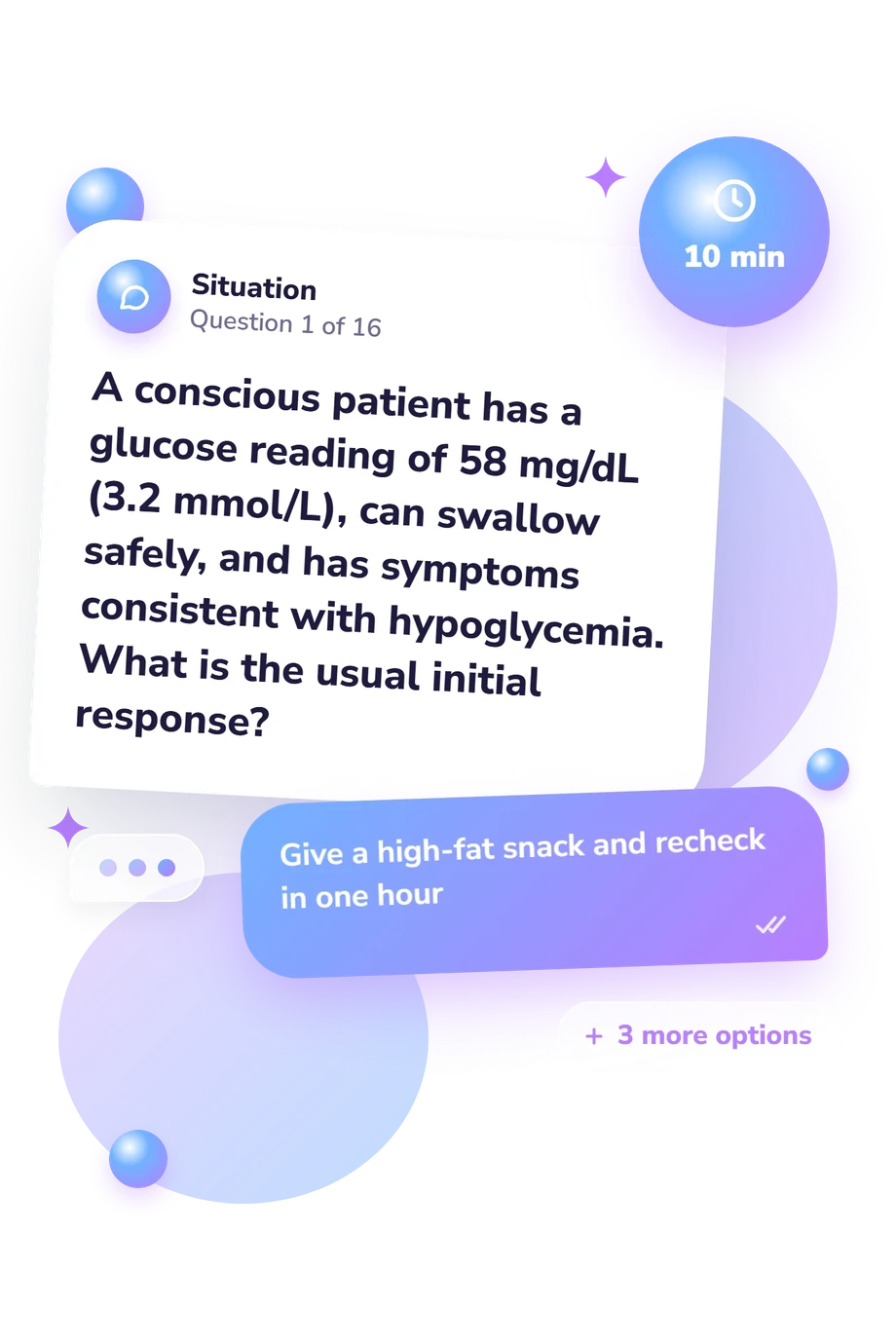
Example Questions From the Test
- Glucose status at the exact moment the sample is collected
- Only fasting glucose during the previous week
- Lifetime exposure to elevated glucose
- Average glycemia over roughly the preceding two to three months
- To reduce lipohypertrophy and unpredictable insulin absorption
- To prevent insulin from entering the bloodstream
- To make every insulin dose act at exactly the same speed
- To eliminate the need to inspect injection sites
- Hypoglycemia, respiratory alkalosis, and absent ketones
- Hyperglycemia, isolated hypertension, and metabolic alkalosis
- Hyperglycemia, ketone production, and metabolic acidosis
- Normal glucose, hypercalcemia, and respiratory acidosis
Diabetes Quiz for Nurses - Description and methodology of the test
Nurses and nursing students who want to check their working knowledge of diabetes can use this diabetes quiz for nurses as a focused learning review. It suits readers preparing for clinical placements, continuing education, or a return to diabetes care. The diabetes mellitus quiz for nurses presents bedside decisions as one overall educational review, not as separate topic scores.
What This Assessment Explores
Practical diabetes knowledge is the focus, not symptoms, personality, or attitudes. The intended reader is anyone reviewing how to recognize, explain, or respond to common nursing situations involving glucose control, insulin, monitoring, acute complications, prevention, and patient teaching. Within the diabetes mellitus quiz, these content areas contribute to one overall knowledge score rather than separate domain results.
The four content areas contributing to that overall score are:
- Acute glucose management shows whether the respondent can choose appropriate first actions for hypoglycemia, ketosis, delayed meals, and severe illness.
- Insulin safety reflects understanding of timing, injection-site rotation, basal treatment, exercise planning, and sharps disposal.
- Monitoring and prevention cover HbA1c and sensor readings, foot protection, kidney screening, and patient education.
- Core disease knowledge tests recognition of type 1 mechanisms, metformin’s main action, diabetic ketoacidosis, and hyperosmolar hyperglycemic state.
Methodology and Scientific Basis
Each item combines a brief clinical or teaching scenario with four answer choices, or presents a direct knowledge question with four choices. Selecting the best option tests recognition and applied judgment rather than confidence. The displayed Diabetes Nursing Knowledge score ranges from 0-16 and uses Foundation to build (0-6), Developing knowledge (7-12), and Strong knowledge (13-16).
The content is conceptually consistent with Scheiderich and colleagues’ nurse diabetes-knowledge assessment, but this online questionnaire is not an adaptation of that work. Work by Drass and colleagues and El-Deirawi and Zuraikat provides relevant supporting evidence because these studies examine relationships between perceived diabetes knowledge and tested performance, showing why confidence should not be treated as evidence of mastery.
It combines mechanisms, medication actions, monitoring, urgent complications, prevention, and patient teaching in one result. This is an unvalidated educational score and is not proof of clinical competence. For nurses using this diabetes nursing quiz to guide general study, the score is best read alongside current protocols, supervised learning, and patient-specific clinical judgment. Prior training, attention, and interpretation can also affect performance.
- Scheiderich SD, Freibaum CN, Peterson LM. Registered nurses' knowledge about diabetes mellitus. Diabetes Care. 1983;6(1):57-61. 10.2337/diacare.6.1.57
- Drass JA, Muir-Nash J, Boykin PC, Turek JM, Baker KL. Perceived and actual level of knowledge of diabetes mellitus among nurses. Diabetes Care. 1989;12(5):351-356. 10.2337/diacare.12.5.351
- El-Deirawi KM, Zuraikat N. Registered nurses' actual and perceived knowledge of diabetes mellitus. Journal of Vascular Nursing. 2001;19(3):95-100. 10.1067/mvn.2001.118311
Updated: