
Geography Bee Quiz
How the Scales are Structured
Who Usually Takes This Test?
See How You Compare
Below is a preview of how scores are typically distributed across each scale.
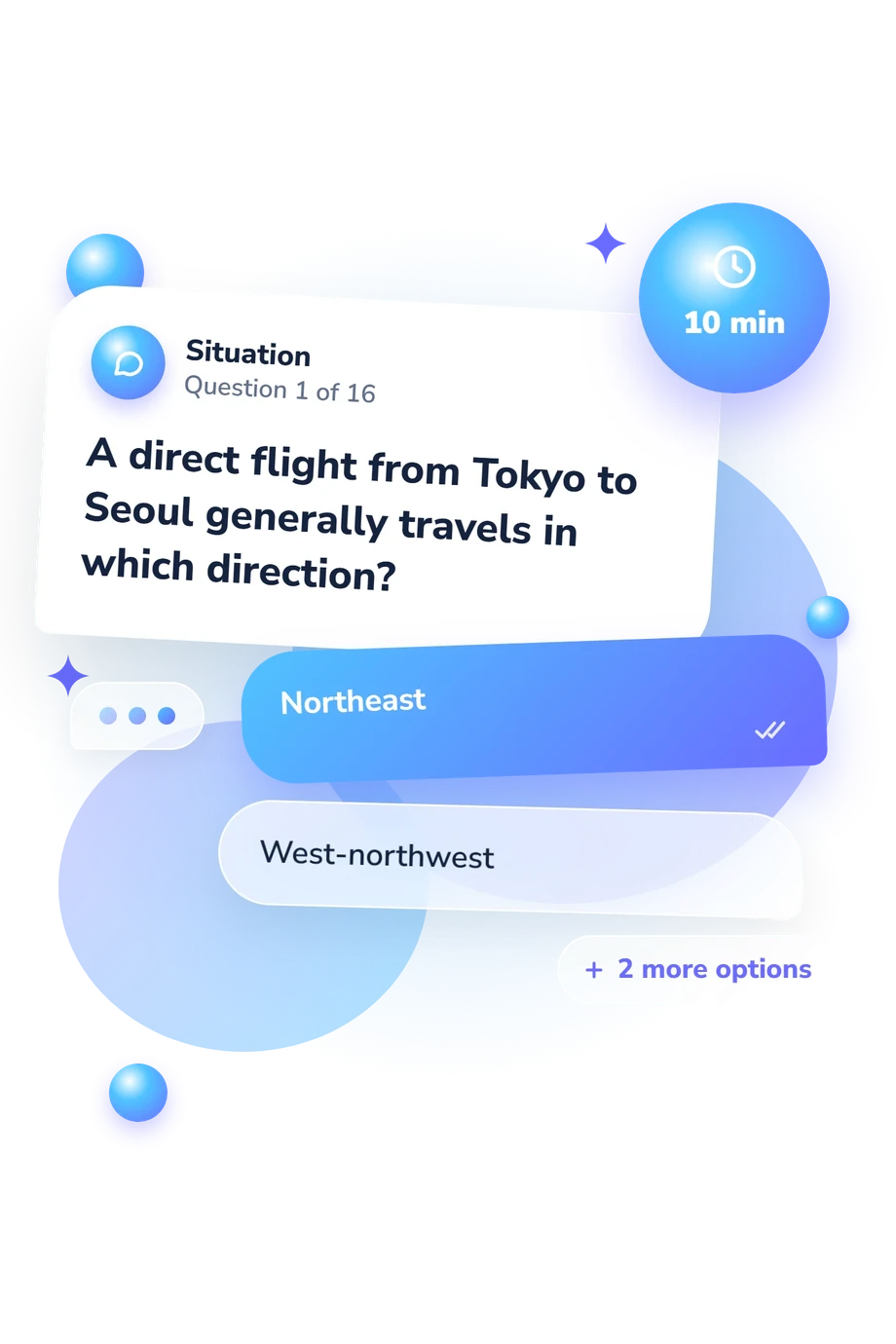
Example Questions From the Test
- Northeast
- West-northwest
- Southeast
- South-southwest
- Congo
- Niger
- Nile
- Zambezi
- Algeria
- Portugal
- Tunisia
- Morocco
Geography Bee Quiz - Description and methodology of the test
Designed for readers who want a practical snapshot of world-location knowledge, this geography bee quiz turns familiar map facts into a focused self-check. It suits learners, travelers, students, and anyone strengthening geographic literacy. This online geo bee quiz samples capitals, borders, landforms, regional relationships, and directional reasoning, then gives one overall result rather than separate topic scores.
What This Assessment Explores
What it measures is recall and spatial reasoning about places around the world. The items connect capitals with countries, identify rivers and seas, recognize borders and islands, locate mountain ranges, and interpret direction or relative position. This geographic bee quiz samples practical location knowledge rather than personality, intelligence, or overall academic ability.
The displayed scale is Geography Bee Knowledge (0-16), where the score equals the number of correct answers. Its result bands describe the level shown to the visitor:
- Emerging (0-6) indicates recognition of some geographic features, with major regions, capitals, borders, and map relationships still offering useful review targets.
- Developing (7-12) reflects broad geographic knowledge alongside less familiar locations and spatial connections that can be sharpened.
- Strong (13-16) indicates confident command of world locations and geographic reasoning across several question types.
Methodology and Evidence Base
Each item presents one geography prompt with four answer choices, making the task recognition and selection rather than open-ended map drawing or written recall. The displayed result is one total count of correct answers, so higher accuracy produces a higher result. Questions in this test sample location knowledge rather than cover a complete curriculum; these geography-bee quiz questions emphasize recognition over open-ended explanation.
Its rationale is conceptually consistent with Eve, Price, and Counts (1994) on gaps in geographic knowledge, Dunn (2011) on location knowledge and spatial thinking, and the National Geographic-Roper (2002) survey of geographic literacy. These sources support the topic's educational relevance, but they do not show that this online questionnaire is a validated adaptation of their instruments.
Use the result as a study aid for choosing review topics. The displayed bands are descriptive summaries of the total score rather than separate skill scores. Performance can vary with schooling, travel experience, language, attention, and guessing, and multiple-choice recognition may not equal the ability to explain or apply geography independently.
- Eve, Raymond A., Bob Price, and Monika Counts. (1994). Geographic Illiteracy among College Students. Youth & Society, 25(3), 408-427. 10.1177/0044118X94025003006
- Dunn, James M. (2011). Location Knowledge: Assessment, Spatial Thinking, and New National Geography Standards. Journal of Geography, 110(2), 81-89. 10.1080/00221341.2010.511243
- National Geographic-Roper. (2002). 2002 Global Geographic Literacy Survey. Prepared by RoperASW for the National Geographic Education Foundation, November 2002.
Updated: