
Belly Type Quiz
How the Scales are Structured
Who Usually Takes This Test?
See How You Compare
Below is a preview of how scores are typically distributed across each scale.
Example Questions From the Test
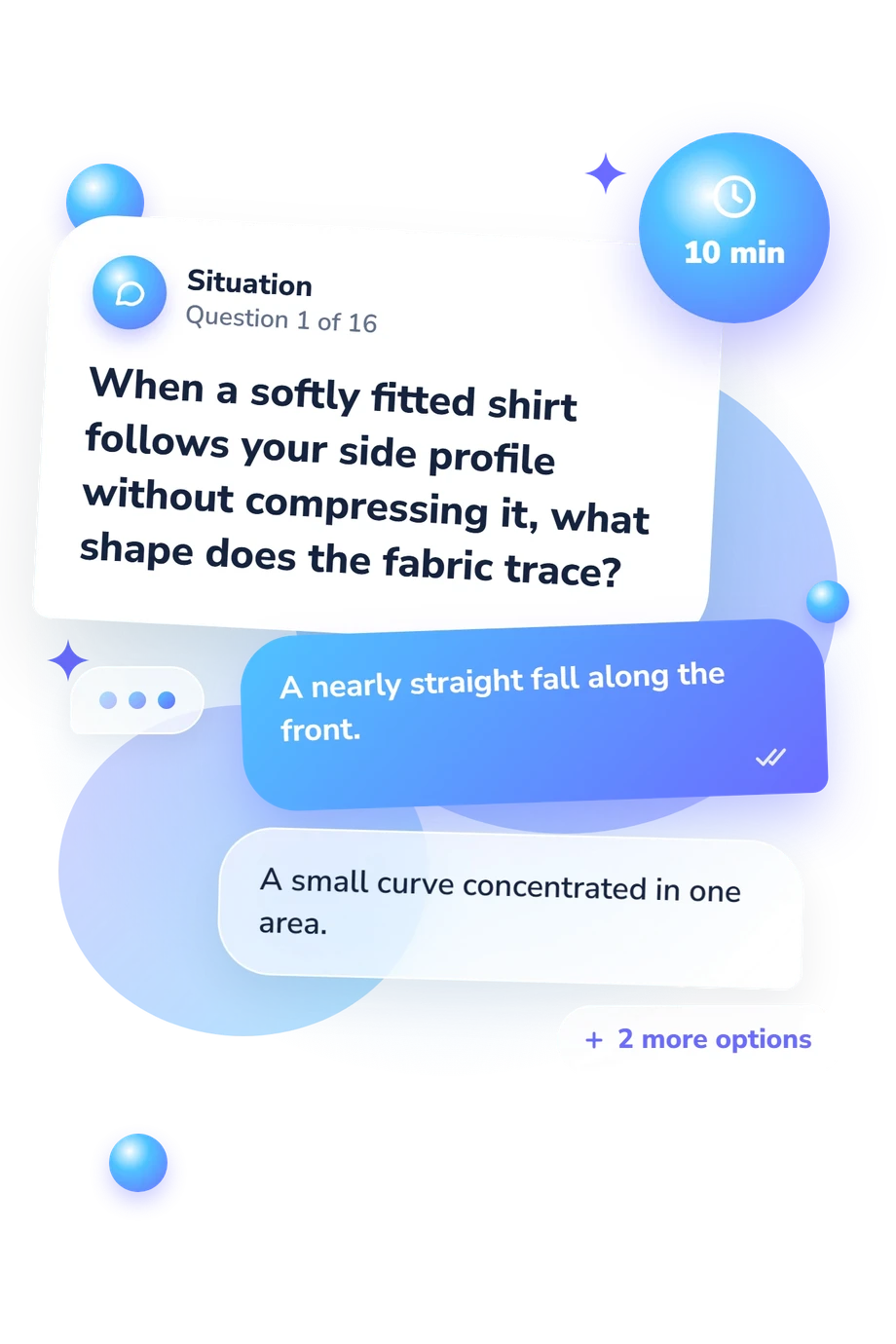
- A nearly straight fall along the front.
- A small curve concentrated in one area.
- A broad, smooth arc across much of the belly.
- A rounded arc with a visible interruption or change of direction.
- It is pushed outward in a clearly noticeable arc.
- It curves outward by a moderate amount.
- It follows a shallow outward curve.
- It falls close to straight along the front.
- The lower front pushes the fabric noticeably farther outward.
- Upper and lower areas affect the fabric about equally.
- The upper area pushes the fabric farther outward.
- There is a mild but visible lower-area emphasis.
Belly Type Quiz - Description and methodology of the test
People who want a clearer description of their abdominal outline can use this belly type quiz to compare front and side-view features without reducing appearance to one label. It is suited to adults reflecting on how clothing, posture, and viewing angle affect the outline they notice. If you are asking what type of belly do I have, the result organizes those observations into a visual profile rather than a medical explanation.
What This Assessment Explores
The focus is visible abdominal contour. Front and side observations consider projection, lower emphasis, continuous roundness, and horizontal divisions. The result addresses the practical question of what type of belly do you have by showing which visual tendencies are more prominent.
The four dimensions are reported as follows:
- Crease-Defined (0-12) shows whether horizontal breaks organize the outline: Limited match (0-4), Partial match (5-8), or Strong match (9-12).
- Lower-Focused (0-12) shows whether fullness below the navel defines the outline: Limited match (0-4), Partial match (5-8), or Strong match (9-12).
- Low-Projection (0-12) shows whether the belly stays close to the torso line: Limited match (0-4), Partial match (5-8), or Strong match (9-12).
- Smoothly Rounded (0-12) shows whether a continuous outward curve dominates: Limited match (0-4), Partial match (5-8), or Strong match (9-12).
Methodology and Scientific Basis
Each item presents four answer choices describing a neutral observation, such as how fabric falls, where the furthest point lies, or whether a curve changes direction. The response format asks for the closest recurring description rather than a measurement, so posture, clothing, angle, and honest self-observation can affect the outcome.
Scoring produces separate profile totals from the selected responses. Higher totals indicate a closer match to that visual tendency, while lower totals indicate a limited match. The displayed ranges do not reveal how many points each answer contributes, so the result should be read comparatively. The resulting belly profile is a current descriptive snapshot, and sudden, painful, persistent, or otherwise concerning changes should be evaluated medically.
Its visual logic is conceptually consistent with Purcaru et al. (2019), who show how thoracic-abdominal profiles can be represented through image-based geometry. Lee et al. (2020) and Thelwell et al. (2020) likewise illustrate how shape-based anthropometry can add detail to conventional measurements. These studies support describing body form, but they do not validate this online questionnaire. The questionnaire is an online self-reflection tool rather than a standardized diagnostic instrument, and self-report can be affected by current context and self-perception.
- Purcaru Monica Ana Paraschiva, Repanovici Angela, Nedeloiu Tiberiu. Non-Invasive Assessment Method Using Thoracic-Abdominal Profile Image Acquisition and Mathematical Modeling with Bezier Curves. Journal of Clinical Medicine. 2019;8(1):65. 10.3390/jcm8010065
- Lee Kyu Sun, Song Hwa Kyung, Kim Sungmin. Categorization of lower body shapes of abdominal obese men using a script-based 3D body measurement software. Fashion and Textiles. 2020;7:3. 10.1186/s40691-019-0199-8
- Thelwell Michael, Chiu Chuang-Yuan, Bullas Alice, Hart John, Wheat Jon, Choppin Simon. How shape-based anthropometry can complement traditional anthropometric techniques: a cross-sectional study. Scientific Reports. 2020;10:12125. 10.1038/s41598-020-69099-4
Updated: