
27 Amendments Matching Quiz
How the Scales are Structured
Who Usually Takes This Test?
See How You Compare
Below is a preview of how scores are typically distributed across each scale.
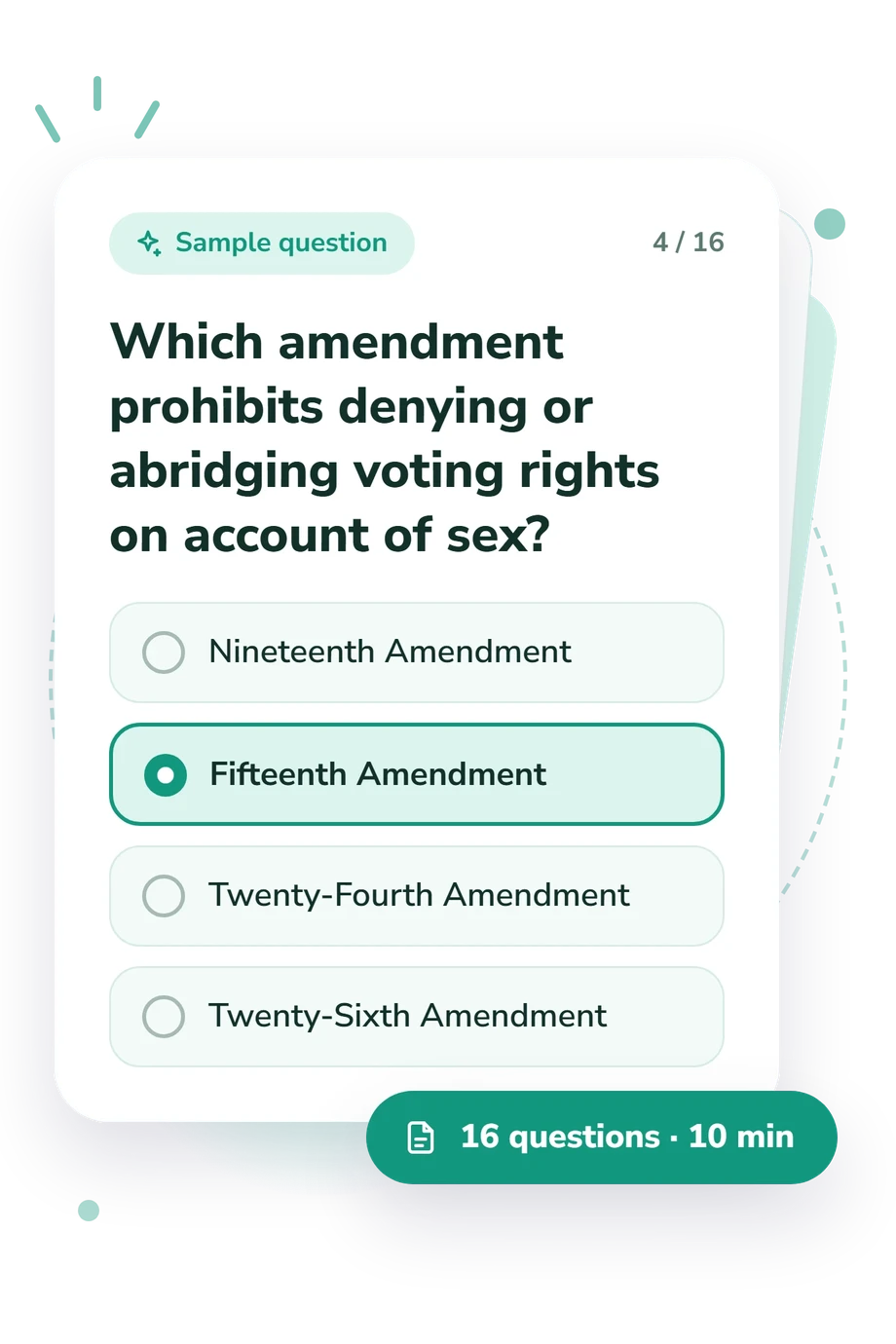
Example Questions From the Test
- Twentieth Amendment
- Nineteenth Amendment
- Eighteenth Amendment
- Twenty-First Amendment
- Nineteenth Amendment
- Fifteenth Amendment
- Twenty-Fourth Amendment
- Twenty-Sixth Amendment
- Twenty-Third Amendment
- Twentieth Amendment
- Twenty-Second Amendment
- Twenty-Fourth Amendment
27 Amendments Matching Quiz - Description and methodology of the test
Students, teachers, and independent learners can use this online amendments quiz to distinguish amendment numbers from the rights, procedures, and historical changes they represent. The 27 amendments matching quiz pdf helps you check whether a familiar civic principle points to the correct constitutional provision. Its result can guide the next round of study by showing which areas deserve closer attention.
What This Assessment Measures
Rather than testing isolated vocabulary, this constitutional amendments quiz asks you to match a right, procedure, reform, or civic scenario with the amendment that fits it. It suits learners who want to strengthen U.S. civics knowledge and distinguish closely related provisions.
The items examine four connected areas:
- Civil liberties show which amendments protect religion, speech, searches, jury trials, due process, equal protection, and the home.
- Voting and representation distinguish rules involving race, sex, age, poll taxes, senators, and presidential electors.
- Executive rules identify provisions governing succession, presidential disability, and term limits.
- Historical reforms connect slavery’s abolition, prohibition, and prohibition’s repeal with their amendments.
Together, these themes show whether you can identify the constitutional provision that most directly fits a stated fact. The displayed result, 27 Amendments Knowledge (0-16), summarizes matching accuracy: Building Foundations (0-6) indicates partial recognition, Developing Command (7-12) reflects many correct connections, and Strong Command (13-16) indicates accurate links across most tested provisions.
Methodology and Evidence Base
Each item presents a short question or scenario with four amendment choices. The task is recognition rather than essay writing: select the provision that most directly matches the constitutional fact described. Its four-choice format makes the 27 amendments test a focused check of matching accuracy, while one point is assigned for each correct match and the total reflects performance across the tested content.
These items draw their content from Amendments 1-27 and from constitutional scenarios involving rights, voting, institutional rules, and historical changes. The United States Constitution supplies the underlying text, while Anastaplo’s commentary, Bernstein and Agel’s historical account, and the Congressional Research Service’s 2024 supplement provide context for interpreting those provisions through July 1, 2024.
The questionnaire is a descriptive civics knowledge check rather than a measure of legal expertise. Results may vary with prior study, wording familiarity, attention, and guessing, so one score is a snapshot of performance on the tested amendment content.
- National Archives and Records Administration. The Constitution of the United States: A Transcription. Washington, D.C.: National Archives, n.d.
- Anastaplo, George. The Amendments to the Constitution: A Commentary. Baltimore: Johns Hopkins University Press, 1995. DOI 10.56021/9780801849596.
- Bernstein, Richard B., and Jerome Agel. Amending America: If We Love the Constitution So Much, Why Do We Keep Trying to Change It? Lawrence: University Press of Kansas, 1995. ISBN 9780700607150.
- Congressional Research Service, Library of Congress. The Constitution of the United States of America: Analysis and Interpretation, 2024 Supplement: Analysis of Cases Decided by the Supreme Court of the United States to July 1, 2024. 118th Congress, Senate Document 118-15. Washington, D.C.: U.S. Government Publishing Office, 2025.
Updated: