
Direct Object Pronouns Spanish Quiz
How the Scales are Structured
Who Usually Takes This Test?
See How You Compare
Below is a preview of how scores are typically distributed across each scale.
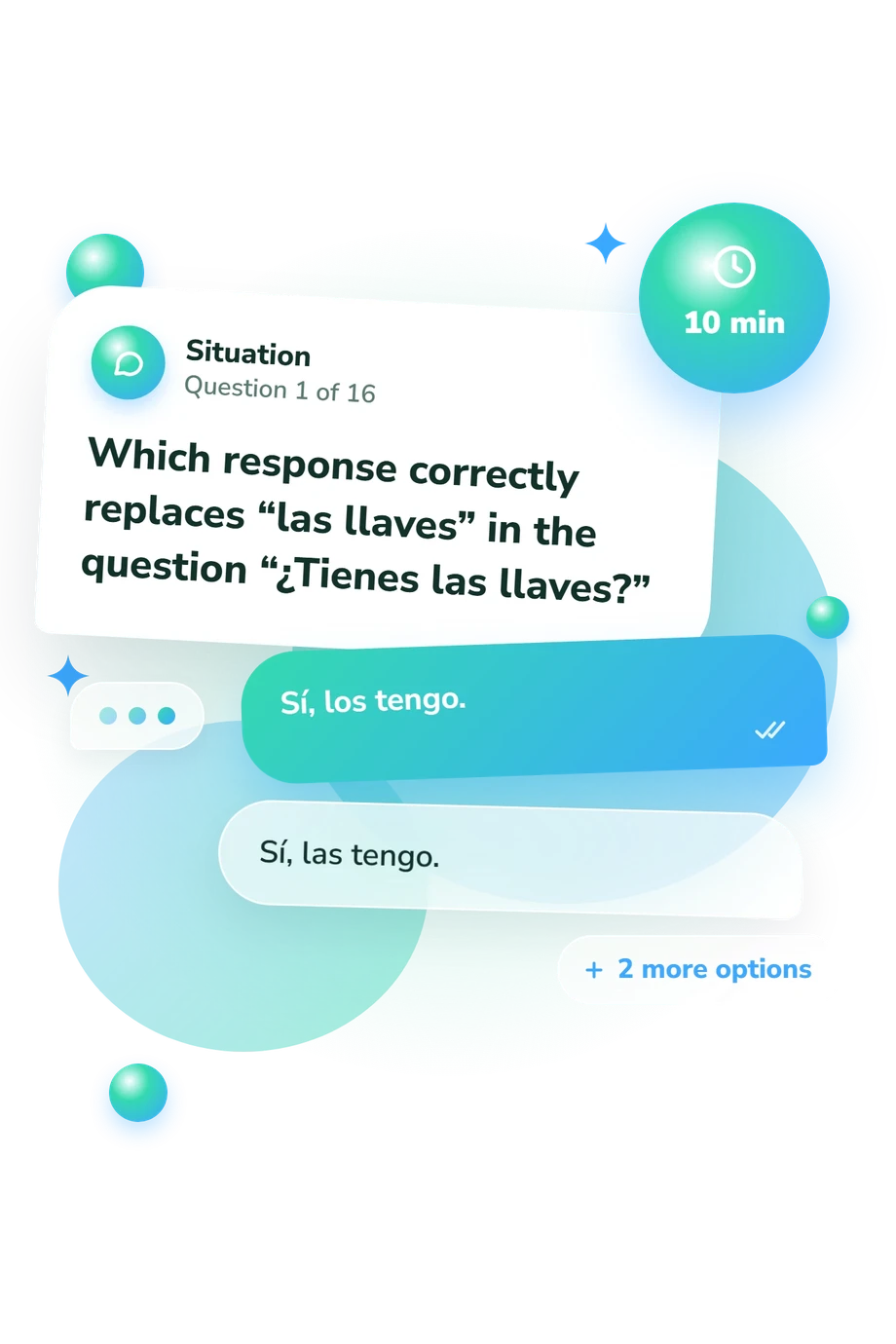
Example Questions From the Test
- Sí, los tengo.
- Sí, las tengo.
- Sí, la tengo.
- Sí, les tengo.
- He la comprado.
- Lo he comprado.
- He comprado la.
- La he comprado.
- Lo estoy leyendo / Estoy leyéndolo
- Estoy lo leyendo / Estoy leyendo lo
- La estoy leyendo / Estoy leyéndola
- Los estoy leyendo / Estoy leyéndolos
Direct Object Pronouns Spanish Quiz - Description and methodology of the test
Students and independent learners who want to strengthen everyday Spanish grammar can use this assessment to check whether they can identify a direct object and select the pronoun that replaces it. The Direct Object Pronouns Spanish Quiz focuses on practical choices in statements, questions, affirmative and negative commands, and constructions with infinitives. Its focused format supports review of agreement and placement. Learners can use this Spanish direct object quiz to decide which rules deserve more practice.
What This Assessment Measures
These items test several linked skills. You identify the noun, person, or neutral idea functioning as the verb’s object and answering "what?" or "whom?", then match lo, la, los, or las by gender and number. Other questions test placement with conjugated verbs, infinitives, affirmative commands, and negative commands. Learners who still hesitate over agreement or position may find this quiz on Spanish object pronouns useful for targeted practice.
The result is reported on Spanish Direct Object Pronouns Knowledge (0-16), with three bands:
- Foundation to build (0-6) indicates that direct-object identification or agreement needs review.
- Developing knowledge (7-12) shows that many core rules are present, but agreement or placement may be inconsistent.
- Strong knowledge (13-16) reflects accurate use across the common sentence patterns tested.
These labels describe performance on the grammar tasks and point to the areas most worth practising next.
Methodology and Evidence Base
Each item presents a Spanish sentence, question, or command with four answer choices. They ask you to choose a pronoun, place it correctly, identify the direct object, or combine direct and indirect pronouns as se lo. Some also test the two placements available with an infinitive or a progressive construction, making this a targeted knowledge check rather than a free translation exercise.
Its grammar framework is conceptually consistent with Schwenter and Torres Cacoullos (2014), whose study examines factors affecting direct-object clitic placement, and with Pizzini (1982), which addresses clitic positioning in Spanish. Butt, Benjamin, and Moreira Rodríguez (2019) provides the reference-grammar basis for agreement, placement, commands, and pronoun combinations. These publications provide grammatical context for the item content; they do not validate or norm this questionnaire.
Responses are consolidated into one knowledge result for interpretation. The displayed result for this direct object pronoun quiz uses learning descriptors, not population percentiles or clinical categories. Performance can reflect attention, prior instruction, and guessing, so use the result to choose focused practice rather than judge overall Spanish proficiency.
- Schwenter, Scott A., and Rena Torres Cacoullos. "Competing Constraints on the Variable Placement of Direct Object Clitics in Mexico City Spanish." Revista Española de Lingüística Aplicada/Spanish Journal of Applied Linguistics, vol. 27, no. 2, 2014, pp. 514-536. 10.1075/resla.27.2.13sch
- Butt, John, Carmen Benjamin, and Antonia Moreira Rodríguez. A New Reference Grammar of Modern Spanish. 6th ed., Routledge, 2019.
- Pizzini, Quentin A. "The Positioning of Clitic Pronouns in Spanish." Lingua, vol. 57, no. 1, 1982, pp. 47-69. 10.1016/0024-3841(82)90070-5
Updated: