
Kissing Quiz
How the Scales are Structured
Who Usually Takes This Test?
See How You Compare
Below is a preview of how scores are typically distributed across each scale.
Example Questions From the Test
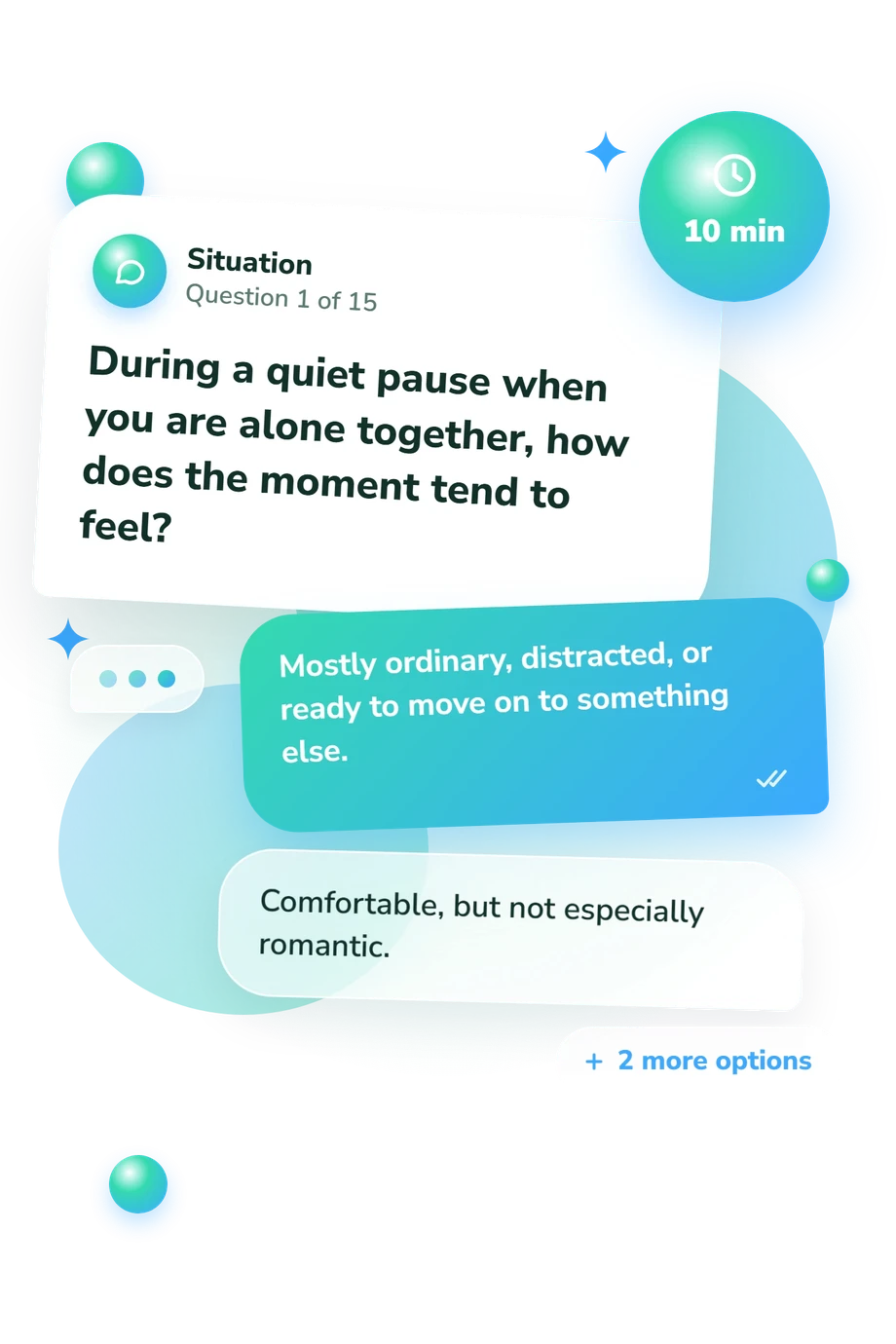
- Mostly ordinary, distracted, or ready to move on to something else.
- Comfortable, but not especially romantic.
- Flirtatious or charged, though neither of us is fully certain what comes next.
- Mutually romantic and relaxed, with both of us engaged in the moment.
- Accept that I do not have enough information and avoid drawing a conclusion.
- Give the situation time and look for a more consistent pattern.
- Mention that I am interested and let him decide whether to respond.
- Ask a low-pressure, direct question about whether the interest is mutual.
- The subject has not come up between us.
- He has made general jokes or comments about kissing and dating.
- He has hinted that he has imagined us kissing.
- He has directly said he would like to kiss me if I want that too.
Kissing Quiz - Description and methodology of the test
For anyone trying to read an ambiguous romantic moment, this kissing quiz offers a structured way to examine whether interest, comfort, and boundaries are being communicated. The questions suit someone wondering whether a possible kiss is mutually wanted, while also inviting attention to their own readiness. As a how to kiss quiz, it supports clearer reflection rather than guessing from one isolated signal.
What This Assessment Explores
Rather than treating attraction as a yes-or-no mystery, the assessment separates expressed interest from shared comfort and communication. As a kissing style quiz, it suits someone considering a kiss with someone they know. The result describes patterns, not hidden thoughts.
The dimensions are:
- Consent and Communication Clarity (0-15) shows how openly wishes and boundaries are discussed: Mostly unspoken (0-5), Partly clarified (6-10), or Openly clarified (11-15).
- Expressed Romantic Interest (0-15) reflects observable romantic signals: Limited evidence (0-5), Suggestive interest (6-10), or Clearly expressed interest (11-15).
- Reciprocal Ease (0-15) describes mutual comfort with closeness: Little shared momentum (0-5), Emerging chemistry (6-10), or Strong reciprocal ease (11-15).
Together, these dimensions separate ambiguity, tentative chemistry, and direct communication. They do not establish consent: a freely given yes in the moment remains decisive, while pressure, fear, discomfort, or ignored boundaries override any score.
Methodology and Scientific Basis
Each item describes a social situation involving messages, plans, proximity, hesitation, boundaries, or a possible kiss. Four response options move from ambiguous evidence toward clearer communication, stronger interest, or mutual ease, letting the respondent choose the closest description.
Responses form profile scores, but the questionnaire does not state how many points each choice contributes. Its bands describe patterns, not the probability of a kiss. This making out quiz organizes observations before a direct, low-pressure conversation.
Conceptually, the questionnaire is consistent with the Consent to Sex Scale (Jozkowski and Peterson, 2014), which addresses how consent is perceived and assessed. It is not an adaptation of that instrument. The dual-measures study by Jozkowski et al. (2014) and review by Muehlenhard et al. (2016) support treating consent as communicated, contextual, and changeable rather than inferred from attraction alone.
This online self-report questionnaire is not a standardized version of those measures, and it does not state population norms or diagnostic thresholds. Answers can reflect memory, self-awareness, current mood, and the interaction selected for reflection. Read the profile alongside direct words, observable behavior, and respect for any pause or change of mind.
- Jozkowski, K. N., & Peterson, Z. D. (2014). Assessing the validity and reliability of the perceptions of the Consent To Sex Scale. Journal of Sex Research, 51(6), 632-645. DOI 10.1080/00224499.2012.757282
- Jozkowski, K. N., Sanders, S., Peterson, Z. D., Dennis, B., & Reece, M. (2014). Consenting to sexual activity: The development and psychometric assessment of dual measures of consent. Archives of Sexual Behavior, 43(3), 437-450. DOI 10.1007/s10508-013-0225-7
- Muehlenhard, C. L., Humphreys, T. P., Jozkowski, K. N., & Peterson, Z. D. (2016). The complexities of sexual consent among college students: A conceptual and empirical review. Journal of Sex Research, 53(4-5), 457-487. DOI 10.1080/00224499.2016.1146651
Updated: