
Which Batman Villain Are You Quiz
How the Scales are Structured
Who Usually Takes This Test?
See How You Compare
Below is a preview of how scores are typically distributed across each scale.
Example Questions From the Test
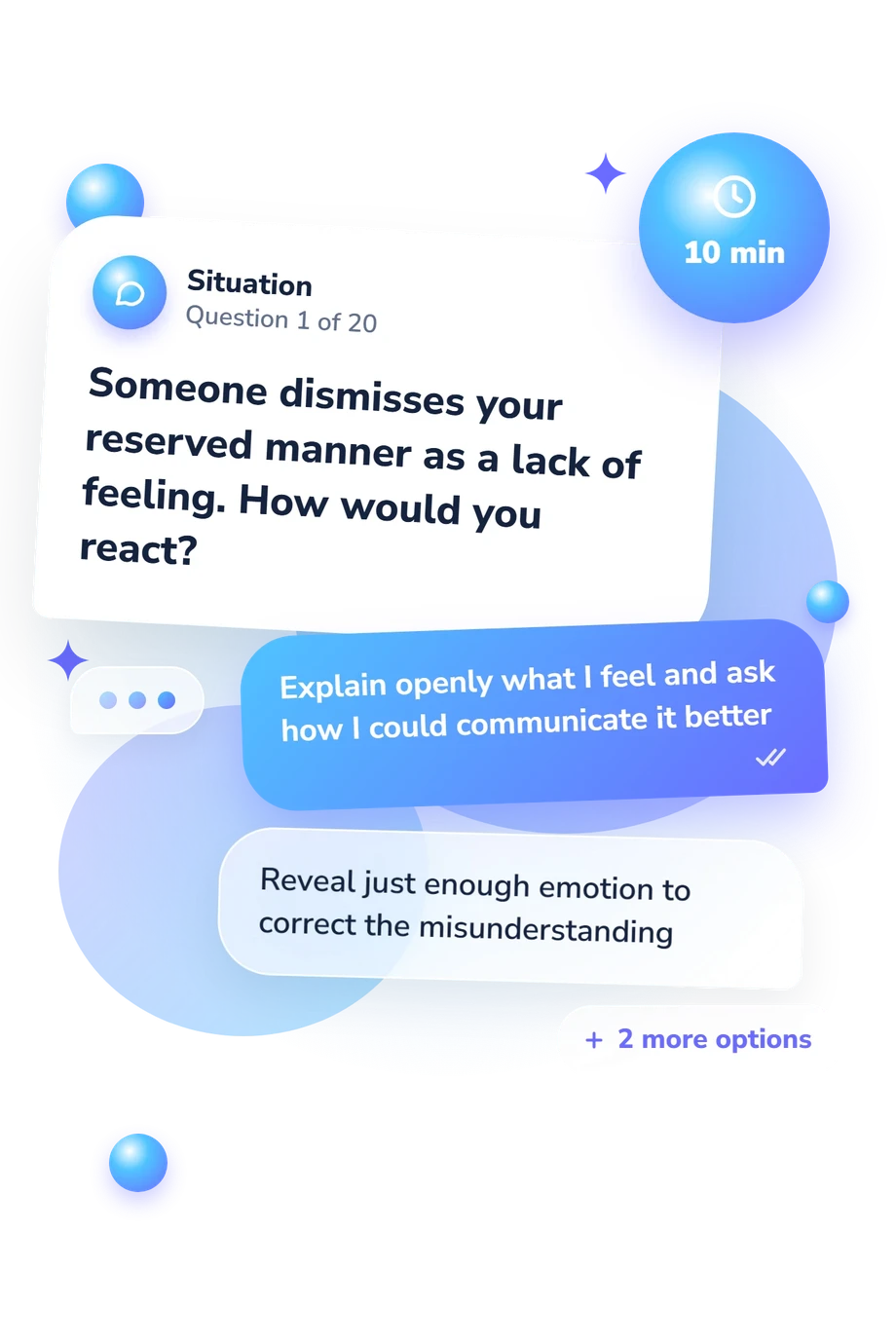
- Explain openly what I feel and ask how I could communicate it better
- Reveal just enough emotion to correct the misunderstanding
- Accept that not everyone needs access to what drives me
- Use a concrete action rather than words to show that I care
- Turning the collapse into a stranger, more theatrical game
- Retreating long enough to design a dependable replacement
- Studying exactly who disrupted the scheme and why
- Adapting quickly while preserving the original objective
- Dry remarks that keep other people at an emotional distance
- Absurd comedy that makes everyone question what will happen next
- Clever wordplay that demonstrates intellectual superiority
- Light humor that eases tension without changing the situation
Which Batman Villain Are You Quiz - Description and methodology of the test
For readers who enjoy comic-book characters as mirrors for personality, the Which Batman Villain Are You Quiz offers a structured way to compare personal instincts with five fictional antagonists. It suits anyone curious about values, loyalties, problem-solving habits, or personal style rather than literal moral classification. As a Batman villain personality quiz, it produces a leading affinity or blended profile.
What This Assessment Explores
Scenarios cover loyalty, independence, technical control, ecology, disruption, puzzles, recognition, and competing obligations. They suit anyone seeking a playful fictional-villain comparison.
The five affinities are:
- Catwoman (0-12) measures autonomy and codes: Steady Ally (0-4), Agile Individualist (5-8), Elegant Outsider (9-12).
- Mr. Freeze (0-12) measures devotion and technical focus: Flexible Realist (0-4), Reserved Specialist (5-8), Devoted Visionary (9-12).
- Poison Ivy (0-12) measures ecological identification and anti-exploitation: Human-Centered Pragmatist (0-4), Green Advocate (5-8), Force of Nature (9-12).
- The Joker (0-12) measures unpredictability and theatrical provocation: Grounded Operator (0-4), Playful Disruptor (5-8), Agent of Chaos (9-12).
- The Riddler (0-12) measures puzzles, intellectual competition, and recognition: Direct Thinker (0-4), Curious Strategist (5-8), Master of Enigmas (9-12).
By asking what Batman villain you are, the quiz shows the strongest match; scores within one point form a blend.
Methodology and Scientific Basis
Each item presents a fictional situation with four response options. The respondent chooses the closest instinct across communication, attachment, strategy, humor, environmental conflict, rules, recognition, and problem-solving. This format makes preferences easier to compare without technical vocabulary.
Scoring keeps the five affinities independent instead of producing one overall personality score. The highest result is the leading match, while scores within one point form a blend. A Batman villain test result is therefore a comparative profile of themes, not a permanent identity.
Methodologically, the questionnaire is conceptually consistent with Kjeldgaard-Christiansen et al. (2021), not an adaptation of that work, which links personality differences with engagement with fictional villains. Brodie and Ingram (2021) add context on dark-triad traits and comic-book character preferences, while Black et al. (2019) examine moral judgment, strategic traits, and responses to morally troubling characters. These studies support the subject, but they do not validate this online questionnaire, whose scoring is not presented as standardized. Self-report answers can shift with mood, self-image, and interpretation, so read the result as a snapshot of current preferences.
- Kjeldgaard-Christiansen, Jens, Anne Fiskaali, Henrik Høgh-Olesen, John A. Johnson, Murray Smith, and Mathias Clasen. “Do dark personalities prefer dark characters? A personality psychological approach to positive engagement with fictional villainy.” Poetics, 85, 101511 (2021). 10.1016/j.poetic.2020.101511
- Brodie, Zara P., and Joanne Ingram. “The dark triad of personality and hero/villain status as predictors of parasocial relationships with comic book characters.” Psychology of Popular Media Culture, 10(2), 230-242 (2021). 10.1037/ppm0000323
- Black, Jessica E., Yomna Helmy, Olivia Robson, and Jennifer L. Barnes. “Who can resist a villain? Morality, Machiavellianism, imaginative resistance and liking for dark fictional characters.” Poetics, 74, 101344 (2019). 10.1016/j.poetic.2018.12.005
Updated: