
Am I Cold Hearted Quiz
How the Scales are Structured
Who Usually Takes This Test?
See How You Compare
Below is a preview of how scores are typically distributed across each scale.
Example Questions From the Test
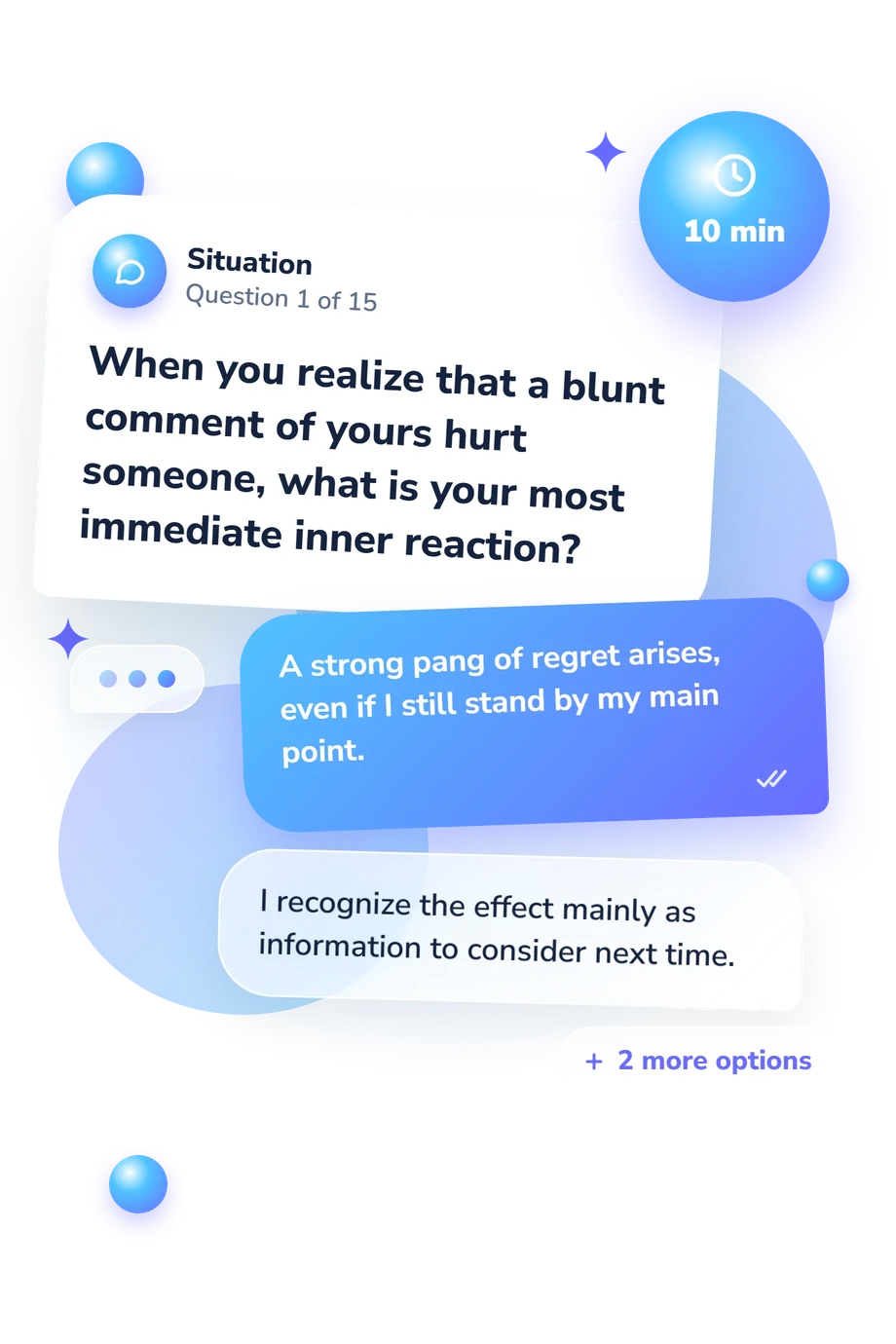
- A strong pang of regret arises, even if I still stand by my main point.
- I recognize the effect mainly as information to consider next time.
- I feel some discomfort once I understand how the comment landed.
- I am mildly bothered, but focus more on whether the comment was accurate.
- I explain that I cannot engage and leave them to choose another source of support.
- I check what they need and offer one manageable form of support.
- I stay fully available despite my exhaustion because their need feels more pressing.
- I send a brief caring response and suggest reconnecting after I have recovered.
- I listen again and explore what kind of reassurance or help they need.
- I acknowledge it briefly, then steer toward another subject.
- I remind them of my earlier answer and avoid reopening the discussion.
- I listen for a while, then gently suggest a practical next step or a pause.
Am I Cold Hearted Quiz - Description and methodology of the test
People who wonder whether they seem distant, restrained, or hard to reach can use the Am I Cold Hearted Quiz to examine interpersonal patterns rather than judge themselves by a single label. The questionnaire is suited to anyone reflecting on how they respond to other people’s feelings, requests, and bids for connection. This cold hearted person quiz produces a profile that distinguishes sensitivity, support, and affection.
What This Assessment Explores
The test looks beyond outward warmth or detachment. Its scenarios involve hurt feelings, repeated worries, rejection, exclusion, practical requests, reassurance, and affection. They organize the result into three patterns:
- Emotional Resonance (0-15) shows how strongly others’ feelings register internally: Quiet impact (0-5), Selective resonance (6-10), or Strong resonance (11-15).
- Responsive Care (0-15) shows how readily you adjust actions when someone needs support: Firm independence (0-5), Balanced response (6-10), or Highly responsive (11-15).
- Warmth of Expression (0-15) shows how openly you communicate affection and reassurance: Reserved warmth (0-5), Contextual warmth (6-10), or Visible warmth (11-15).
A profile may reveal concern that stays private, practical help that coexists with firm limits, or warmth that varies by context. The test treats the How Cold Am I Quiz as a question about emotional responsiveness or reserve, not a moral verdict; higher scores are not automatically better.
Methodology and Scientific Basis
Each item presents a social situation with four response options. The respondent chooses the answer closest to their usual reaction or behavior, and responses are combined into three profile dimensions. The displayed bands describe the result; the questionnaire does not specify a universal point value for each option or a diagnostic cutoff.
Emotion-focused content is conceptually consistent with the Basic Empathy Scale (Jolliffe & Farrington, 2006). Support situations overlap with prosocial behavior research by Carlo and Randall (2002), while affection and reassurance items connect with the Emotional Expressivity Scale of Kring, Smith, and Neale (1994). These are reference frameworks, not evidence that this questionnaire is an adaptation or standardized reproduction of those instruments.
Read the profile as a pattern: one band may change meaning beside the other two. Scores can vary with stress, relationship history, social norms, and the person imagined in a scenario. Honest self-report depends on self-awareness; read bands as tendencies in the current context, not fixed traits. The profile from this cold hearted quiz raises questions about empathy, boundaries, and communication but cannot settle relationship concerns.
- Jolliffe, Darrick, and David P. Farrington. “Development and validation of the Basic Empathy Scale.” Journal of Adolescence 29, no. 4 (2006): 589-611. 10.1016/j.adolescence.2005.08.010
- Carlo, Gustavo, and Brandy A. Randall. “The Development of a Measure of Prosocial Behaviors for Late Adolescents.” Journal of Youth and Adolescence 31, no. 1 (2002): 31-44. 10.1023/A:1014033032440
- Kring, Ann M., David A. Smith, and John M. Neale. “Individual differences in dispositional expressiveness: Development and validation of the Emotional Expressivity Scale.” Journal of Personality and Social Psychology 66, no. 5 (1994): 934-949. 10.1037/0022-3514.66.5.934
Updated: