
What Represents Me Quiz
How the Scales are Structured
Who Usually Takes This Test?
See How You Compare
Below is a preview of how scores are typically distributed across each scale.
Example Questions From the Test
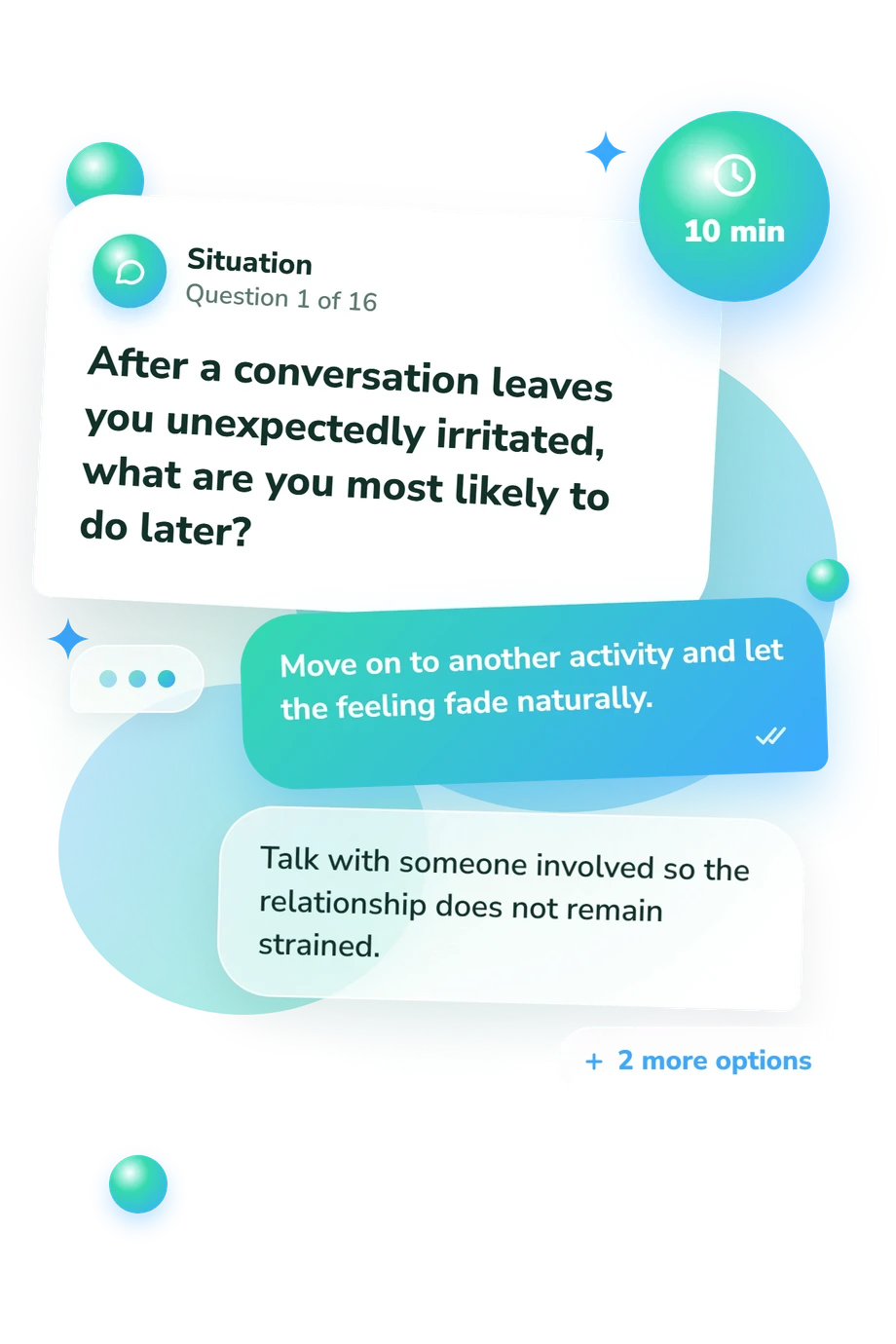
- Move on to another activity and let the feeling fade naturally.
- Talk with someone involved so the relationship does not remain strained.
- Replay the exchange to identify what it touched in me and why.
- Note the likely trigger and decide whether it deserves more attention.
- I can name a few priorities, though their order depends on the season of life.
- The relationships and shared experiences that hold people together.
- A clear set of values that helps me decide where to put my energy.
- Keeping enough openness to be changed by what I encounter.
- Give them space to decide what the experience means to them.
- Remind them of strengths and possibilities they may not see yet.
- Help them identify one realistic option for moving forward.
- Offer to connect them with someone who might understand.
What Represents Me Quiz - Description and methodology of the test
People who want to understand the qualities they bring to relationships, decisions, curiosity, and self-observation can use the What Represents Me Quiz as a guided reflection. Rather than assigning a fixed type, it turns symbolic choices into a profile of current tendencies. As a quiz about the things that represent me, it can help readers notice how several affinities coexist and which patterns feel most familiar.
What This Assessment Explores
Written situations prompt reflection on disagreement, direction, uncertainty, encouragement, connection, and inner reactions. As a quiz about objects that describe me, each symbolic choice represents a style of responding rather than a definition of the whole person.
The four result dimensions are:
- Bridge (0-12) reflects affinity with connection, translation, and common ground: Independent Path (0-4), Active Crossing (5-8), Living Bridge (9-12).
- Compass (0-12) reflects affinity with direction, conviction, and purposeful movement: Open Horizon (0-4), Emerging Bearing (5-8), True North (9-12).
- Lantern (0-12) reflects affinity with curiosity, encouragement, and visible possibilities: Quiet Glow (0-4), Kindled Light (5-8), Bright Lantern (9-12).
- Mirror (0-12) reflects affinity with introspection, emotional honesty, and inner patterns: Outward Lens (0-4), Reflective Surface (5-8), Clear Mirror (9-12).
The profile shows which affinities stand out.
Methodology and Scientific Basis
Each item presents a familiar situation with four possible responses covering priorities, connection, emotional processing, curiosity, and uncertainty. The most natural choice contributes to a comparative profile across the four dimensions, not a judgment about which response is healthiest.
Scoring compares the four scores: the highest shows strongest current affinity, while scores within one point form a blend. As an online test about what represents me, this tool functions as a symbolic self-reflection questionnaire, with results describing current tendencies rather than fixed traits.
The conceptual anchor is Belk’s Extended Self framework, which links objects and identity, alongside Wheeler and Bechler’s work on objects and self-identity. Reflective choices are conceptually consistent with the Self-Reflection and Insight Scale, while value-oriented choices can be compared with Schwartz’s theory of basic values. These sources offer theoretical comparison; this questionnaire is not scored as those published instruments.
Results are descriptive profile levels, with interpretation tied to the questionnaire’s symbolic categories and comparative pattern. Self-report means mood, self-awareness, and the imagined situation can influence responses, so the outcome is best read as a snapshot of current tendencies.
- Belk, Russell W. 1988. Possessions and the Extended Self. Journal of Consumer Research 15(2): 139-168. 10.1086/209154
- Wheeler, S. Christian, and Christopher J. Bechler. 2021. Objects and self-identity. Current Opinion in Psychology 39: 6-11. 10.1016/j.copsyc.2020.07.013
- Grant, Anthony M., John Franklin, and Peter Langford. 2002. The Self-Reflection and Insight Scale: A New Measure of Private Self-Consciousness. Social Behavior and Personality: An International Journal 30(8): 821-835. 10.2224/sbp.2002.30.8.821
- Schwartz, Shalom H. 2012. An Overview of the Schwartz Theory of Basic Values. Online Readings in Psychology and Culture 2(1). 10.9707/2307-0919.1116
Updated: