
Fanfic Quiz
How the Scales are Structured
Who Usually Takes This Test?
See How You Compare
Below is a preview of how scores are typically distributed across each scale.
Example Questions From the Test
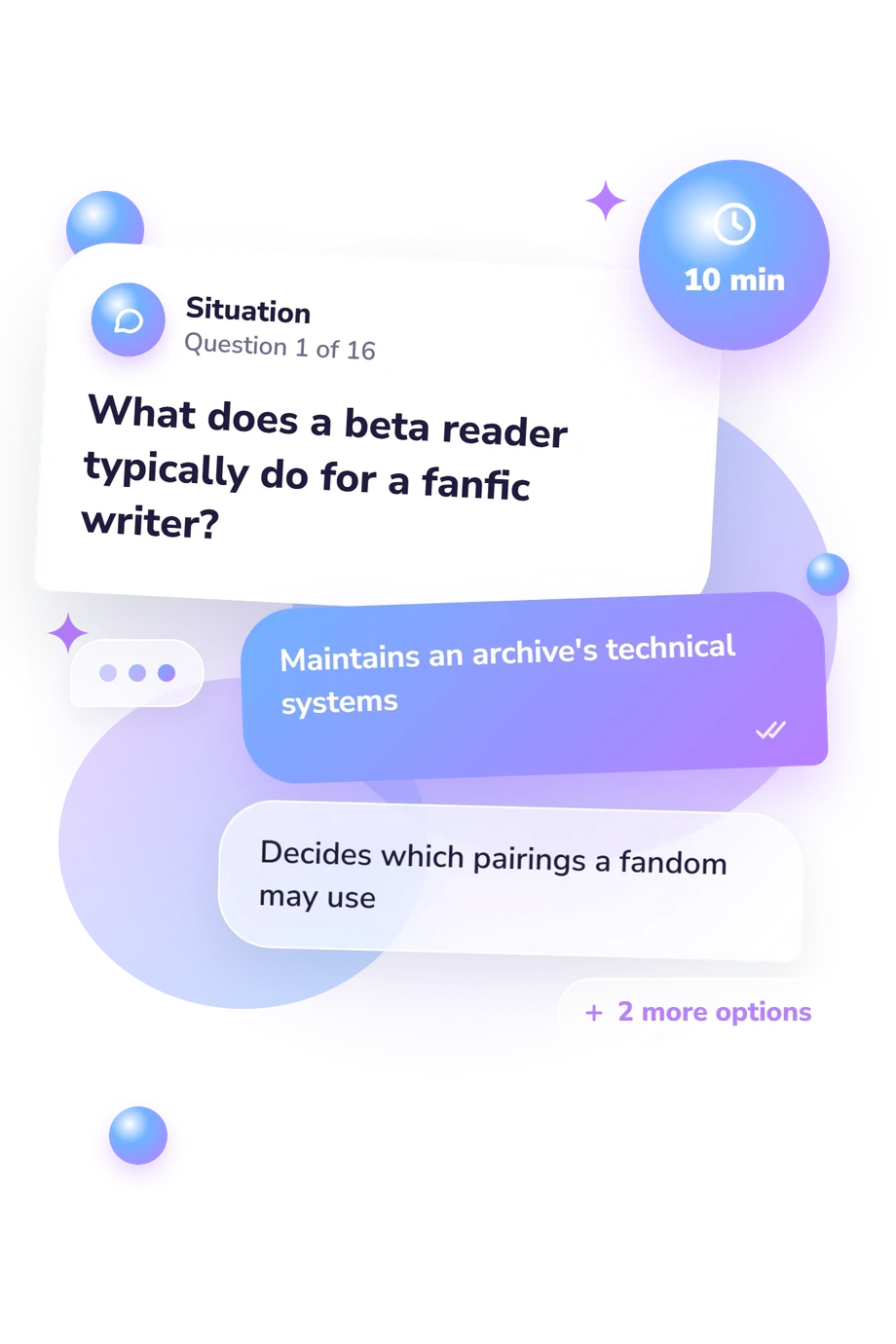
- Maintains an archive's technical systems
- Decides which pairings a fandom may use
- Reviews a draft and offers feedback before publication
- Creates official artwork for the source material
- A collection of very short fanfics posted together
- A written fic formatted as a fictional podcast transcript
- A story produced through a group prompt exchange
- An audio performance or recording of a fanfic
- A beta character
- A reader-insert character
- A canon character
- An original character, or OC
Fanfic Quiz - Description and methodology of the test
Readers and writers who want to place familiar fan-created storytelling terms in context can use this fanfic quiz as a focused knowledge check. It turns conversations about tags, genres, characters, and canon into a clear profile of what you recognize. Framing the activity as a fanfiction taste quiz also makes it useful for choosing topics to explore next.
What This Assessment Measures
Items ask you to identify terms, formats, and conventions in context, so the result reflects shared language rather than writing quality. Rather than judging taste, this fanfiction quiz checks whether familiar labels match the situations they describe.
The question themes include:
- Canon and terminology knowledge shows how well you recognize canon, headcanon, fanon, and canon divergence.
- Formats and narrative techniques show whether you distinguish missing-scene, fix-it, fusion, point-of-view, and alternate-universe constructions.
- Community practices show your understanding of beta readers, podfic, original characters, content notices, and crossovers.
- Fanfic Knowledge ranges from 0-16: Emerging familiarity (0-6) shows recognition of some ideas; Developing fluency (7-12) shows understanding of many common terms; Strong fluency (13-16) shows broad command of formats, conventions, and community language. It measures terminology knowledge, not creativity or value as a fan.
Methodology and Evidence Base
The items use four-option multiple choice. Each question has one intended correct response, and the displayed score awards one point for each correct answer. These bands organize familiarity with fanfiction language; they do not measure creativity, literary merit, or fandom identity.
Conceptually, the questionnaire sits within scholarship on fan practices and community learning. Tosenberger (2007) describes fanfiction as a space with recognizable conventions and shared interpretive activity. Karpovich (2006) shows how beta readers contribute editorial knowledge, while Evans et al. (2017) examines distributed mentoring in fanfiction communities. Jenkins (1992) offers a broader account of fans as active interpreters and producers. The questionnaire is conceptually consistent with these works, but it is not an adaptation of any one published scale.
As a fanfiction terminology quiz, it is best read as a structured vocabulary check. Its categories are descriptive for this questionnaire, not standardized population norms, and performance can be influenced by how much a respondent reads, writes, or participates in particular fandoms. Honest answers and varied experience make the profile more useful, while a single score should not be treated as a clinical or educational placement decision.
- Tosenberger, Catherine. Potterotics: Harry Potter Fanfiction on the Internet. PhD dissertation, University of Florida, 2007.
- Karpovich, Angelina I. “The Audience as Editor: The Role of Beta Readers in Online Fan Fiction Communities.” In Fan Fiction and Fan Communities in the Age of the Internet: New Essays, edited by Karen Hellekson and Kristina Busse, pp. 171-188. Jefferson, NC: McFarland, 2006.
- Evans, Sarah, Katie Davis, Abigail Evans, Julie Ann Campbell, David P. Randall, Kodlee Yin, and Cecilia Aragon. “More Than Peer Production: Fanfiction Communities as Sites of Distributed Mentoring.” In Proceedings of the 2017 ACM Conference on Computer-Supported Cooperative Work and Social Computing, pp. 259-272. ACM, 2017. 10.1145/2998181.2998342
- Jenkins, Henry. Textual Poachers: Television Fans and Participatory Culture. New York: Routledge, 1992.
Updated: