
Anime Opening Quiz
How the Scales are Structured
Who Usually Takes This Test?
See How You Compare
Below is a preview of how scores are typically distributed across each scale.
Example Questions From the Test
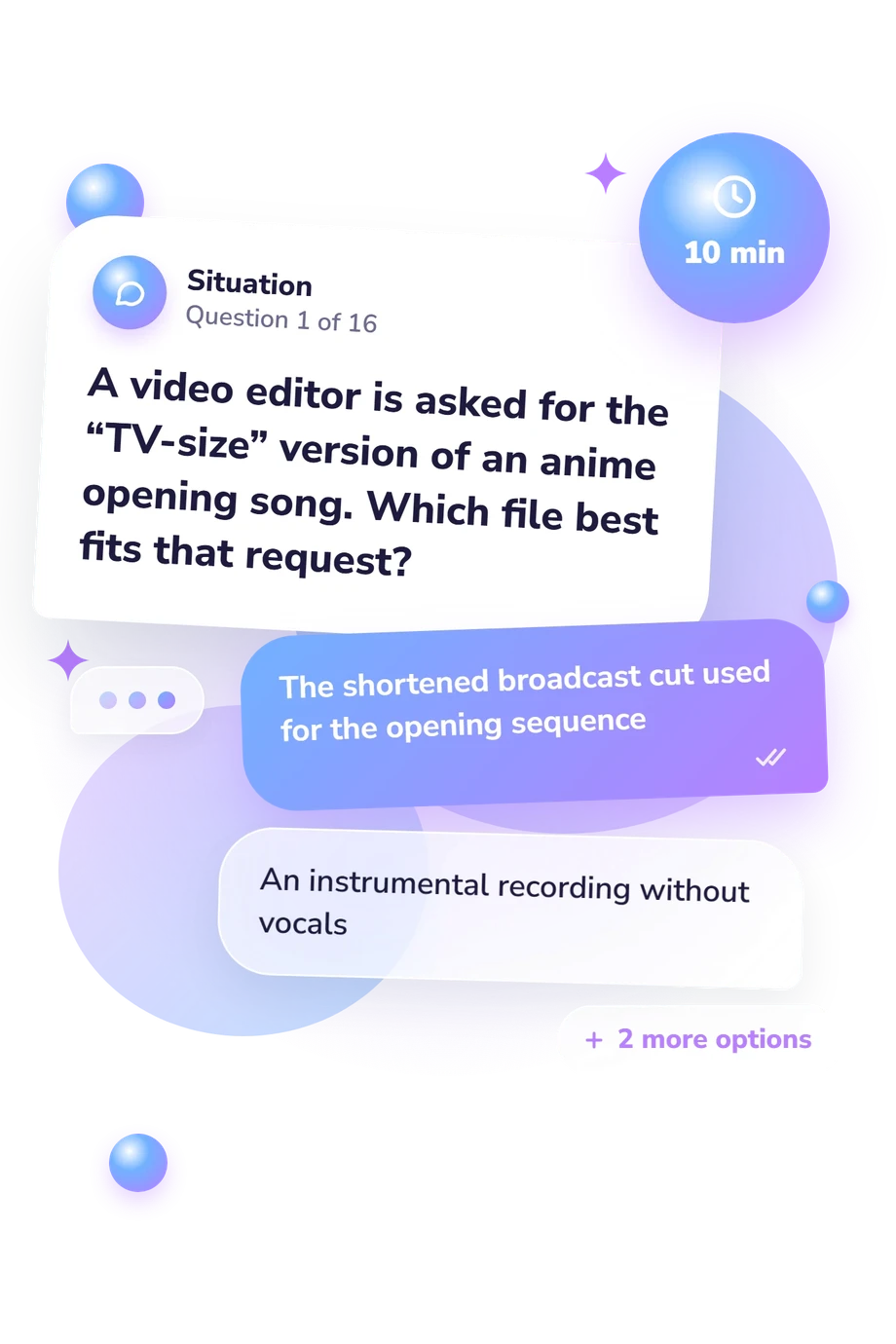
- The shortened broadcast cut used for the opening sequence
- An instrumental recording without vocals
- The full-length commercial single
- A fan-made remix synchronized to episode footage
- Neon Genesis Evangelion
- The Vision of Escaflowne
- Serial Experiments Lain
- Revolutionary Girl Utena
- My Hero Academia
- Tiger & Bunny
- One-Punch Man
- Mob Psycho 100
Anime Opening Quiz - Description and methodology of the test
Fans who want to connect songs, performers, series, and broadcast conventions can use this anime opening quiz to check what they know. It suits listeners who enjoy recognition as well as the terminology surrounding how openings are labeled, edited, and used. Its focus is knowledge rather than personal taste. The anime intro quiz gives a single profile for self-checking and choosing what to revisit.
What This Assessment Explores
This questionnaire measures anime-opening knowledge: connecting songs with the correct series, identifying performers, and understanding conventions used to describe an opening. It suits viewers, listeners, editors, and fans seeking a focused check of recognition and terminology rather than musical taste or fandom identity.
The items make this an anime theme song quiz as well as a terminology check: they combine recall with classification. The result draws on these areas:
- Song-to-series recognition shows whether familiar themes are linked to the anime they introduce.
- Performer recognition indicates how well artists and recurring song associations are remembered.
- Opening terminology checks labels such as “TV-size,” “creditless opening,” “OP2,” and “cold open.”
- Anime Opening Knowledge spans 0-16: Starter Listener (0-6) reflects some recognition; Developing OP Spotter (7-12) reflects a solid base with gaps; Opening Expert (13-16) reflects broad accurate connections and command of opening labels.
Methodology and Evidence Base
The format uses four answer choices in a self-administered knowledge assessment. Questions combine direct identification, such as matching “Gurenge” or “Tank!” to a series, with applied items about editing and broadcast terminology. Examples include TV-size cuts, creditless footage, cold opens, revised visuals, and OP2 labels. The displayed result summarizes performance across song, series, and convention knowledge.
Its evidence base is conceptual, not a claim that this questionnaire reproduces a published scale. Kitaba and Drexler (2024) discuss anison and opening songs in anime culture; Green (2022) examines music in anime production; and Laturnas (2020) treats theme songs as paratexts framing experience. The questionnaire is consistent with these discussions, but is not an adaptation of them. These sources provide scholarship about music, series identity, and presentation conventions; they do not validate this questionnaire, establish norms, or justify its bands.
Because this is an anime opening trivia quiz, it gives a snapshot with fixed choices. Familiarity with eras, franchises, performers, or localized versions affects it, as can memory errors. The band describes performance on these questions, not expertise, musical ability, or cultural knowledge.
- Kitaba, Hideyuki, and Anita Drexler. “Tool Kits / 3: A Short Outlook of Anison from 1963 to the 21st Century.” In The Palgrave Handbook of Music and Sound in Japanese Animation, edited by Marco Pellitteri, 45-66. Palgrave Macmillan, 2024. 10.1007/978-981-97-0429-3_3
- Green, Laurence. From Score to Song - The Rise of the “Star Composer” and the Role of Music in Contemporary Anime. PhD thesis, SOAS University of London, 2022. 10.25501/SOAS.00037278
- Laturnas, Jaylene. “Don’t Skip the Opening! Anime Theme Songs as Paratexts.” In Media Res, September 2, 2020.
Updated: