
Am I Addicted to Social Media Quiz
How the Scales are Structured
Who Usually Takes This Test?
See How You Compare
Below is a preview of how scores are typically distributed across each scale.
Example Questions From the Test
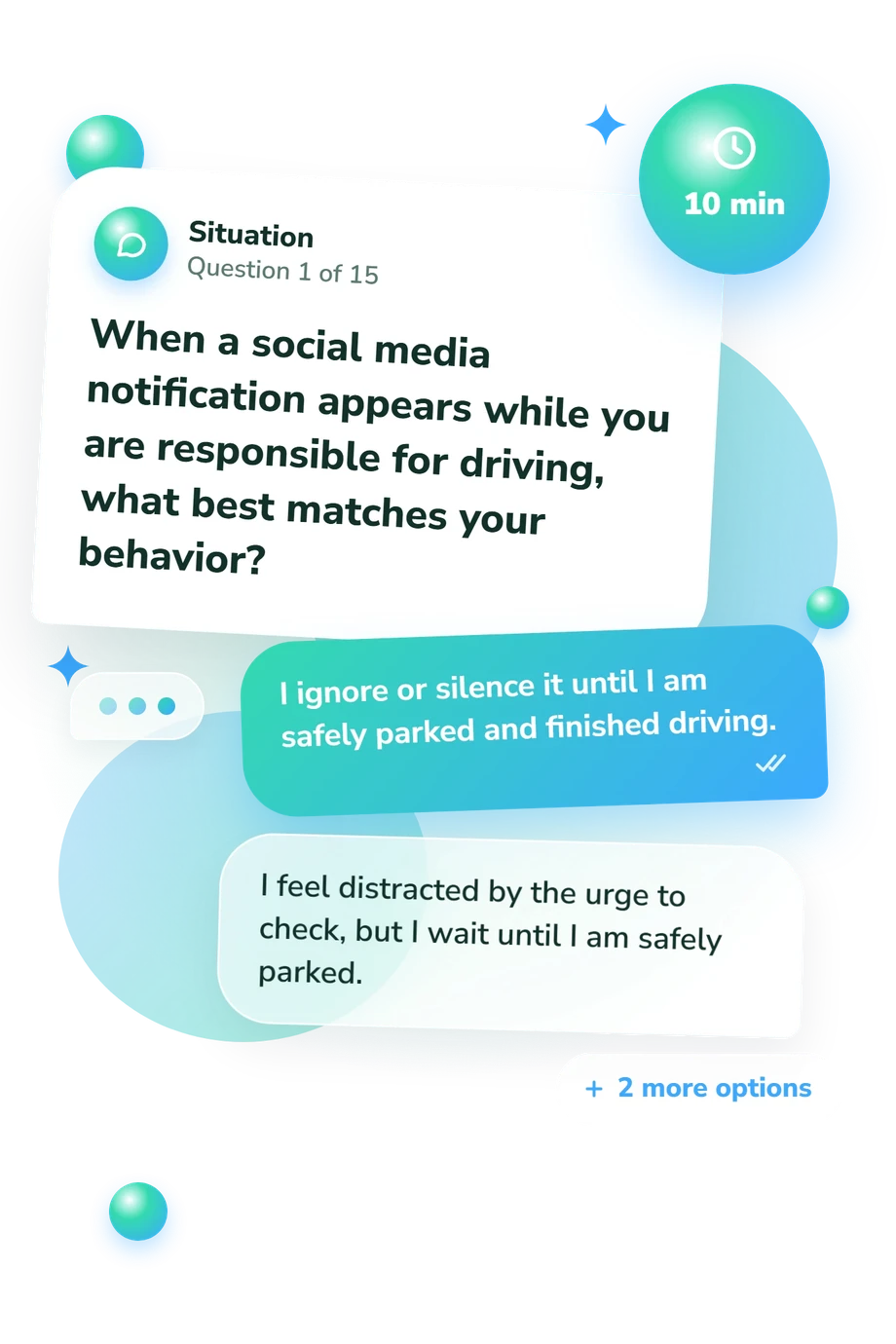
- I ignore or silence it until I am safely parked and finished driving.
- I feel distracted by the urge to check, but I wait until I am safely parked.
- I have pulled over solely to check even when doing so substantially disrupted my journey.
- I have checked while the vehicle was moving or stopped in traffic, even once.
- It may be one coping option, but I can also choose other forms of support or rest.
- I sometimes scroll longer than intended before switching to another response.
- I regularly rely on scrolling to avoid the feeling, even though I usually feel no better afterward.
- I feel unable to face distress without it, or continued use has sharply intensified my distress.
- I repeatedly override or disable it and continue for a substantial period.
- I sometimes extend the session briefly, then stop.
- I usually stop or finish one small task and leave.
- I often override it more than once before I can disengage.
Am I Addicted to Social Media Quiz - Description and methodology of the test
People who feel pulled toward frequent checking can use this questionnaire to examine whether social media is affecting attention, emotions, relationships, or everyday responsibilities. The Am I Addicted to Social Media Quiz frames those experiences as patterns to reflect on rather than as a fixed identity. This social media addiction quiz can be most useful when its result prompts specific, realistic changes.
What This Assessment Explores
These questions examine whether social-media use is difficult to regulate, emotionally absorbing, or disruptive. They suit anyone reviewing habits around driving, sleep, work, self-care, conversations, or offline activities. Anyone taking the Are You Addicted to Social Media Quiz sees whether a domain shows no indicator, an indicator, or action recommended; concerning experiences matter independently of the total.
Its displayed result dimensions are:
- Control Over Checking (0-15) shows difficulty resisting urges, automatic opening, time loss, or limits: No indicator (0), Indicator present (1-2), Action recommended (3-15).
- Emotional and Relationship Pull (0-15) measures emotional and relationship impact, including distress, comparison, reliance, and conflict: No indicator (0-0), Mild indicator (1-2), Action recommended (3-15).
- Impact on Daily Functioning (0-15) captures disruption to sleep, routines, responsibilities, activities, or safety: No indicator (0), Limited disruption (1-2), Action recommended (3-15).
Methodology and Scientific Basis
Each item describes a concrete situation and offers four response choices representing different levels of control, emotional pull, interference, or risk. The examples cover notifications while driving, overriding timers, scrolling to manage distress, disrupted routines and sleep, comparison, conflict, lost time, and missed obligations. Responses are combined into the three displayed scales; a red-flag response scored 3 overrides the total and should be acted on. The questionnaire does not document response-to-total scoring.
Conceptually, content is consistent with the Bergen Social Media Addiction Scale and its addictive-use components. It is also consistent with the Social Media Disorder Scale, the Bergen Facebook Addiction Scale, and Griffiths’s components model; first three are published measures, last a theoretical model; this questionnaire is not an adaptation of them. As a social media addiction test, this questionnaire is an online self-reflection tool. Its bands are unvalidated reflective summaries, not diagnostic or severity cutoffs; current stress, self-awareness, and candor can shape results. Act on a red-flag response: never check social media while driving or operating machinery; seek urgent local help in immediate danger.
- Andreassen, C. S., Billieux, J., Griffiths, M. D., Kuss, D. J., Demetrovics, Z., Mazzoni, E., & Pallesen, S. (2016). The relationship between addictive use of social media and video games and symptoms of psychiatric disorders: A large-scale cross-sectional study. Psychology of Addictive Behaviors, 30(2), 252-262. 10.1037/adb0000160
- van den Eijnden, R. J. J. M., Lemmens, J. S., & Valkenburg, P. M. (2016). The Social Media Disorder Scale. Computers in Human Behavior, 61, 478-487. 10.1016/j.chb.2016.03.038
- Andreassen, C. S., Torsheim, T., Brunborg, G. S., & Pallesen, S. (2012). Development of a Facebook Addiction Scale. Psychological Reports, 110(2), 501-517. 10.2466/02.09.18.PR0.110.2.501-517
- Griffiths, M. D. (2005). A 'components' model of addiction within a biopsychosocial framework. Journal of Substance Use, 10(4), 191-197. 10.1080/14659890500114359
Updated: